


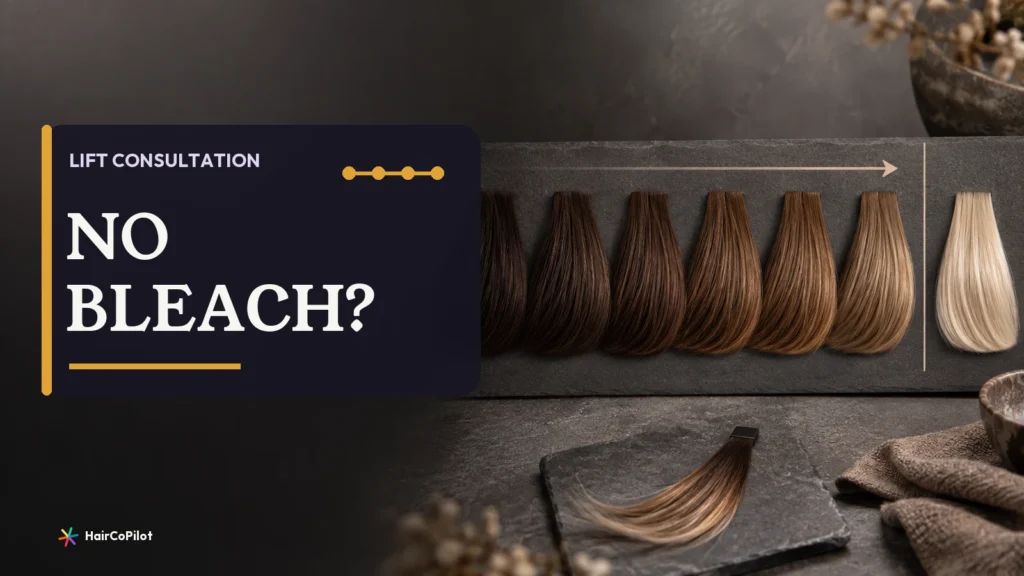
Two questions decide whether this can be done, and only two. Is the hair you need to lift natural or has it been coloured before, and how many levels does the target actually require? Answer those honestly and the rest follows: permanent colour lifts natural pigment within published limits, it does not remove artificial pigment, and a target that exceeds either boundary is a lightener conversation whatever the client hoped. This guide sets out what the published figures cover, how to establish the history you are working with, which test answers which question, and what to offer when the honest answer is no.
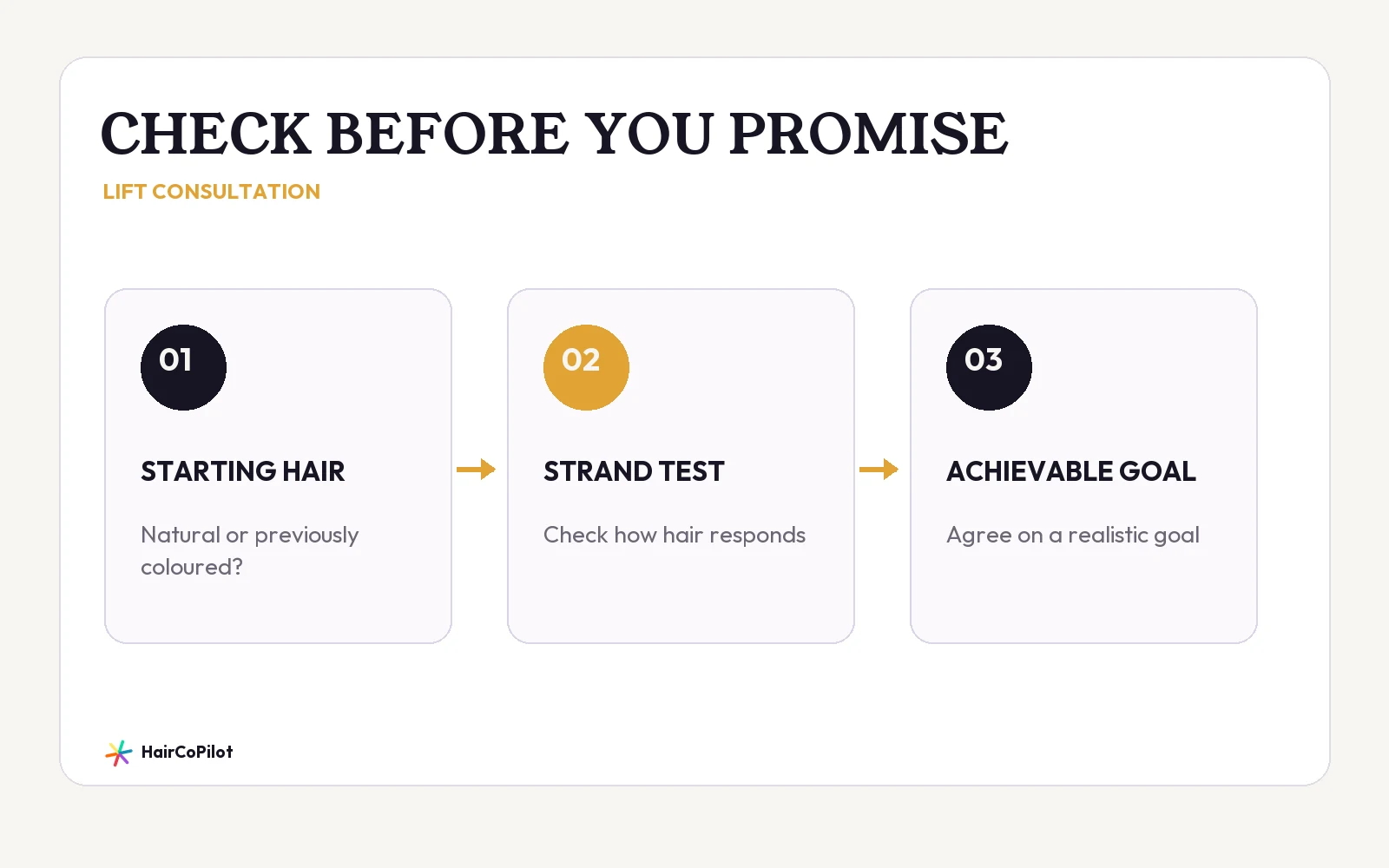
Start with the map, not the target
Before any figure is useful, you need to know what is on the head. That means looking at the hair in zones, because a single client routinely has three different histories between her scalp and her ends.
Natural regrowth at the root. Permanent colour through the mid-lengths from the last eighteen months. Older, more porous ends carrying whatever came before that, possibly including box colour or a direct dye the client has forgotten about. Each zone behaves differently, and the lightest result you can reach is set by the most stubborn one, not by the average.
Establishing history from a client who is vague is a skill in itself. “Have you coloured it before?” produces unreliable answers, because clients do not count semi-permanent products, root touch-ups done at home, or anything applied more than a year ago. Better questions are specific and non-judgemental: what have you put on it in the last two years, including anything from a supermarket or a friend; has anyone else coloured it; has anything ever gone wrong. Then look, because the hair answers more reliably than the client does.
Where the history is genuinely unknown, that is not a reason to proceed carefully. It is a reason to test, and to say so.
What permanent colour can lift, in published numbers
The figures below are Wella’s, taken from its own usage guidelines for Koleston Perfect. Other manufacturers publish their own and the numbers differ; use the guidance for the line in your hand rather than transferring these. What matters here is the shape of the limit, which is consistent across the category.
According to Wella’s Koleston Perfect usage guidelines, the developer strength sets the lift:
- 1.9% for colour balancing, blonde toning and glossing, with no lift;
- 4% for the same depth or darker;
- 6% for one level of lift, and for coverage of grey;
- 9% for two levels of lift, or three levels with Special Blonde;
- 12% for three levels of lift, or four to five levels with Special Blonde.
Processing time follows the shade family rather than the developer: the same guidance gives 30 to 40 minutes for standard shades whatever the developer, and 50 to 60 minutes for Special Blonde shades mixed 1:2.
Wella’s own guidance on high lift is equally explicit about its ceiling. Its high lift blonde article states that “the Koleston Perfect Special Blonde shades give you up to five levels of lift, depending on the natural colour you’re working with and the developer you use”, with 9% for up to three levels and 12% for up to five, mixed at 1:2.
Two phrases in that sentence do the real work. “Depending on the natural colour you’re working with” is the acknowledgement that five levels is a ceiling and not a typical outcome. And “natural” is the condition on everything else.
Why it stops at previously coloured hair
The same Wella guidance puts it directly: “First up, check that your client’s hair hasn’t been previously coloured. If it has, then you should use a lightener and toner.”
That is the boundary, and it is worth explaining to clients rather than asserting. Oxidative colour lifts the hair’s own pigment and deposits new pigment in the same step. What it does not do is remove pigment that was deposited by a previous colour service. Artificial pigment is not the hair’s natural melanin and does not respond to the same process.
So a client with permanent colour through her lengths who wants to be three levels lighter is not asking for a high-lift service. She is asking for a colour removal or a lightening service followed by toning, whether or not she has used the word bleach. Saying that plainly at the consultation is the whole job. Discovering it forty minutes into an application is how a correction appointment gets booked.
The practical version of the rule: high lift is a service for virgin hair. Regrowth on an otherwise coloured head can sometimes be lifted, but that creates its own problem, because the newly lifted root will sit against lengths that were not lifted, and the difference has to be managed with tone rather than pretended away.
Condition is the second ceiling
Lift is not free, and the published figures describe what the chemistry can do, not what a particular head of hair should be asked to do.
A Special Blonde application at 12%, mixed 1:2 and processed for 50 to 60 minutes, is a substantial service. On fine, previously processed, porous or mechanically damaged hair, the question is not whether the levels are reachable but whether what is left afterwards is hair the client wants. That assessment is yours and it is not in any usage table.
Two observations are worth making explicitly in the consultation. Porosity that varies along the strand will produce an uneven result, because the more porous zones lift faster and grab more tone. And hair that already breaks during detangling will not improve by being lifted, whatever product is used alongside it.
Which test answers which question
The two tests do different jobs and neither substitutes for the other. Our guide to patch test and strand test sets out both in detail; the short version as it applies here:
The allergy alert test is about safety, not results. Wella’s guidance on hair colour safety tests states that the skin allergy test should be performed 48 hours prior to every application. It tells you nothing about how light the hair will go. It is not optional, and it is not something the target level changes.
The strand test is about the result. Wella describes it as showing how the colour will develop on that hair, accounting for factors such as previous treatments and exposure. This is the test that answers the question this article is about, and it is the one most often skipped precisely when it matters most: on a head with an uncertain history and an ambitious target.
Do it on hair from the zone you are least confident about, not from the easiest place to reach. A strand from clean regrowth tells you nothing about the ends that will decide the appointment.
When the answer is no, offer something real
A refusal with no alternative is a lost client. There are usually four honest offers.
Lower the target. Two levels lighter, achieved cleanly and evenly, generally looks better than four levels reached badly. Show her the difference on a swatch rather than describing it, because “two levels” means nothing to a client and a visible comparison means everything.
Stage it. A plan across two or three appointments, with what happens at each one written down, gives the client the destination without pretending it fits into one afternoon. It also lets you assess the condition after the first stage rather than committing in advance.
Change the placement instead of the level. A face-framing or partial approach delivers the brightness a client is usually actually asking for, with a fraction of the exposure across the head. Many clients describing a global lift are describing how they look in photographs, and photographs are mostly the front.
Change the direction. Where the underlying warmth is the obstacle, working with it rather than against it — a warmer target that the base supports — produces a result the client can keep, and one that does not fade towards a colour she did not order.
Where the hair is already carrying an uneven history and the conversation is really about correcting it, that is a different and longer appointment. Our guide to the colour correction consultation covers how to scope it.
Informed consent, written down
For anything ambitious, the conversation needs to end with an agreement rather than an impression. Three things belong in it.
What you expect to achieve today, in levels and in plain language. What you cannot promise, stated as a limit rather than as a hedge. And what happens if the strand test or the first application shows something different from what you both expected, including whether the appointment stops.
Record it. Not as a legal exercise, but because the next appointment depends on knowing what was attempted, what was used, how long it processed, and what the hair did. Formulas without processing times and without the result are notes, not records, and the difference shows up six weeks later.
A salon example
A client arrives with shoulder-length hair, a natural level 5 root of about four centimetres, and lengths that have been coloured at home at roughly level 5 to 6 for the past two years. She brings a photograph at about level 8 with cool tone and asks whether it can be done without bleach, because she has read that bleach damages hair.
The assessment takes five minutes. The root is virgin and could be lifted with a high-lift shade: three levels is within the published ceiling, although a cool result from a natural 5 is not something that ceiling guarantees. The lengths cannot: they carry artificial pigment that oxidative colour will not remove, and Wella’s own guidance says as much. Lifting only the root would produce a lighter band against darker lengths, which is worse than where she started.
So the honest answer to her question is that her target is not achievable without a lightener, and the reason is her own previous colour rather than anything about her hair. That is a better sentence than a vague “it’s difficult”, because it is specific and it is not her fault.
What she is offered is the staged version: a first appointment lifting the lengths with a lightener in a controlled placement, bringing the natural regrowth up to the same level so the root does not sit darker than the lengths, and toning the whole head to a warmer level 7 than the photograph; a strand test first because the home colour history is not documented; and a review before deciding whether a second stage is worth the condition cost. She is also told plainly that the photograph’s tone was achieved on a different starting point and that matching it exactly is not something anyone can promise.
She books the first stage, with the target written down and the strand test scheduled. The appointment that would have failed became one that can succeed.
Frequently asked questions
Can permanent colour lift previously coloured hair?
Not the coloured lengths. Natural regrowth can be lifted, but Wella’s own high lift guidance instructs colourists to check that the hair has not been previously coloured, and to use a lightener and toner if it has. Oxidative colour lifts natural pigment; it does not remove artificial pigment from a previous service.
How many levels can high lift colour achieve?
Wella states up to five levels for Koleston Perfect Special Blonde, depending on the natural colour and the developer, with 9% giving up to three levels and 12% up to five, mixed at 1:2. Other manufacturers publish their own figures; use the guidance for the line you are working with.
Is a strand test enough, or is a patch test still needed?
Both, and they answer different questions. Wella’s safety guidance states the skin allergy test should be performed 48 hours before every application. The strand test predicts the result, accounting for previous treatments; it does not replace the allergy alert test.
What if the client refuses bleach on principle?
Explain what the limit actually is — her previous colour, not a preference of yours — and offer a real alternative: a lower target, a staged plan, a partial placement, or a warmer direction the base supports. A refusal with no alternative loses the client and solves nothing.
Use HairCoPilot in your salon
An ambitious service is only safe to repeat if you know exactly what was used last time. HairCoPilot lets you save the formula with the line, shade, quantities, developer and processing time in the client record, and reopen the service at the next appointment rather than reconstructing it. Start your free trial.