


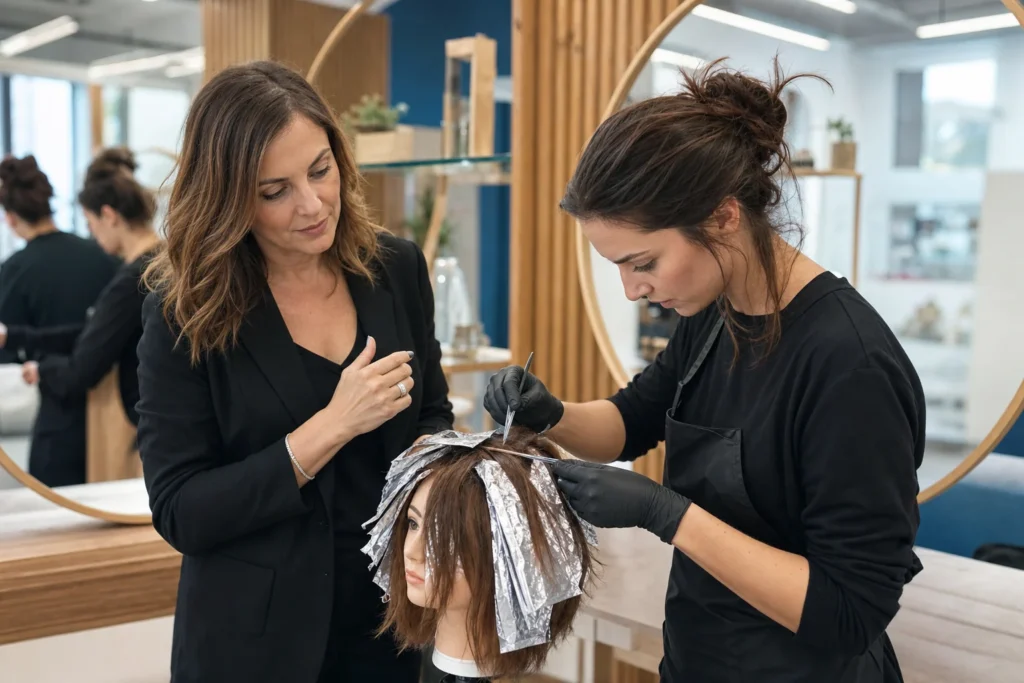
Professional growth becomes easier when “get better” is translated into one observable skill, a practice routine and evidence of progress. A 90-day plan is long enough to build repetition but short enough to maintain focus. It can be used by an employed stylist, an independent professional or a salon owner coaching a team member.
Days 1–10: choose one development priority
Review recent services, client feedback and situations where you needed support. Group the evidence into technical skill, consultation, time management, retail communication, photography or leadership. Select one primary priority and one supporting behaviour.
Write the goal as an outcome: “Conduct a complete colour-history consultation without missing key variables” is more useful than “improve consultations”.
Establish a baseline
- Observe or record three current examples.
- Note the step where confidence or consistency falls.
- Ask a trusted colleague for specific feedback.
- Choose one measure, such as completeness, timing or repeatability.

Days 11–30: learn the model
Use formal education, manufacturer technical material, demonstrations and supervised practice to understand the correct sequence. Break the skill into smaller decisions. For a haircut this could include sectioning, elevation, weight and finishing; for a consultation it could include history, target, constraints and confirmation.
Create a one-page checklist in your own language. The checklist is a learning aid, not a permanent substitute for judgement.
Days 31–60: practise deliberately
Choose cases that allow repetition without unnecessary risk. Before each case, state the element you are practising. Afterward, compare the outcome with the plan and record one adjustment. Repeating a service without reflection reinforces habits; deliberate practice tests a specific decision.
Use feedback at three levels
- Technical: Was the method controlled and appropriate?
- Client: Were expectations and maintenance understood?
- Operational: Was the service documented and delivered within a realistic workflow?
Days 61–80: apply the skill independently
Reduce prompts gradually. The mentor should move from directing the process to asking questions that reveal the professional’s reasoning. Continue to request support when the case exceeds the agreed level of competence.
Days 81–90: demonstrate and teach
Prepare a short case review showing the starting point, decision, method, result and what you would change. Explaining the process to another person exposes gaps and turns individual learning into team knowledge.
Build a useful portfolio
Include consistent photographs, a short case description and the decisions that created the result. A portfolio should show judgement and progression, not only perfect final images. Obtain the necessary client permission before using photographs.
Career growth beyond technical skill
As competence grows, choose a second dimension: consultation leadership, mentoring, commercial awareness, education or creative direction. Seniority is demonstrated by reliable decisions and the ability to improve the work around you, not only by years in the industry.
A weekly review template
- What did I practise?
- Which decision improved?
- Where did I need help?
- What evidence do I have?
- What will I repeat next week?
At the end of 90 days, retain the parts of the plan that produced evidence and choose the next priority. Career development becomes sustainable when each cycle is specific, supported and connected to real salon work.
Related HairCoPilot guides
Choose evidence that matches the skill
Technical goals may use sectioning diagrams, formulas, timed practice and consistent photographs. Consultation goals can use completed history records, client understanding and mentor observation. Leadership goals need evidence that another person can perform more confidently because of the support provided.
Keep client data private and obtain permission for portfolio use. The learning record should contain enough context to review the decision without exposing unnecessary personal information.
When to seek supervision
A development plan should expand competence without encouraging unsafe independence. Agree in advance which chemical services, corrections or unfamiliar hair conditions require a senior review. Asking for support at the right moment is evidence of professional judgement, not a failure of confidence.
HairCoPilot supports salons that want to connect professional expertise, consultation quality and consistent client work. Explore HairCoPilot for salons.