


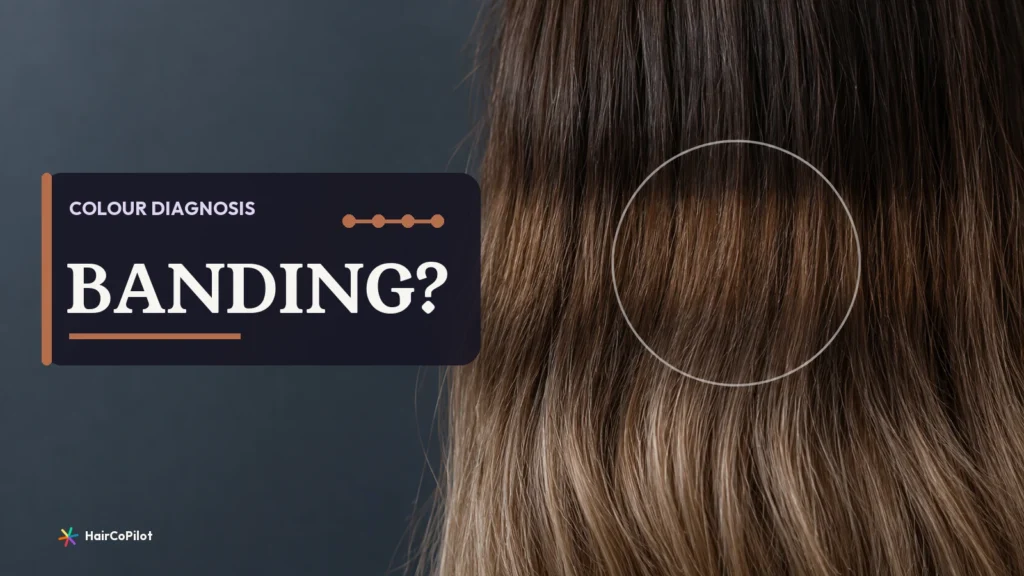
Do not formulate until you know what you are looking at. Banding is a symptom with several different causes, and the correction that fixes one makes another worse. A band caused by repeated overlapping is not the same problem as a band caused by a porosity change, which is not the same as a root that looks warm because it was processed against the scalp. This guide is about the diagnostic step that comes before any plan: how to read the pattern, how to separate the possible causes, what to test, and how to describe it to the client without alarming her.
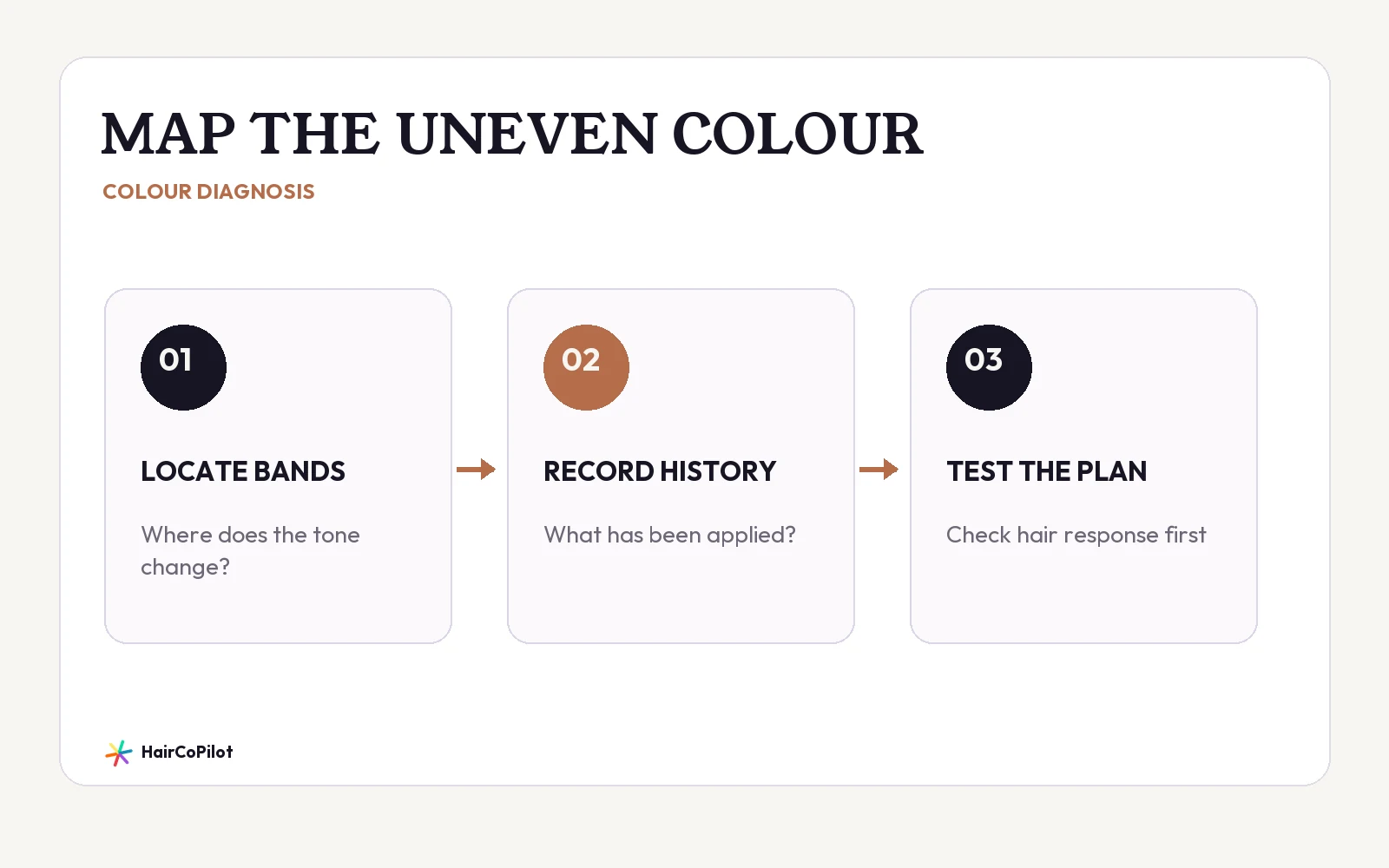
Read the pattern first
Stand the client in even light, away from a window, and look at the lengths in sections rather than at the overall impression. What you are mapping is where the changes are and how sharp they are.
How many bands are there, and where? One band usually points to a single event: one previous service, one boundary, one line where two things met. Several regular bands point to a repeated process, typically overlapping root applications over successive appointments.
Are the edges sharp or gradual? A sharp edge is an application boundary — the place where product stopped or started. A gradual transition is more likely a porosity gradient, where the hair’s condition changes along the strand rather than where the product landed.
Is the band warmer, cooler, lighter or darker than the hair around it? Warmer and lighter usually means more lift or less deposit in that zone. Cooler and darker usually means more deposit, or deposit onto more porous hair that grabbed it.
Does the pattern relate to the head or to the strand? A difference between the crown and the nape relates to the head, and usually to heat, timing or application order. A difference along the same strand relates to that strand’s history.
That four-part reading takes two minutes and it eliminates most of the wrong answers before anyone opens a colour chart.
The usual causes, and how to tell them apart
Overlapping on regrowth applications
The classic banding pattern. Each root application extends slightly beyond the new growth onto hair that was already coloured, so a zone receives colour twice, three times, four times. Over a year the result is a series of denser or, with lift in the formula, lighter bands at regular intervals down the hair.
The tell is regularity. The bands are spaced roughly at the interval between appointments and they correspond to a measurable length of growth.
A boundary where two services met
One sharp line, at a distance from the scalp that corresponds to a single past event: where foils stopped, where a home colour was applied, where a previous stylist started a global application.
The tell is that there is one of them, and the client can usually date it once you show her where it is.
Porosity difference
The ends of long hair are years older than the mid-lengths and have been washed, brushed, heated and exposed for that much longer. More porous hair takes deposit faster and holds it differently, so the same formula applied evenly produces an uneven result.
The tell is that the transition is gradual rather than sharp, and that the affected zone corresponds to the oldest hair rather than to any application boundary.
Heat at the scalp
A root area that processes faster because of body heat, producing a lighter or warmer band close to the scalp that is not present further down. This is often described as hot roots, and it is a processing effect rather than a history effect.
The tell is proximity to the scalp and the absence of any corresponding event in the client’s history.
The colour that was never removed
Old direct dye, box colour with unknown content, or a build-up of permanent deposit that has accumulated in one zone. It may not read as a band until you try to lift, at which point the zone refuses to behave like the hair around it.
The tell is that the visible result and the client’s account do not match, and this is the case where testing is not optional.
Collect the history without leading the answer
Clients under-report. Not dishonestly: they genuinely do not count semi-permanent products, root touch-ups between appointments, anything applied by a friend, or anything more than a year ago.
Ask specifically rather than generally. What has gone on your hair in the last two years, including anything from a supermarket. Has anyone else coloured it. Has anything ever gone unexpectedly dark or unexpectedly orange. When did you last have it lightened, not coloured — clients distinguish these two words less reliably than we assume.
Then check the history against what you can see. Where the two agree, you have a working account. Where they disagree, the hair is the more reliable witness, and that discrepancy is itself diagnostic information: it usually means something was applied that the client does not think of as colour.
Our guide to the colour correction consultation covers how to structure the wider conversation once you have the diagnosis; this article is about the step before it.
What a photograph cannot tell you
Two photographs are involved in most banding conversations and neither is evidence.
The client’s inspiration image. Taken in someone else’s light, on someone else’s starting point, and frequently processed by a filter that alters warmth and saturation. Treat it as a description of a direction, never as a target to be matched.
The photograph the client took of her own hair. Clients send pictures of their banding, usually in bathroom light, and the bands look far worse or far better than they do in person. Colour temperature in artificial light shifts warmth dramatically, and phone processing routinely boosts saturation.
So do the assessment in person, in consistent light, and make your own photographic record under the conditions you control, so that the comparison at the next appointment is between two comparable images rather than two different bathrooms.
Test before you commit
Two tests, two different questions. Our comparison of the patch test and the strand test covers both in full.
For banding, the strand test is the one that earns its place, and where you take the strand from matters more than the test itself. Take it from the band you understand least, not from the most accessible section. A strand from clean regrowth tells you nothing about the zone that will decide the appointment.
Where the history is genuinely unknown — an unidentified product, a colour that has behaved unpredictably before, or any suspicion of a metallic or direct dye — test before any chemical service, and be prepared for the honest outcome, which is sometimes that the service should not go ahead today.
Explain it without alarming her
The client is usually anxious and often blames herself or the previous salon. Neither helps.
Describe the pattern factually: here is where the colour is denser, here is where it is lighter, and this is the distance from your scalp, which corresponds to about this much time. Name the mechanism without naming a culprit: this happens when root colour overlaps slightly onto hair that already has colour on it, which is very common and builds up gradually.
Then be clear about scope. Say whether this is a one-appointment problem or a staged one, and say it before quoting a price. A client who learns halfway through that it will take three visits feels misled, even when the assessment was accurate.
And say what you will not do today. Refusing to lift an unknown band without a test is a professional decision, not a failure of service, and framing it that way keeps the client’s confidence rather than losing it.
Record the map, not just the verdict
The diagnostic work has value at the next appointment only if it survives. Record the distances from the scalp, which zone was warmer or cooler, what the client reported, where the strand test was taken and what it did, and what you decided not to do.
That record is what lets a second appointment start where the first ended, and it is what protects you if the client’s account changes. Our guide to digital colour records covers keeping this against the client rather than in a notebook, which is the difference between a diagnosis and a memory.
Frequently asked questions
What causes banding in coloured hair?
Several different things, which is why diagnosis comes first: repeated overlapping on regrowth applications, a boundary where a previous service stopped, a porosity gradient along the strand, faster processing at the scalp, or an old product that was never fully removed. The pattern tells you which.
How do I tell banding from hot roots?
Position and history. A warmer or lighter zone immediately at the scalp with no corresponding event in the client’s history is a processing effect. A band at a distance from the scalp corresponds to something that happened at a datable point.
Can I just apply a darker colour over the bands?
Depositing over a band can even the appearance temporarily, but it does not address the cause and it adds another layer of deposit to a zone that may already be saturated. Diagnose first, and decide whether the plan is correction or camouflage — then tell the client which one you are doing.
Should I strand test even when the client says she has never coloured her hair?
Where the visible result and the account do not match, yes. The discrepancy is itself the reason to test.
Use HairCoPilot in your salon
A diagnosis is only useful if it is still there in six weeks. HairCoPilot keeps the client record and the colour service together, so the map you made today, the formula you used and what you decided not to do are in one place at the next appointment. Start your free trial.