



An AI hair consultation can help organise ideas, visualise a direction and make the client’s history easier to retrieve. It cannot feel the hair, verify an allergy-alert procedure, judge the reliability of an incomplete history or take responsibility for the service. Those decisions remain with the colourist.
The strongest consultation uses technology to improve the conversation—not to turn a generated image into a promise. The goal is an informed, realistic agreement about the result, route, risk, maintenance and next step.
What AI can contribute to a colour consultation
Used with appropriate controls, AI can support several preparation and communication tasks:
- Organise the client’s goals, references and previous service notes.
- Create visual directions for discussion, with clear limitations.
- Summarise a long history into points the colourist should verify.
- Compare maintenance routes in client-friendly language.
- Prompt the team when important fields or follow-ups are missing.
- Turn the agreed plan into structured documentation.
These outputs are starting points. The colourist must compare them with what is visible and verifiable in the salon.
The decisions only the colourist can make
1. Whether the service should proceed
The professional assesses hair and scalp condition, previous chemical work, testing requirements and signs that the planned service should change or stop. A digital preview cannot establish technical suitability.
2. Whether the history is reliable enough
Clients may forget a home colour, smoothing treatment, metallic-salt product or previous correction. The colourist asks follow-up questions, observes the hair and uses the appropriate professional tests. AI can highlight gaps; it cannot make missing facts safe.
3. What result is realistic today
A reference image does not show every part of the starting point, lighting, editing or maintenance. The colourist explains what can be achieved in one visit, what may require stages and what would compromise condition or predictability.
4. The technical route
Product system, formula, sectioning, placement, processing and adjustment depend on professional training, manufacturer instructions and the actual client. A suggestion that ignores one constraint can still look convincing.
5. Whether the client has given informed agreement
Agreement is more than saying yes to a picture. The client should understand the planned direction, limits, price range, time, maintenance, alternatives and significant uncertainties before the service begins.
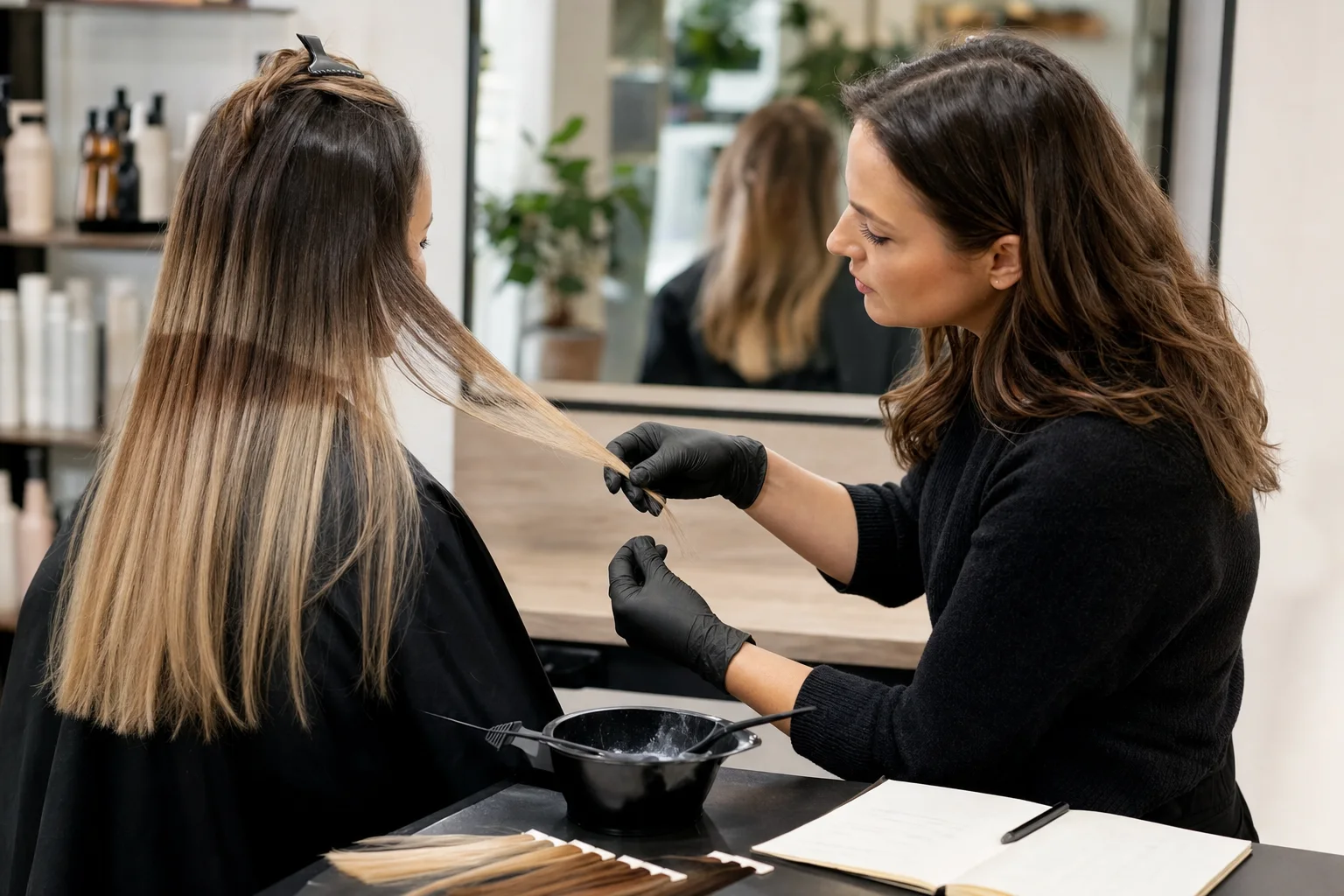
A seven-stage AI-assisted consultation
- Listen before visualising: ask what the client wants to feel, what they like and dislike, and why they are considering a change now.
- Build the history: record previous professional and home colour, chemical services, relevant sensitivities and current care.
- Assess in person: examine condition, porosity, elasticity, density, level, tone, regrowth and banding under suitable light.
- Use AI for exploration: compare directions or organise information, clearly labelling visuals as illustrative.
- Apply professional constraints: define what is technically suitable, what needs testing and what should be staged.
- Agree the plan: confirm result, route, price, timing, maintenance and alternatives in language the client understands.
- Document reality: after the service, save the formula, processing, adjustments and observed result—not merely the original suggestion.
This makes the record useful at the return visit. For a full set of prompts, use our professional consultation checklist.
How to present AI visuals responsibly
A generated preview can help clients compare warmer and cooler directions or consider the visual impact of depth. It should not be shown as an exact prediction. Before presenting it:
- Explain that screen colour, lighting and generated texture can differ from the finished result.
- Use the client’s image only with an appropriate basis and clear purpose.
- Do not let a preview override condition, testing or product limitations.
- Discuss maintenance and future sessions, not only the first-day appearance.
- Record which direction the client preferred and the professional plan actually agreed.
The visual supports shared language. The consultation still depends on listening and honest boundaries.
Safety and documentation are not optional
Follow the manufacturer’s current instructions and the professional requirements that apply to the salon. The UK’s National Hair & Beauty Federation publishes guidance on consultation and allergy-alert testing protocols, including the importance of asking and recording relevant client information. AI reminders may support the process, but they do not replace the procedure or its record.
If an AI summary omits a detail, the original record should remain available. Give the colourist a simple way to correct the summary and note who approved the final plan.
Five warning signs of a weak AI consultation
- The client sees a generated image before the colourist understands the goal.
- The tool produces a formula without verified condition, history and product context.
- The team cannot explain where a recommendation came from.
- The client’s image or data is entered without a clear purpose or appropriate handling.
- The generated preview is treated as a guaranteed result.
When any of these appears, pause and return to the professional consultation.
How HairCoPilot supports the process
HairCoPilot is designed to connect the consultation with the technical and relationship history that follows. The colourist can use digital support to organise information and communicate possibilities, then record the decisions that were actually made.
The value grows over time: the next appointment begins with the previous formula, result, adjustments, care and maintenance context. Read HairCoPilot for colour consultation and our guide to digital hair colour records.
Frequently asked questions
Can AI predict the exact final hair colour?
No preview can guarantee an exact result. Starting colour, condition, previous chemistry, product behaviour, technique, lighting and screen display all affect what the client sees and what is achievable.
Can a client complete the whole consultation online?
Online information can improve preparation, but services with technical or safety implications require the professional assessment and procedures appropriate to the client and product.
Does AI replace the colourist’s creativity?
No. It can expand references or organise options, but the colourist interprets the person, hair, lifestyle, technical limits and aesthetic direction. Creativity includes knowing which idea not to pursue.
Use technology to make judgement more visible
A responsible AI hair consultation gives the colourist better context and gives the client clearer choices. It does not hide who made the decision. Let AI assist with organisation and exploration; keep diagnosis, safety, technical planning and informed agreement firmly human.
Explore HairCoPilot for salons and continue with our guide to professional hair colour theory.