


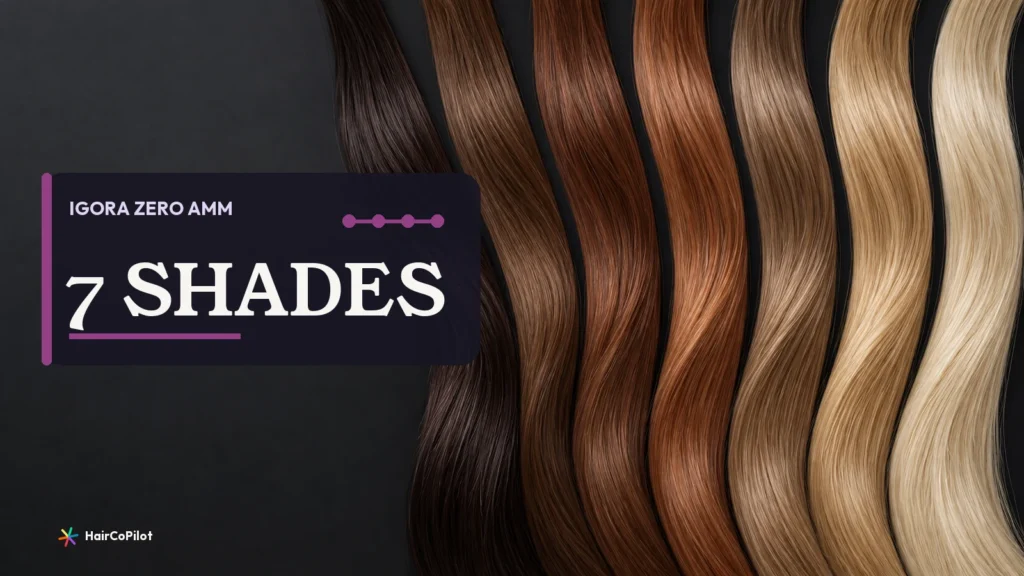
Seven new shades is only useful information if you know which families they extend. The page Schwarzkopf Professional Italia publishes for IGORA ZERO AMM names the additions and sets out what the line claims, and the shade chart it links explains the structure those additions slot into. This brief covers what is confirmed, where the seven sit, and what the consultation consequences are — including the one that matters most, which is grey coverage.
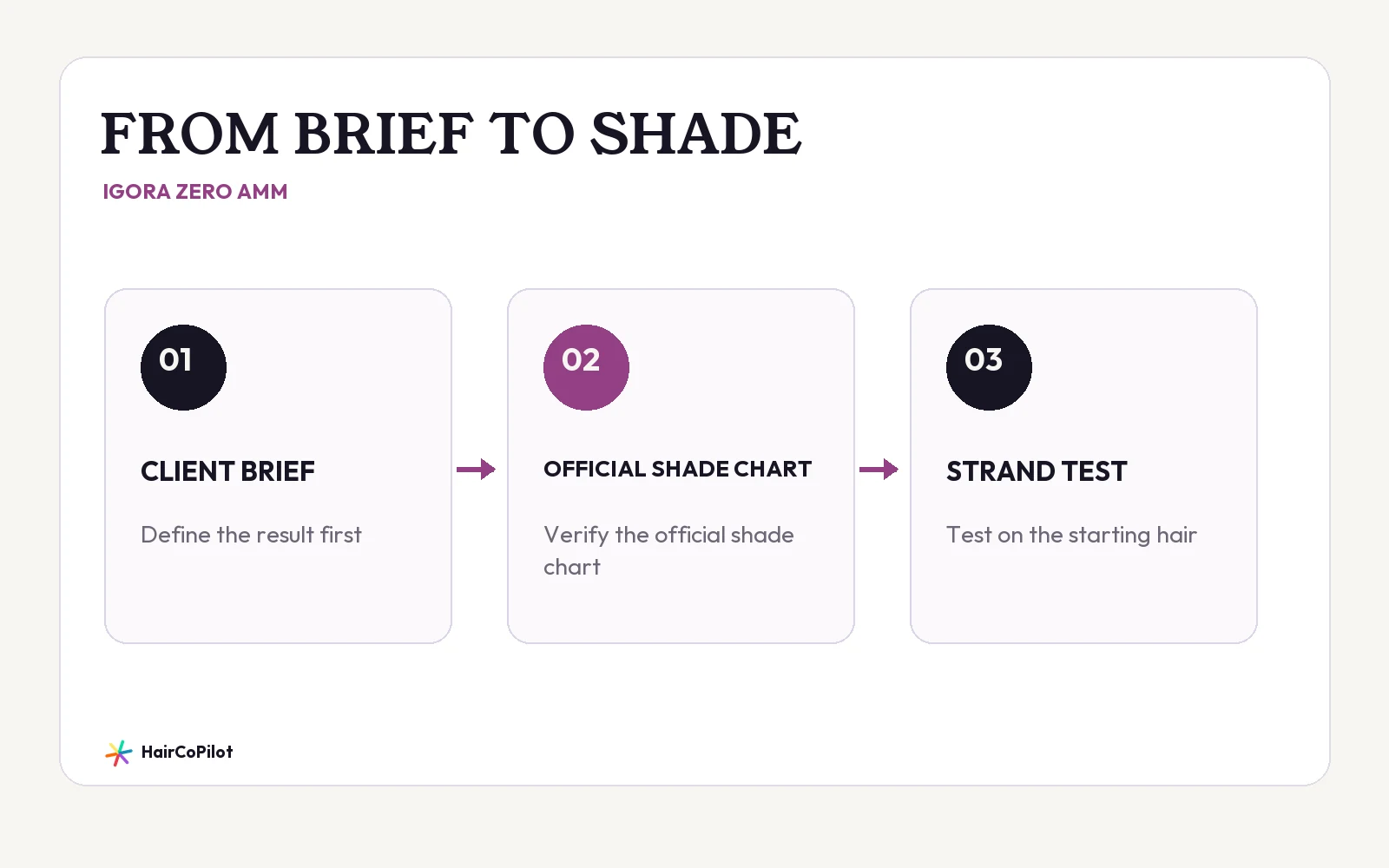
What the brand states about the line
IGORA ZERO AMM is presented as a permanent colour that is 100% ammonia-free and without ammonia odour. The claims listed on the Italian page are natural, true-to-tone results, up to 100% coverage of white hair, and up to three levels of lift with the 10- series.
Instead of ammonia, the formula uses monoethanolamine (MEA) as the alkalising agent. The brand states that MEA delivers the same pH value as ammonia and is almost odourless. That is the clearest statement on the page for a consultation: the sensory experience changes, the working pH does not.
The technology is described as Phytolipid Technology, a blend of micronised natural oils and optimised pigments. The oils named are grapeseed oil and apricot kernel oil, and the brand’s explanation is that the micronised oils increase diffusion, actively pushing pigment for more uniform penetration, with Omega 9 unsaturated fatty acids sealing the cuticle.
Treat the mechanism claims as what they are: the manufacturer’s account of its own formula. The useful part for the salon is the performance envelope, not the chemistry narrative.
The seven shades, and where they sit
The seven shades identified on the Italian page are 6-06, 7-16, 7-57, 8-06, 8-51, 9-7 and 10-51.
They become meaningful when read against the shade chart structure Schwarzkopf publishes for the line, which groups shades into families with different coverage and lift characteristics:
- Naturals (-0, -06) — up to 100% coverage, two to three levels of lift;
- Extra naturals (-00) — up to 100% coverage, two to three levels;
- Fashion & Cover (-50, -60) — up to 100% coverage, two to three levels;
- Fashion shades (-1 to -9) — up to 50% coverage, two to three levels, with the chart noting up to 100% when mixed with IGORA ZERO AMM natural shades at 2:1;
- Lightening series (10-) — no coverage, up to three levels of lift.
Read that way, the additions are not a random set. 6-06 and 8-06 extend the naturals, the family a colourist reaches for when coverage is the primary requirement. 10-51 extends the lightening series. 7-16, 7-57, 8-51 and 9-7 sit in the fashion families, where the published coverage figure drops to up to 50% unless mixed with a natural.
That last point is the one to carry into consultation. A fashion shade chosen for its tone on a client with significant white hair is a different proposition from a natural shade chosen for coverage, and the chart’s own footnote tells you how the brand expects you to bridge the two.
What the technical parameters mean in practice
The shade chart lists developers at 3%, 6% and 9% (10, 20 and 30 volume) and a processing time of 30 to 45 minutes.
Three levels of lift with the 10- series is the ceiling, and it is stated with the same caveat every manufacturer applies: it is a maximum on a suitable base. It is also, as with any permanent colour, a figure that describes lifting natural pigment. A client whose lengths carry previous colour is not a candidate for lift with this or any other permanent line, and that is a lightener conversation rather than a shade selection one.
How to place it in a consultation
The line’s distinguishing feature is not the shade range. It is the absence of ammonia at an unchanged working pH, and the consultation value of that is narrower and more honest than “gentler colour”.
What it genuinely offers: a service with no ammonia odour, which matters in a small salon, for a client who dislikes the smell, and for a colourist working through several services a day. That is a real benefit and it is what the brand actually claims.
What it does not automatically offer: a different damage profile, a different result, or a service suitable for a client who believes she reacts to hair colour. Ammonia-free is not hypoallergenic, and the allergy alert test requirement is unchanged by the alkalising agent. If a client raises a reaction history, that is a safety conversation and a manufacturer-instruction conversation, not a product-swap one.
For context on how ammonia-free permanent lines are positioned more generally, our article on Wella Pure Perfection covers a comparable proposition from a different manufacturer. The two are not interchangeable and no cross-brand equivalence should be implied, but the consultation logic is similar.
A salon example
A long-standing client with roughly 60% white hair at a natural level 7 asks about switching to an ammonia-free line, because she finds the smell of her current service unpleasant.
The assessment is straightforward and the answer has two parts.
On the smell: yes, this is precisely what the line is positioned for, and the brand’s own claim is that the alkalising agent is almost odourless at the same pH.
On the result: it depends on the shade family she ends up in. If she stays with a natural or Fashion & Cover shade, the published coverage claim is up to 100%, comparable to what she has now. If she has her eye on one of the fashion tones, the published figure drops to up to 50% unless it is mixed with a natural at the ratio the chart specifies, and at 60% white that difference will be visible.
What she is told is the truthful version: the service can change, the coverage expectation depends on the shade she chooses, and the first application should be treated as an assessment rather than assumed to behave exactly like her current line. Recording what happens at that first appointment is what makes the second one predictable, which is the whole argument for structured records — our guide to what a consultation form should capture covers the fields worth having before a line change.
Before you write about it or order it
Two accuracy points.
The page read for this article does not state a launch date. The linked shade chart and technical manual carry a September 2026 reference in their file names, which is an indication of document date rather than an announced availability date. Do not present the line as launching on a particular day, and confirm stock and shade availability with your distributor before promoting it.
And the page also publishes two demonstration looks with full formulas. Those are worked examples on specific bases, not prescriptions, and reproducing them in a caption beside a client photograph is how a demonstration formula becomes an implied promise.
Frequently asked questions
How many levels does IGORA ZERO AMM lift?
Schwarzkopf Professional states up to three levels with the 10- series. As with any permanent colour, that describes lifting the hair’s natural pigment, not removing previous colour.
Does it cover grey?
The brand states up to 100% coverage of white hair. The shade chart qualifies that by family: naturals, extra naturals and Fashion & Cover are listed at up to 100%, while fashion shades are listed at up to 50%, with a note that up to 100% is achievable when mixed with IGORA ZERO AMM natural shades at 2:1.
What replaces the ammonia?
Monoethanolamine (MEA). Schwarzkopf states that it delivers the same pH value as ammonia and is almost odourless.
Is ammonia-free colour safer for a client who has reacted before?
No. Ammonia-free is not hypoallergenic, and the allergy alert test requirement is unchanged. A reaction history is a safety conversation, following the manufacturer’s instructions, not a reason to swap product lines.
Which seven shades were added?
6-06, 7-16, 7-57, 8-06, 8-51, 9-7 and 10-51, as identified on the Schwarzkopf Professional Italia page.
Use HairCoPilot in your salon
A line change is only worth making if you can compare the results. HairCoPilot lets you save each formula with the line, shade, quantities, developer and processing time in the client record, so the first application on a new line and the one before it sit side by side. Start your free trial.