


A home routine does not replace a colour plan. It protects one. That distinction is the whole job when a client asks whether they should be buying something for their blonde, and it is the frame for ULTIMATE COLOR BLONDE, the two-step blonde maintenance routine Wella Professionals described on its Italian site on 1 September 2026. This guide covers what the brand actually claims, how to assess whether a toning routine is the right recommendation for the head in front of you, and how to brief it so the client knows what will change and what will not.
What Wella says the range is
ULTIMATE COLOR BLONDE is presented as an extension of the existing ULTIMATE COLOR line rather than a standalone system. It consists of two products: an Onyx Shampoo and a Moisturizing Conditioner.
According to the Wella Professionals page, the Onyx Shampoo combines violet pigments with activated charcoal to counteract unwanted yellow and warm reflections, and is left on the hair for up to five minutes, or less when the warmth is milder. The conditioner is described as restoring moisture and detangling while depositing neutralising pigment more gently, with a processing window of up to three minutes.
Both products draw on the ULTIMATE COLOR blend the brand already promotes: glycine and a metal purifier, positioned as helping to remove the metal build-up that dulls hair, plus B5 to seal in hydration. The brand’s breakage claim sits on the conditioner and is qualified: up to 90% less breakage, compared with a non-treating shampoo. That footnote matters. It is a comparison with a baseline, not a promise of repair, and it should be repeated in that form when you quote it to a client.
Wella positions the range for every kind of blonde that picks up unwanted yellow: full colour, highlights, balayage, natural blonde that has warmed in the sun or from repeated heat styling, and grey hair showing yellow undertones from environmental exposure. Renya Xydis, Creative Director at Wella Professionals, is quoted on the same page recommending use once or twice a week, with a normal routine in between.
That frequency guidance is the single most useful line on the page for a salon conversation, because most disappointment with violet products comes from using them either too rarely to matter or as a daily shampoo.
Where a toning routine belongs in the colour plan
A pigmented shampoo and conditioner work on the surface of the tone. They adjust how warm the blonde reads between appointments. They do not lift, they do not correct banding, and they do not extend the life of a toner that was wrong for the base in the first place.
That is why this conversation should follow the colour decision, never lead it. If the tone in the chair is not where the client wants it on the day of the service, the answer is a service adjustment, not a product recommendation. If the tone is right on the day and drifts warm over the following weeks, that is exactly the gap a home routine is designed to cover.
Two related decisions sit alongside it. First, whether the warmth the client dislikes is genuinely surface oxidation and mineral build-up, or whether it is exposed underlying pigment from an over-ambitious lift. The second cannot be managed with a violet shampoo. Second, whether the hair has the condition to take a drying toning step at all: on compromised mid-lengths, a routine that promises hydration alongside toning is a more defensible recommendation than a traditional purple shampoo, and Wella positions the range explicitly on that contrast.
If retail advice is a weak point in your salon, the framework in our guide to recommending home care without hard selling applies here without modification: recommend from the diagnosis, not from the shelf.
Assess the blonde before you recommend anything
Four observations are enough to decide whether a toning routine is worth suggesting, and they take under a minute at the basin.
Where the warmth actually sits
Look at root, mid-lengths and ends separately under consistent light. Warmth concentrated at the ends often reflects sun and heat exposure on the oldest hair. Warmth spread evenly through pre-lightened lengths is more likely to be tonal drift after a toner has faded. Warmth appearing in a band suggests a previous application boundary, and belongs in a correction conversation rather than a retail one.
How porous the hair is
Highly porous lengths take up violet pigment quickly and can tip cool or grey-looking within a couple of uses. Those clients need a shorter processing time than the packaging maximum, and they need to be told that in advance.
What the client’s water and styling habits are
Mineral-rich water and frequent heat styling both push blonde warm faster. This is where the metal purifier framing in the ULTIMATE COLOR blend is relevant, and it is also where a realistic expectation is set: a routine slows the drift, it does not stop it.
Whether the client wants a cool blonde at all
Not every blonde client is chasing neutral or ash. A client who has asked for a warm, golden result does not need a violet routine, and recommending one anyway is how a product ends up unused in a bathroom cupboard.
A salon example
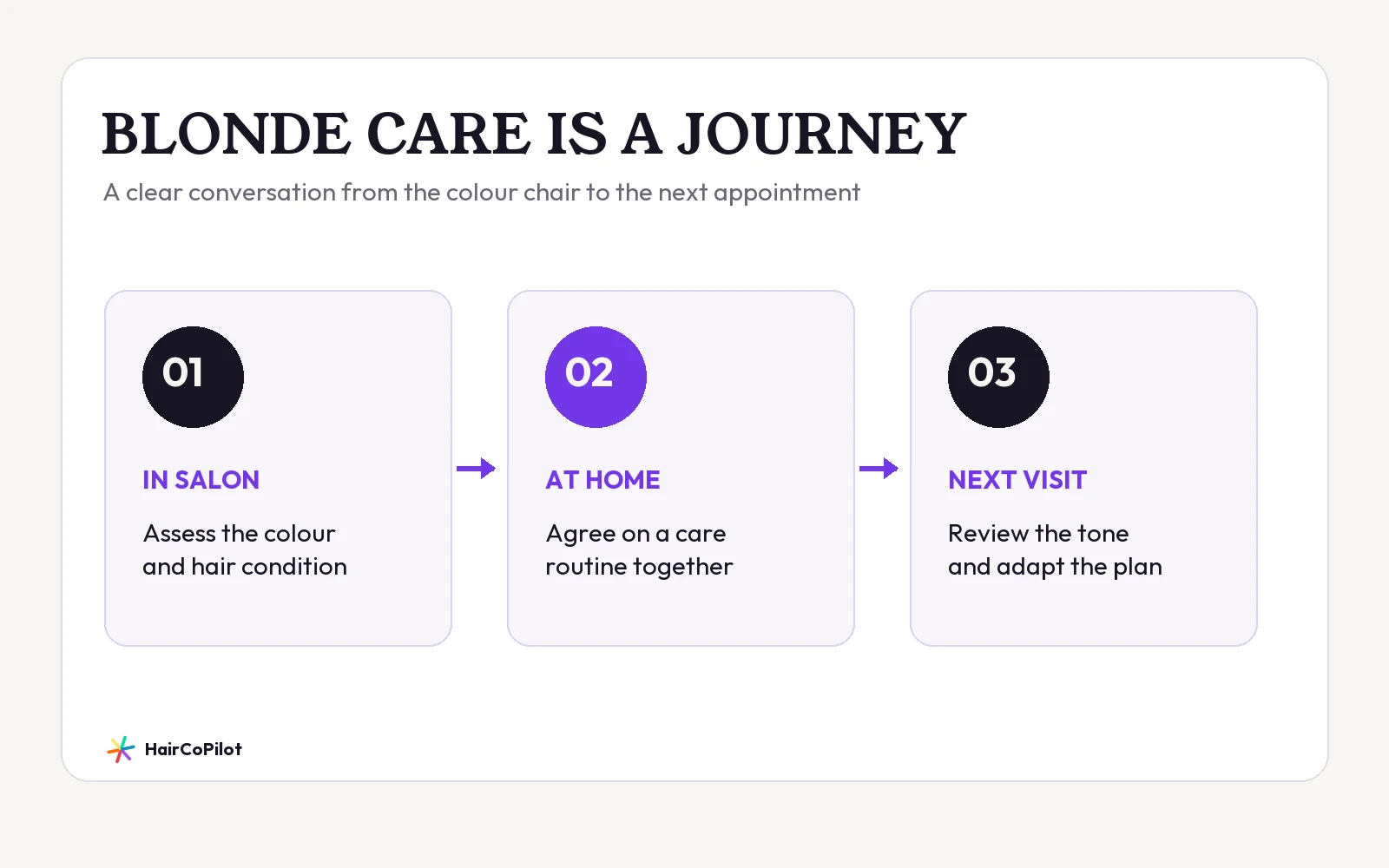
A client comes in eight weeks after a full head of balayage with a toner at level 9. The ends read yellow, the mid-lengths are acceptable, and she says she has been swimming twice a week through September. Her stated goal is to hold a cooler blonde for the remaining four weeks before her next appointment.
The decision is not to sell a routine and move on. It is to refresh the tone in the salon first, because the ends are past what a home product will correct, and then to brief the routine for the weeks that follow: the Onyx Shampoo once a week rather than twice, given the porosity of the ends, with the processing time kept short on the first use so she can see how quickly her hair takes the pigment. The conditioner goes on every wash, because hydration is the part she will notice and the part that keeps her using the routine at all.
The instruction she leaves with is specific: one toning wash a week, watch the first one, come back to twice a week only if the yellow returns before the fourth week. That is a recommendation she can follow and you can review.
Brief it so it can be reviewed
The value of a home routine to the salon is not the retail margin on two bottles. It is that the next appointment starts from a known variable instead of a guess. If you know a client has been toning weekly and the hair still reads warm at week five, you learn something about her water, her styling or her base. If you do not know what she has been doing, you learn nothing.
So record the recommendation with the same care as the formula: which products, what frequency, what processing time you told her to use, and what she reported at the next visit. Our guides to colour formula management and digital colour records both treat aftercare instructions as part of the record, not as a separate note, and that is the practice worth adopting here.
One final boundary. This is a haircare range. It is not related to Wella Pure Perfection, the ammonia-free permanent colour line, and the two should not be presented together as a single announcement. One is an in-salon colour service. The other is what happens in the client’s bathroom for the eight weeks afterwards.
Frequently asked questions
Is ULTIMATE COLOR BLONDE a new launch?
Wella Professionals published the Italian article describing the range on 1 September 2026. The page presents the products as available, not as a future launch, and gives no separate release date. Confirm distributor availability in your market before you build a retail display around it.
How often should a client use the Onyx Shampoo?
Wella Professionals Creative Director Renya Xydis is quoted on the brand page recommending once or twice a week, with a normal routine the rest of the time. Adjust downwards for very porous hair.
Can it be used on natural blonde or grey hair?
Wella states yes for both: natural blonde that has picked up warmth from sun or heat styling, and grey hair showing yellow undertones. It remains a cosmetic toning step in either case.
Will it fix brassiness from an old colour?
No. A pigmented shampoo adjusts how warm a tone reads on the surface. Exposed underlying warmth from lifting, or a visible band from a previous application, is a salon correction conversation.
Use HairCoPilot in your salon
Record the routine where the formula lives. In HairCoPilot you can build the colour formula with the line, shade, quantities, developer and processing time you actually used, save it to the client record, and reopen it at the next visit alongside what you told the client to do at home. Start your free trial.