



The most important word on this product page is “rottura”. Davines describes the ENERGIZING Overnight Serum as helping to reduce hair fall caused by breakage, and the difference between that and hair loss is the entire consultation. Read carelessly, the page supports a conversation no salon should be having. Read accurately, it supports a straightforward one about fragile hair, mechanical damage and an overnight leave-in step. This brief covers what the brand actually states, what its own test footnotes qualify, and how to recommend it honestly.
What the product is, according to Davines
The serum sits in the NATURALTECH ENERGIZING line and is presented as a chronobiology-inspired night treatment: the idea that hair and scalp enter a repair mode during sleep, making the night a receptive moment for a leave-in step.
On the Davines Italia product page, the described benefits are that it helps reduce hair fall caused by breakage, strengthens fragile strands, supports overnight regeneration, hydrates the scalp and lengths, and helps protect against the signs of scalp ageing. The stated target is fragile hair prone to breakage.
The page lists two key actives: a Night Fortifier, described as a biotechnological active derived from the microalgae Spirulina Maxima and Chlorella, and a Hair Energy Complex combining green tea extract with niacinamide. The product is listed as vegan, with 95.7% natural-origin ingredients and 98.8% biodegradable ingredients by the brand’s own definitions, both of which are explained on the page.
Application, as published: in the evening, on dry or towel-dried hair and scalp, one to two pipettes on the scalp and one to two through lengths and ends, massaged in, not rinsed, with normal styling the following morning. Frequency is given as preferably every evening, alternating nights for clients with excess sebum or very fine hair.
Read the footnotes before you repeat the claims
This is where a salon brief earns its keep. The headline figures on the page carry numbered footnotes, and the footnotes narrow them considerably.
The claim of being three times more effective at reducing hair fall is footnoted to an independent laboratory instrumental test over eight weeks against placebo, measuring the reduction of breakage-related shedding. That qualifier is not decoration. It means the endpoint measured was hair breaking, not hair leaving the follicle, and it is the only responsible way to quote the figure.
The hydration figure is footnoted to a consumer self-assessment with 35 users worldwide. The figure for hair feeling stronger and more resistant is footnoted to a self-assessment with 20 people over twelve weeks. Self-assessment means the participants reported the result; it is a perception measure, not an instrumental one, and 20 people is a small panel.
None of this makes the product a bad recommendation. It makes it a cosmetic one, with cosmetic evidence, which is exactly what it is sold as. What it rules out is presenting the numbers in the salon as though they were clinical outcomes.
Where it fits in a home routine
The useful question is not whether the serum works. It is which client problem it addresses.
It is a leave-in, applied to both scalp and lengths, used overnight. That places it alongside the parts of a routine the client does last thing rather than in the shower, which is a genuine advantage for clients who will not add another step to a morning they are already rushing.
The target it names — fragile hair prone to breakage — is observable. You can see breakage: short pieces of varying length with blunt or frayed ends, concentrated where tension, heat or a chemical service has done its work. If you are looking at that, the recommendation is defensible and you can describe what you expect the client to notice: less breakage during detangling, hair that feels more resistant when she brushes it.
The target it does not name is hair loss, and the page does not claim to address it. Neither should you.
The conversation, and the boundary
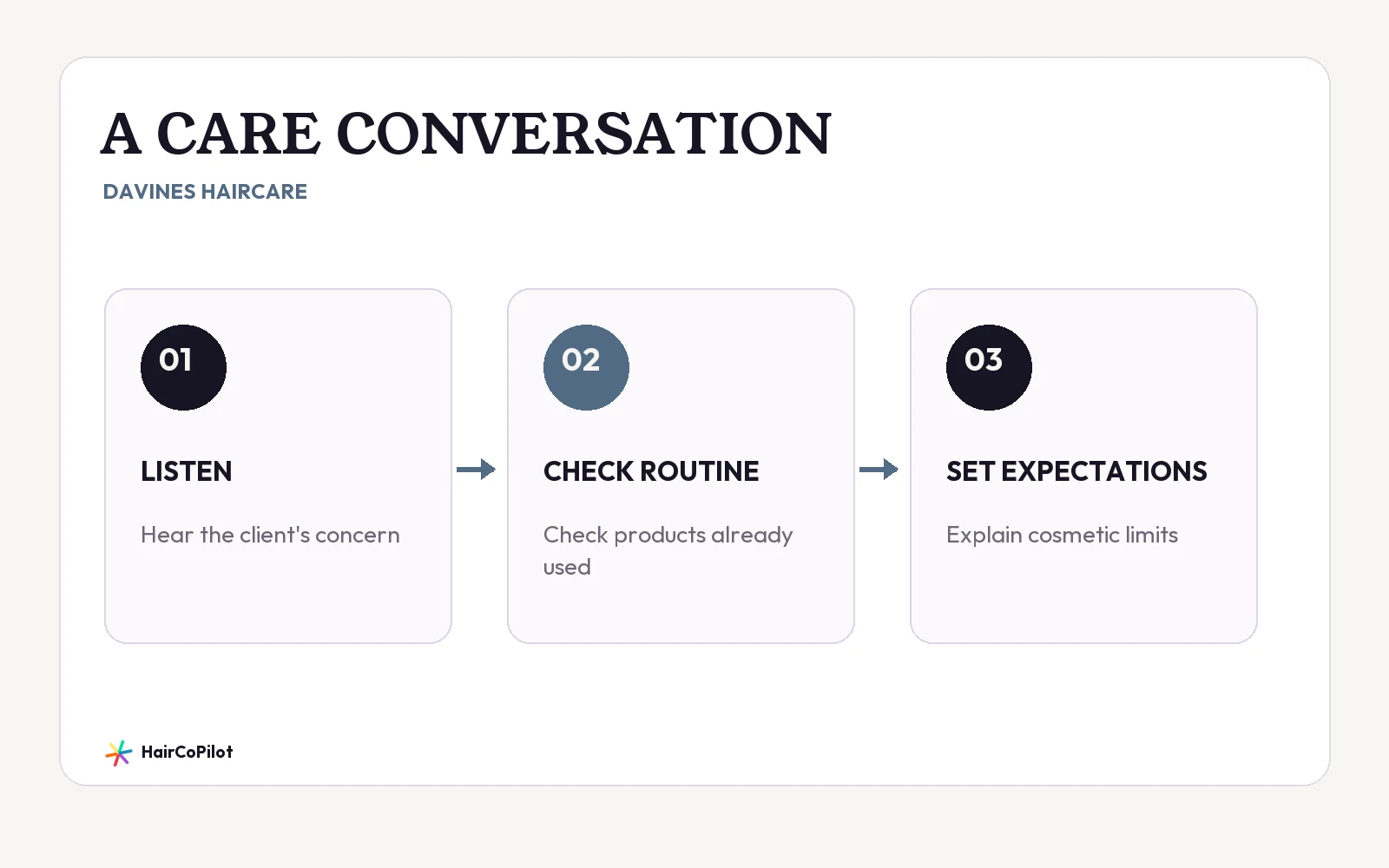
If a client raises shedding, the recommendation is not the first move. A salon does not diagnose hair loss, does not name conditions, and does not present a cosmetic product as a treatment for it. The professional response is to observe, ask neutral questions about when it started and what changed, and suggest a medical assessment where the pattern warrants one.
The serum belongs in that conversation only in one specific place: if what you are actually seeing is breakage rather than shedding from the root, then saying so, and recommending a product that targets breakage, is genuinely useful. A client who has been worrying about hair loss and is actually snapping her hair on a hairbrush has been given the wrong problem to worry about, and correcting that is worth more than the sale.
Two sentences to avoid entirely. “This will stop your hair falling out” is a claim the brand does not make and you cannot support. “It’s clinically proven” misrepresents what a self-assessment panel is.
The framework in our guide to recommending home care without hard selling applies with particular force to a client who is anxious about her hair. Anxiety makes a confident recommendation land harder, which is precisely the reason to keep it inside what the product does.
A salon example
A client books a cut and says she has been losing a lot of hair since the summer. She has seen the serum in the salon and asks whether she should buy it.
The first move is to look. The hairs she is finding on her brush come away full length with bulbs, and the crown reads evenly, not patchily. That is not breakage, and it is not something the serum was built for.
The second move is to say so plainly: what you are seeing is hair coming out at the root rather than snapping, you cannot tell her why, and this is a question for a doctor rather than a product. The honest answer to her question is no, not for this.
The third move is what you did find. Her mid-lengths, on the other hand, are showing short broken pieces around the ponytail line, and she wears it up for work every day. That is the problem the serum addresses, and it is worth explaining as a separate issue — alongside a change to how she ties it up, which will do more than any bottle.
She leaves with one product recommendation she understands, one problem correctly identified as outside your remit, and the reason for both. That is a better appointment than one that ends with a bigger sale.
Note it and review it
An overnight leave-in is a habit, and habits are the part clients abandon quietly. Record what you recommended, for what reason, and what you asked her to watch for, so that the next appointment is a review rather than a fresh guess: did the breakage around the ponytail line reduce, did she actually use it, did she use it every night or twice a week.
Keeping that note against the client rather than in a notebook is the difference between a recommendation and a relationship. Our guides to digital colour records and client retention systems both treat the follow-up as part of the service rather than as an afterthought, and a home-care recommendation with no review attached is just a transaction.
Two accuracy notes before you post about it
The Davines Italia page labels the serum as new, and the site was running a salon-linked initiative described as available until 31 October. That is a retail promotion with a date, not a product launch date, and the two should not be merged in a caption.
Second, the product URL cited in older planning notes now returns a 404. The live Italian page at the time of checking was the leaflet URL referenced above. Confirm the current link before publishing, because a dead source link in an article that depends on quoting the source accurately is worse than no link at all.
Frequently asked questions
Does the Davines Overnight Serum stop hair loss?
Davines does not claim that. The page describes it as helping to reduce hair fall caused by breakage, and the footnote to the headline figure specifies breakage-related shedding measured against placebo over eight weeks. Hair loss is a medical question.
What does “3 times more effective” refer to?
According to the footnote on the Davines page, an independent laboratory instrumental test over eight weeks versus placebo, on the reduction of breakage-related shedding.
How often should it be used?
The brand states preferably every evening, alternating nights for clients with excess sebum or very fine hair. It is applied to dry or towel-dried hair and scalp and is not rinsed out.
Is it a new launch?
The Italian page labels it as new. The page read for this article did not state a launch date, so no launch claim is made here. Confirm current availability with your Davines representative.
Use HairCoPilot in your salon
A recommendation you cannot find again is not a recommendation. HairCoPilot keeps the client record and the service in one place, so what you advised at this appointment is in front of you at the next one, alongside the formula you used. Start your free trial.