


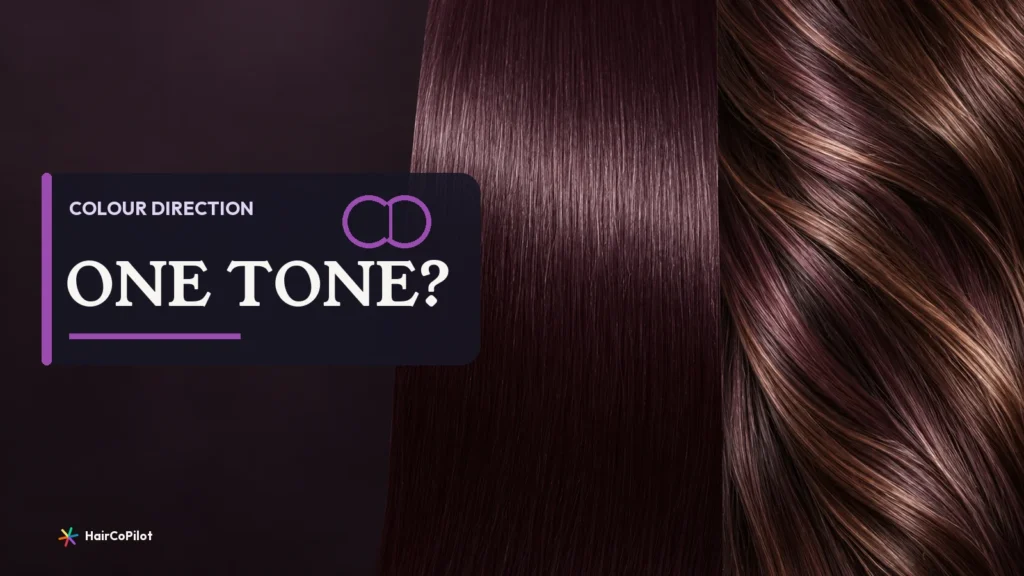
First, a caveat that belongs at the top rather than buried at the bottom. “Colour drenching” is a phrase borrowed from interior design, where it describes painting walls, trim and ceiling in one tone. Applied to hair it has no standard professional definition, no manufacturer technical documentation behind it, and no measured evidence that it is growing as a request. What it does describe usefully is a real and long-standing decision: whether a client is better served by one immersive tone from root to tip, or by a result built from more than one level. This guide treats the decision seriously and the label as what it is — a way of describing a look, not a technique with rules.
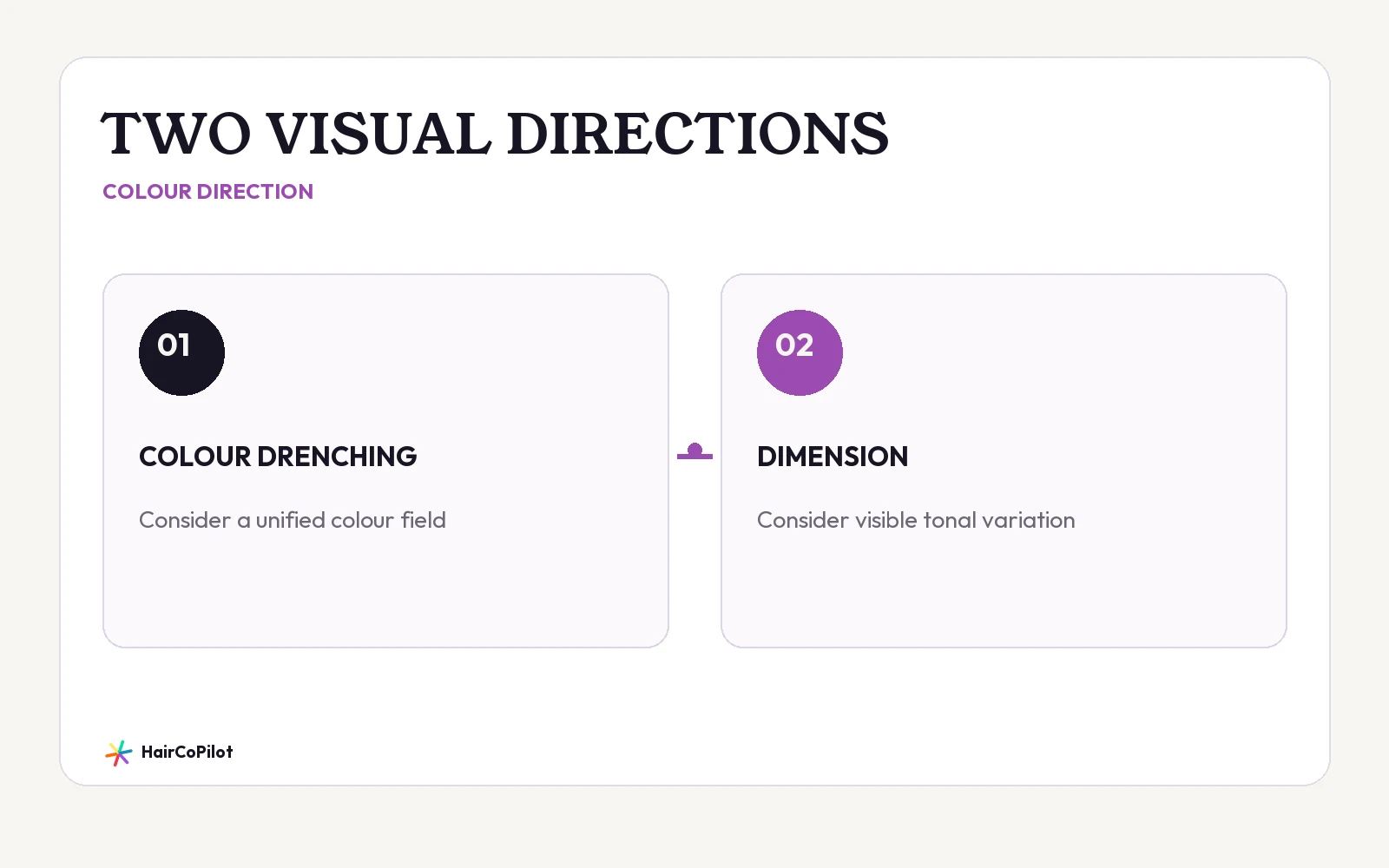
What each result actually does
The immersive single tone
One depth, one tonal direction, applied from root to tip, with shine rather than contrast doing the work. There is no dimension built into the result by design; the interest comes from the tone itself and from how light moves across an even surface.
Its strengths are specific. It reads as intentional and expensive when the tone is right. It is fast to deliver relative to a foiled service. And on hair that is already one level through the lengths, it is the least invasive way to change how the client looks.
Its weakness is equally specific. Every imperfection in the base shows, because there is nothing to distract the eye. Uneven porosity, an old colour band, a warm patch at the crown: a single tone reveals all of it rather than concealing it.
The dimensional result
Two or more levels present in the same head, distributed with foils, weaves, freehand work or a combination. The interest comes from the relationship between light and depth rather than from a single tone.
Dimension conceals. It gives the eye somewhere to go, which is why it forgives an imperfect base and why it flatters most hair. It also gives you a lever: contrast at the face, depth through the back, brightness where the client actually looks in the mirror.
What it costs is time in the chair, exposure for the hair, and a maintenance commitment that is harder to walk away from.
Choose on the base, not on the reference image
The base decides more than the brief does. Three questions in order.
Is the existing hair even? If the lengths carry a visible band, a difference between mid-lengths and ends, or an old colour that stops at a line, a single immersive tone will expose it rather than hide it. Assessing that honestly before agreeing to a global service is the whole job. If what you are looking at is uneven in bands, that is a diagnosis conversation rather than a colour choice.
Is the target lighter or deeper than what is there? Going deeper with a global tone is straightforward and forgiving. Going lighter with a global tone is constrained by what permanent colour can actually lift on that hair, and by what it cannot lift at all where the hair has been coloured before. Where the target needs more lift than the base allows, the real options are a dimensional service using placement to create the impression of lightness, or a staged plan.
How much natural depth is at the root? A client with a level 4 natural base asking for an immersive level 8 is asking for a regrowth line every four weeks. A client whose natural base is close to the target can wear a global tone for months without it looking neglected.
If the underlying pigment behaviour behind those decisions is something you want to revisit, our guide to professional colour theory covers what you are depositing onto and why a global tone behaves differently at the root than through the ends.
Grow-out is the deciding factor more often than the look
This is the part that clients underestimate and stylists should raise first.
A global tone has a single boundary: where new growth meets coloured hair. That boundary is sharp by definition, and how visible it becomes depends entirely on the contrast between the natural base and the applied tone. Small contrast, invisible grow-out. Large contrast, a hard line on a predictable schedule.
A dimensional result has no single boundary, because the transition is distributed. That is why foiled and freehand services are routinely described as lower maintenance, and it is generally true — but only when the placement was designed with the grow-out in mind rather than to maximise brightness on the day.
So the honest question to the client is not which look she prefers in a photograph. It is what she wants to be looking at in week eight, and how often she genuinely intends to come back. The answer frequently reverses the brief she arrived with.
A salon example
A client arrives with a saved image of a deep, glossy, single-tone chestnut and says she wants to stop having highlights because she is tired of the upkeep.
Her current hair is level 8 through the lengths from two years of foils, with a natural level 6 root, and the ends are noticeably more porous than the mid-lengths.
The consultation surfaces three things she had not considered. A global deep tone over pre-lightened, unevenly porous hair will grab darker on the ends unless the application is managed for it, so the result will not be the even field in the photograph without extra work. Her natural level 6 will grow in lighter than the target, which is a reversal of the regrowth pattern she is used to and will look different from what she expects. And the upkeep she is tired of is the foiling appointment, which a global tone genuinely removes — but replaces with a root application on a fixed schedule.
What she books is a global tone one level lighter than the reference, closer to her natural base, with the ends addressed separately in the application. The reference image was a starting point, not a specification, and the change was driven by her actual maintenance complaint rather than by the picture.
Consultation questions worth asking
Four questions separate the two options faster than any explanation.
- When you look in the mirror, where do you want the light to be?
- What do your roots look like when you are due an appointment, and how do you feel about that?
- How often do you realistically want to be here?
- Is there anything about your hair you want the colour to hide?
That last one is the most useful and the least asked. A client who wants to conceal something is describing a dimensional service, whatever she says she wants. Our checklist of colour consultation questions covers the broader structure; these four are the ones specific to this decision.
Maintenance, honestly described
A single immersive tone fades as a whole. Deposit softens across the entire head at once, which means the result stays consistent but loses richness, and the client notices it as dullness rather than as a change of colour. Depending on the product family, a gloss or refresh between colour appointments is often the difference between a tone she loves and one she tolerates.
A dimensional result fades unevenly, because the lightened sections and the untouched sections behave differently. The usual complaint is warmth returning to the brightest pieces while the rest looks unchanged, and the usual solution is a toning service rather than a full repeat.
Say which of those two futures the client is buying. It is a short sentence and it prevents most of the disappointment.
Record the distribution, not just the formula
For a global tone, record how the application was managed: whether the ends were treated differently, what went on first, how long each section processed. For a dimensional service, record the placement — section pattern, how close to the scalp, how much was left out — because that is the part that determines whether the next appointment reproduces the look or drifts.
A shade code without that context is not a record. Our guide to colour formula management covers what to capture so the next appointment starts from the last one rather than from memory.
Frequently asked questions
What is colour drenching?
It is a descriptive phrase borrowed from interior design, used for an immersive single-tone result from root to tip. It is not a defined professional technique and no manufacturer technical documentation stands behind the term, so treat it as a way of describing a look rather than a method with rules.
Is a single tone lower maintenance than highlights?
It depends on the contrast with the natural base. A global tone close to the client’s natural depth grows out very softly; one several levels away produces a sharp regrowth line on a predictable schedule. Dimensional work distributes the transition instead of concentrating it.
Can a global tone be applied over old highlights?
It can, but pre-lightened and unevenly porous hair takes deposit unevenly, particularly on the ends. That is an application decision, and the result will not match a reference photograph taken on virgin hair without managing it.
Which one suits an uneven base?
Dimension. A single immersive tone exposes bands, patches and porosity differences rather than concealing them.
Use HairCoPilot in your salon
Whichever result you agree on, the detail that makes it repeatable is the application, not the shade code. HairCoPilot lets you save the formula with line, shade, quantities, developer and processing time in the client record, and reopen the service at the next appointment. Start your free trial.