



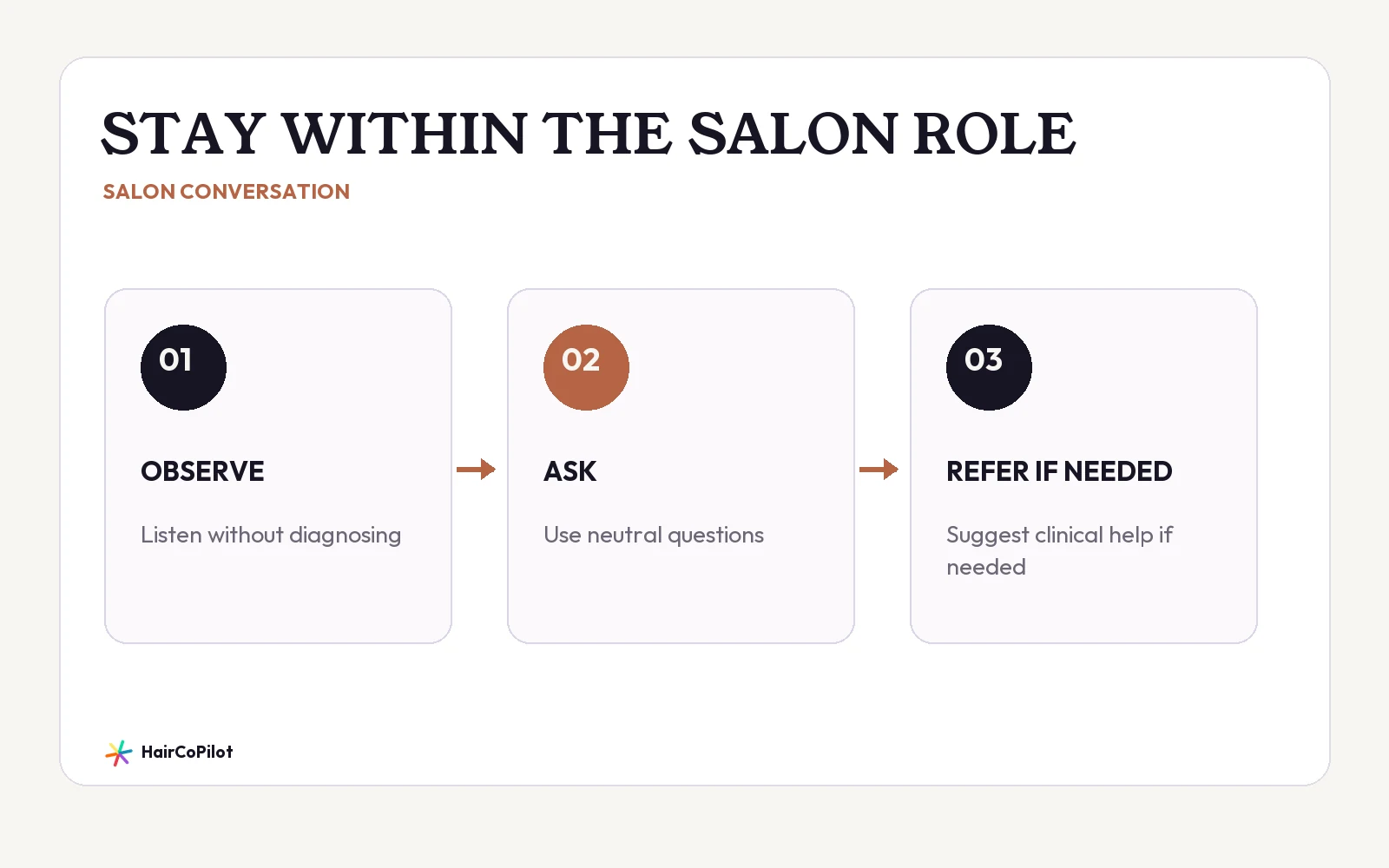
You are not there to diagnose, and the client is not really asking you to. When someone says “my hair is falling out more than usual”, she is usually asking two things at once: is this normal, and should I be worried. A hairdresser can answer neither with a clinical verdict, but can do something more valuable: listen carefully, observe accurately, say clearly what is outside the salon’s role, and point towards a medical assessment when the pattern warrants one. This guide sets out how to hold that conversation in late summer and autumn, when the question comes up most often.
What the evidence actually shows about seasonality
There is real published work behind the idea of seasonal shedding, and it is more specific than the general talk about autumn suggests.
A retrospective study by Kunz, Seifert and Trüeb, published in Dermatology in 2009, analysed trichograms from 823 apparently healthy women who complained of hair loss, after excluding those with a disease or medication known to cause it. It found an annual periodicity, with the maximal proportion of telogen hairs in summer, a second and less pronounced peak in spring, and the lowest telogen rates in late winter (Kunz M, Seifert B, Trüeb RM. Dermatology 2009;219(2):105–10).
The detail that matters for an autumn conversation is what a high telogen proportion in summer implies. A hair that enters the resting phase is not shed on the same day. DermNet notes that shedding typically becomes noticeable two to four months after a triggering event, as new hairs push out the resting ones. Follicles identified as resting in summer are therefore plausibly the hairs a client notices in her brush in September and October. That is a coherent explanation, and it is worth understanding, but it describes a population pattern, not the cause of any individual client’s experience.
A second piece of evidence approaches it from the other direction. Hsiang and colleagues at Johns Hopkins analysed Google search data from eight countries in both hemispheres between 2004 and 2016, and reported in the British Journal of Dermatology that summer and autumn were associated with greater hair loss searching (Hsiang EY, Semenov YR, Aguh C, Kwatra SG. Br J Dermatol 2018;178(4):978–979). The authors were explicit that the physiology behind seasonal variation is not established.
Search interest is what people are worried about, not what is happening on their heads. It suggests when clients are likely to raise the subject. It does not tell you that any particular client’s shedding is seasonal, and repeating it as reassurance is where a well-meant conversation starts to overreach.
What the client is counting, and why the number is unreliable
The most commonly cited benchmark comes from the American Academy of Dermatology, which states that it is normal to shed between 50 and 100 hairs a day, and distinguishes hair shedding, where more hair than usual falls out, from hair loss, where something stops hair from growing in the first place (AAD: Do you have hair loss or hair shedding?).
That figure is useful context and almost useless as a measurement. Nobody counts accurately. More importantly, what a client perceives depends on how often she washes, how long her hair is, whether she has changed her routine, and whether she has started paying attention for the first time. Three days between washes concentrates three days of shedding into one drain.
So do not turn the conversation into arithmetic. What is informative is change, not quantity: whether this is different from her normal, when it started, and whether anything else changed around the same time.
Questions that gather information without implying a diagnosis
The aim is a clear account you can repeat back to her, and that she could repeat to a doctor. Keep the questions open and factual.
- When did you first notice it, and has it been steady or getting worse?
- Where do you notice it most: in the shower, on the brush, on the pillow, on your clothes?
- Has anything changed in your health or your routine in the last six months?
- Have you changed how often you wash or style your hair?
- Is your scalp comfortable, or is there any itching, soreness or flaking?
That six-month window is deliberate. The AAD lists common triggers for excessive shedding including childbirth, a high fever, surgery or illness, significant stress, losing a considerable amount of weight and stopping birth control pills, and notes that shedding typically appears months after the event, usually settling within six to nine months as the hair regains its normal fullness. DermNet adds nutritional deficiency, thyroid disorders and severe illness to the picture. You are not screening for any of these. You are simply asking what changed, so that she can join the dots herself or take a clear account to someone qualified to.
Two habits protect the conversation. Do not offer a cause: “it’s probably stress” is a diagnosis in casual clothing. And do not ask about medical conditions directly. If she volunteers information, listen. If she does not, it is not yours to collect.
What you can legitimately observe at the basin
There are things a stylist sees that a client cannot, and describing them accurately is a real contribution.
Breakage or shedding. Hairs that have shed come away full length with a small pale bulb. Breakage produces short pieces of varying length with blunt or frayed ends, often concentrated where a band, a brush or a heat tool does its work. This distinction is squarely within your expertise, and it changes the conversation completely, because breakage is often something you can actually help with.
Whether it looks diffuse or patchy. Describe what you see, without naming a condition. Even, all-over thinning and a distinct bald area are different observations, and the second one deserves a prompt referral.
Whether the scalp looks irritated. Redness, visible flaking, scabbing or anything the client says is sore or itchy is a reason to suggest she has it looked at rather than a reason to recommend a shampoo.
How the parting reads compared with last time. If you have photographs from previous appointments, taken in the same place under the same light, you have a better record of change over time than memory provides.
Say what you observe, not what it means. “The hairs I’m seeing are coming out full length rather than breaking, and it looks even rather than patchy” is a useful sentence. “That’s telogen effluvium” is not yours to say.
The boundary, stated plainly
A salon does not diagnose hair loss, does not name conditions, does not interpret blood tests, does not recommend medication or supplements, and does not promise regrowth. Nothing sold over a salon counter is a treatment for hair loss, and describing a cosmetic product as though it were is both a clinical overstep and a commercial risk.
That does not leave you with nothing to offer. Cosmetic care can genuinely reduce mechanical stress on fragile hair, improve comb-through so less is pulled out during detangling, keep the scalp comfortable and make hair look and feel denser. Those are honest, deliverable benefits. The framework in our guide to recommending home care without hard selling applies with extra force here: a client worried about her hair falling out is more susceptible to a confident recommendation than almost any other client, which is exactly why the recommendation has to stay inside what the product actually does.
It is also worth thinking about the service itself. Softer detangling, avoiding tight tension, reconsidering a style that pulls at the hairline, adjusting the frequency of chemical services: these are legitimate professional adjustments, and they are often more useful to the client than anything she can buy.
When to suggest a medical assessment
The AAD advises seeing a dermatologist if a client is concerned, and notes that the sooner treatment begins, the better the prognosis. DermNet frames medical assessment as the way to identify underlying causes such as thyroid dysfunction or nutritional deficiency and to distinguish shedding from other forms of hair loss.
In practice, suggest a referral when any of the following is present:
- the shedding has been going on for more than a few months without settling;
- there is a distinct patch rather than an even thinning;
- the scalp is sore, itchy, scaling, or the skin looks shiny or scarred;
- the client reports other symptoms alongside it, or a recent significant change in health;
- she is distressed about it, whatever you see.
That last one is not a clinical criterion and it matters as much as the others. A client who is frightened deserves an answer from someone who can actually investigate.
Phrase it without drama. “I can’t tell you what’s causing this, and I don’t want to guess. What I can tell you is what I’m seeing, and I’d suggest showing it to a doctor or a dermatologist so you get a proper answer. In the meantime, here’s what I’d change about how we handle your hair.” That sentence respects her, respects your role, and gives her something concrete to do.
A salon example
A regular client arrives for a root retouch in early October and says she has been finding hair everywhere since the summer. She is upset. She asks whether she should stop colouring.
The conversation goes in this order. First, the observation: the hairs on the gown are full length with bulbs, not broken pieces, and the thinning she is pointing to at the crown reads even rather than patchy. Second, the timeline: it started in late August, it has not worsened, her scalp is comfortable, and she mentions on her own that she had a heavy few months at work and lost some weight over the summer. Third, the boundary: you do not know the cause and you are not going to speculate, but that timing is worth mentioning to a doctor if it carries on, and if it has not settled by the new year she should book an appointment regardless.
On her actual question: nothing you can see suggests the colour is involved, and you tell her that if she ever notices itching, burning or redness after a service she should mention it to you and to her doctor. This is still not the appointment to add a lengthening or high-tension service. You keep the retouch, skip the blow-dry tension she usually has, and change her home detangling routine.
She leaves with an accurate account of her own situation, a clear threshold for seeking advice, and a service she still wants. Nothing was diagnosed and nothing was promised.
Write it down, then follow it up
The single most useful thing a salon can contribute to a client’s hair concern over time is a consistent record. What she reported, when it started, what you observed, what you changed about the service, and what she said at the next appointment.
That record turns a vague worry into a trend. If at the next visit the shedding has settled, you both know. If it has not, she has a documented six-month account to take to a doctor rather than a guess. Our guide to digital colour records covers keeping structured notes against the client rather than in a notebook, and the same discipline applies to observations that have nothing to do with colour.
One caution on the record itself. Note what the client told you and what you observed, in neutral language, and keep it proportionate to the service. Health information belongs to her, and the note should read like a professional observation, not a medical file.
Frequently asked questions
Is autumn shedding a real thing?
There is published evidence of seasonal variation. Kunz and colleagues found the highest proportion of telogen hairs in summer among 823 women, and DermNet notes that shedding becomes noticeable two to four months after a triggering event; applied to a summer peak in resting hairs, that would place the visible effect in late summer and autumn. A Johns Hopkins analysis of search data across eight countries also found summer and autumn associated with greater hair loss searching. None of this establishes the cause for an individual client.
How much shedding is normal?
The American Academy of Dermatology states that it is normal to shed between 50 and 100 hairs a day. In practice the number is not measurable at home, and a change from the client’s own normal is more informative than any count.
Should I recommend a supplement or an anti-hair-loss shampoo?
No. A salon should not recommend supplements or present a cosmetic product as a treatment for hair loss. Recommend products for what they genuinely do — reduce breakage, improve comb-through, keep the scalp comfortable — and refer anything else.
What do I say if a client asks whether it is stress?
Say you do not know and you do not want to guess. Significant stress appears on the AAD’s list of common triggers for excessive shedding, but identifying the cause in one person is a medical assessment, not a salon observation.
Can colouring cause hair to fall out?
Chemical services can damage and break hair, which is a different problem from shedding at the root and looks different in the basin. The exception is a reaction on the scalp: a severe allergic reaction or a chemical burn can cause hair to come out from the root, so redness, burning, blistering or soreness after a service is a reason to refer her promptly. If a client asks, describe what you are actually seeing on her hair rather than answering in general terms.
Use HairCoPilot in your salon
Observations are only useful if they are still there next time. HairCoPilot keeps the client record and the colour service in one place, so the note you make today about what a client reported is in front of you when she sits back down in six weeks, alongside the formula you used. Start your free trial.