


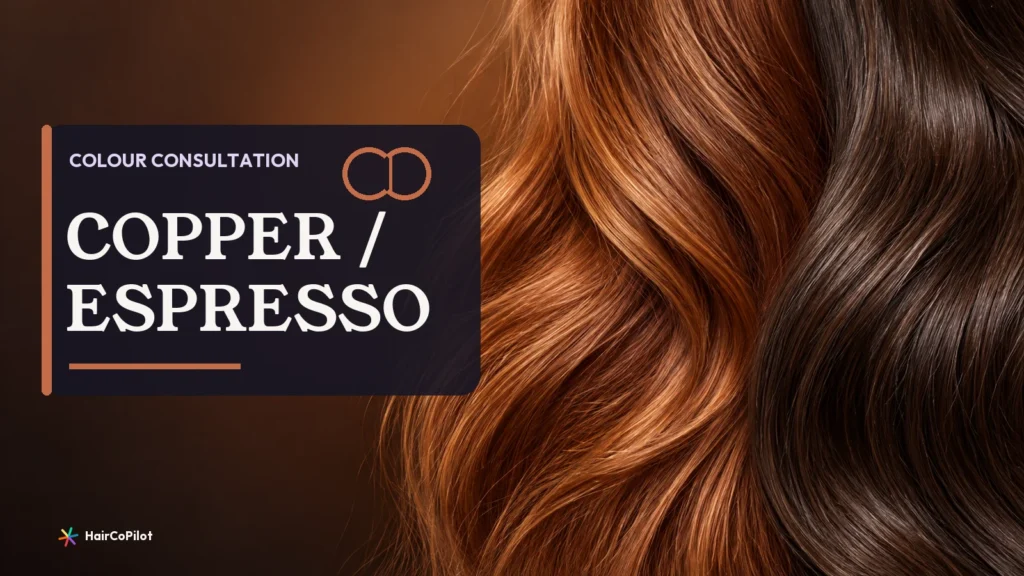
These two directions look like a style choice and behave like a maintenance choice. Copper is a deposit that leaves quickly and needs active upkeep to stay saturated. Espresso is a deposit that stays and becomes a commitment. A client who picks the wrong one for her life will be back in six weeks disappointed, whichever one looked better on the day. This guide sets out how the two behave on different bases, what the regrowth looks like in each case, and how to run the conversation so the decision survives the appointment.
Before anything else, a note on framing. Neither of these is being presented here as the colour of the season. A five-year Google Trends comparison for Italy shows relative interest between search terms, indexed to their own peak, which is not a volume and not a forecast. These are two directions worth being able to discuss well, not two predictions.
What each direction is, visually
Copper is a warm, luminous result built on red-orange reflect. Its appeal is light: it moves, it catches sun, and it makes hair look lively at a level that would otherwise read as ordinary. It sits best in the mid-to-light levels, where there is enough exposed warmth underneath for the reflect to sit on, and it flattens quickly when placed too deep.
Espresso is a deep, saturated brunette with a cool-to-neutral bias and very little visible reflect. Its appeal is density: gloss, weight and a finish that reads polished rather than bright. It sits at the dark end of the scale and its impact comes from surface shine rather than from tonal movement.
They also differ in what they conceal. Espresso hides texture, frizz and unevenness because the eye reads it as one dense surface. Copper reveals everything, because reflect makes the eye follow the hair’s variations rather than its outline.
Compatibility with the base
Copper
Copper needs underlying warmth to sit on and enough lightness to be visible. On a natural level 6 to 8, it is usually straightforward. On a natural level 4, achieving a visible copper means lifting first, which turns a tonal service into a two-part one with everything that follows from it.
On pre-lightened hair, copper is easy to achieve and hard to keep, because pale hair takes the deposit readily and releases it just as readily.
The other consideration is what is already there. Copper over a cool toner produces a muddier result on first application than the client expects, and on hair carrying an old ash deposit it can be actively difficult to get clean. Set that expectation in advance rather than explaining it afterwards.
Espresso
Espresso is technically the easier direction: depositing depth is forgiving, and almost any base can accept it. The difficulty is entirely in what it commits the client to.
Depositing a deep tone over previously lightened hair means that returning to lighter is not a colour appointment but a correction, because permanent deposit does not come out the way it went in. A client who has been blonde for years and is “trying something darker for the winter” needs to be told, in one plain sentence, what the route back looks like before the bowl is mixed.
The underlying pigment behaviour behind both directions is covered in our guide to professional colour theory, which is worth revisiting before a consultation that involves going deep on pre-lightened hair.
Regrowth: the difference nobody anticipates
This is where the two diverge most sharply, and it is the argument that most often settles the consultation.
Copper on a mid-level base grows out gently. The contrast between a natural level 6 and a copper level 7 is small in depth even though it is large in tone, so the line reads as a softening rather than as a band. Copper’s maintenance problem is fade, not regrowth.
Espresso on anything lighter than itself grows out hard. The contrast between a natural base and a deep deposit is maximal, and the line appears on a fixed schedule with no ambiguity about it. Espresso’s maintenance problem is the root, and it is a recurring appointment rather than a product.
So the two directions fail in opposite ways. Copper disappoints by going pale. Espresso disappoints by showing a line. Which failure a client can live with is more predictive than which photograph she prefers.
Fade and home care, sourced
Wella’s own guidance is direct about red and copper tones: it states that red “tends to fade fast” and explains one mechanism plainly — “hot water can open the hair cuticles, allowing red pigments to escape” (Wella, How to maintain red hair). Its recommendations are cooler rinsing water, colour-depositing masks to revive the tone between appointments, heat protection before styling, and UV protection, with the brand noting that few things fade red faster than heat from the sun and from styling tools.
The general fade guidance is consistent with that. Wella states that “every time you wash your hair, water causes the hair shaft to swell and the cuticle to slightly lift, allowing color molecules to escape”, and recommends washing no more than two to three times a week, using lukewarm rather than hot water, and protecting against UV and heat (Wella, How to avoid hair colour fading).
Those are manufacturer recommendations and they apply to both directions, but their weight is different. For espresso, the fade shows as dullness and a loss of shine, which a client tolerates. For copper, fade is the failure mode, and a client who washes daily in hot water will lose the result she paid for within a fortnight.
Which makes the home care conversation part of the colour decision rather than an add-on afterwards. A colour-depositing mask is not an upsell on a copper client; it is the thing that keeps the service looking like the service. The framework in our guide to recommending home care without hard selling covers how to say that without it sounding like a sales pitch — and the honest version is simply that you are telling her what the result requires.
A salon example
A client at a natural level 6 with no previous colour brings two reference images: one copper, one very deep brunette. She says she cannot decide and asks which would suit her.
The useful answer is not about her skin tone. It is three questions.
How often does she wash her hair, and how hot? Daily, hot, and she blow-dries every morning. That is a copper client who will be unhappy in three weeks unless she changes the routine or commits to a depositing mask.
How does she feel about roots? She stretches her appointments to ten or twelve weeks and says she hates the “line”. That rules espresso out almost entirely on a level 6 base, because at week ten the contrast will be obvious.
What does she want people to notice? She says shine.
Copper on a level 6, close to her natural depth, is the answer that fits all three, with one condition made explicit: cooler rinses and a depositing mask, or the tone will not hold. She is told, in advance, that it will fade and that fading is normal for this direction rather than a fault in the service. That single sentence is what turns a fade from a complaint into an expected event.
What to say about the limits
Three sentences, adapted to whichever direction is chosen.
For copper: this will fade faster than other colours, that is how the pigment behaves, and keeping it saturated depends more on how you wash it than on what I do today.
For espresso: this is easy to do and much harder to undo, and if you want to be lighter again later, that is a correction rather than another colour appointment.
For both: the reference photograph was taken on someone else’s starting point, in someone else’s light, and the result we agree on is a direction rather than a match.
Record what was chosen and why
The formula matters, and so does the reason. Record the direction agreed, the client’s washing routine as she described it, and what she was told about fade or regrowth, because the next appointment is a review of whether the prediction held. A copper client who reports that the tone lasted four weeks rather than two has told you something useful about her hair, and that only has meaning if the earlier expectation was written down.
Frequently asked questions
Which fades faster, copper or espresso?
Copper. Wella’s guidance states that red tends to fade fast, and explains that hot water can open the cuticle and allow red pigments to escape. Espresso loses richness and shine over time rather than disappearing.
Can a client go from espresso back to blonde?
Not as a straightforward colour appointment. Permanent deposit does not lift out with colour, so returning to a lighter result is a correction service. Say so before the first deep application, not afterwards.
Does copper suit dark natural bases?
It can, but it needs lift first to be visible, which turns a tonal service into a two-part one. On a very dark base, a warm reflect without lifting will read as depth rather than as copper.
What home care actually matters for copper?
Per Wella’s own guidance: cooler rinsing water, washing less frequently, colour-depositing masks between appointments, heat protection before styling, and UV protection. Washing habits affect a copper result more than almost anything else.
Use HairCoPilot in your salon
A colour direction is a prediction about how the next six weeks will go. HairCoPilot keeps the formula — line, shade, quantities, developer and processing time — in the client record, so at the next appointment you can compare what you used with what actually happened. Start your free trial.