


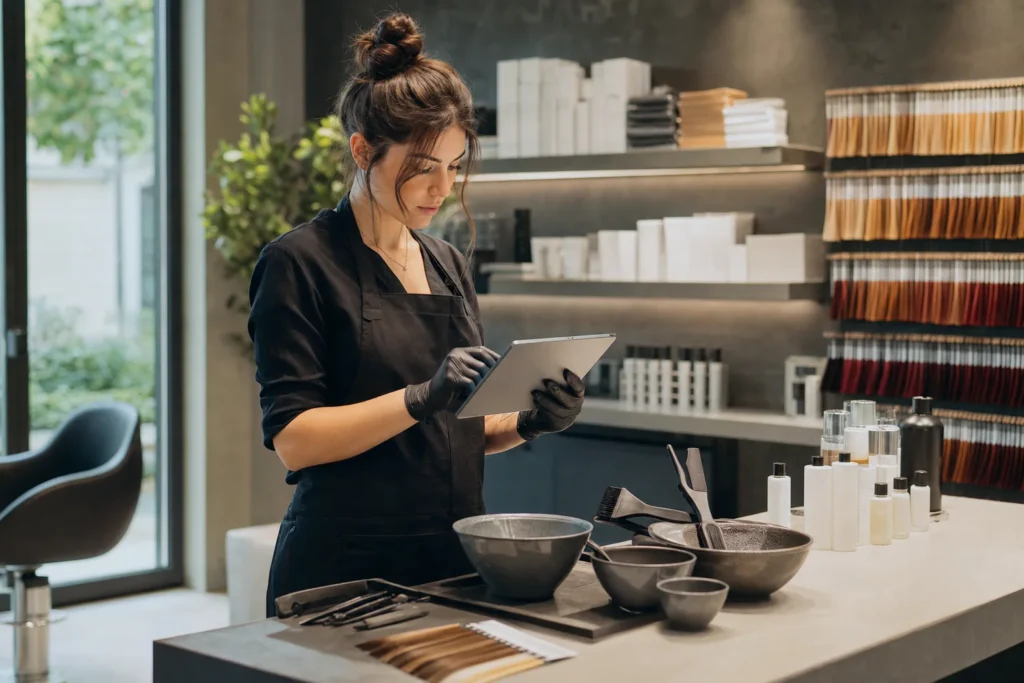
Hair colour formula management is the system that connects what the colourist learned in consultation with what was mixed, applied, processed and observed. A formula without context is only a recipe. A useful record explains why that route was chosen and what should happen at the next visit.
Reliable records improve continuity, team handovers and professional learning. They also reduce the time spent asking a returning client to reconstruct months or years of colour history.
Why a formula alone is not enough
Two clients can receive the same written mix and achieve different results because their starting level, previous colour, porosity, density, product build-up, condition and application are different. Even the same client can respond differently after sun exposure, home colour, a change in maintenance or a longer interval between visits.
A complete formula record needs four connected layers:
- Starting point: what the colourist observed and verified.
- Agreed plan: the desired direction, limits and maintenance route.
- Technical execution: what was actually mixed and done.
- Outcome: what happened, what changed and what to do next.
What to record before mixing
Capture enough context for a qualified colleague to understand the decision later.
- Natural and cosmetic starting level, tone, regrowth and visible banding.
- Relevant professional and home colour history.
- Hair condition, porosity, elasticity, density and areas of concern.
- Required consultation, allergy-alert and strand-test information according to current professional protocol and product instructions.
- The client’s goal, reference images and features they want to avoid.
- The agreed service route, realistic result, time, price range and maintenance.
Use a consistent set of fields, but leave room for professional notes. A rigid form that cannot describe an unusual situation encourages people to put important context somewhere else—or not record it.
Record the formula so another professional can read it
The exact fields depend on the product system, but a salon record commonly needs:
- Brand or product line and exact shade identifiers.
- Quantity of each component, mixing ratio and developer.
- Separate formulas for regrowth, mid-lengths, ends, lowlights, highlights, toner or gloss.
- Application sequence, placement or sectioning notes where they affect the result.
- Start and finish times, processing conditions and checks.
- Treatments, preparation or removal steps used as part of the service.
- Adjustments made during the appointment and the reason.
Follow the manufacturer’s current instructions rather than relying on an old record when a product or protocol changes. The record documents the service; it does not override professional training or product guidance.
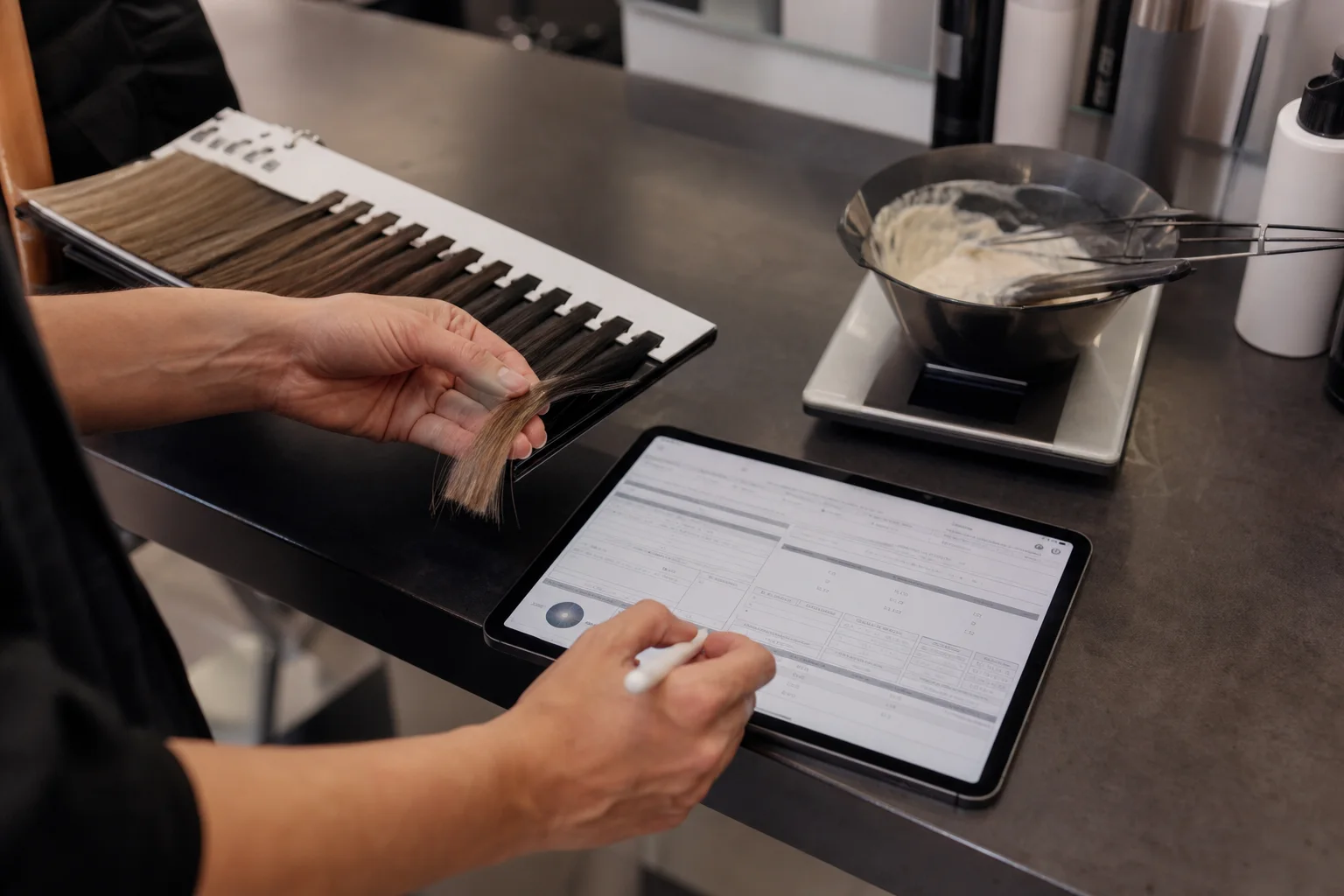
Document the observed result
The finished result is where the formula becomes knowledge. Record under consistent lighting where possible:
- Final level, tonal direction and coverage.
- How resistant, porous or previously coloured areas responded.
- Any difference between the planned and achieved result.
- Client feedback and the agreed home-care route.
- Recommended return window and the next likely service.
- What the colourist would repeat, reduce or change.
Add photographs with appropriate client consent and enough context to compare later. Avoid judging colour only from a filtered social image; keep a technical reference as well as a marketing image.
Use version history instead of overwriting
When a formula changes, preserve the previous version. The adjustment is often the most valuable part of the record: it shows how the hair responded and why the colourist changed direction.
A clear visit timeline might show:
- Consultation and starting assessment.
- Planned formula and service route.
- Formula actually used.
- Processing and adjustments.
- Observed result and photographs.
- Care and next-visit recommendation.
This is easier to review than a single note field where years of entries are repeatedly edited.
Build a handover that protects continuity
A client record belongs to the salon’s service system, not one person’s memory. If another colourist needs to continue the work, they should be able to see the history while still carrying out their own assessment.
- Use the same naming convention for products and service zones.
- Make required fields clear without forcing irrelevant data.
- Record uncertainty explicitly instead of presenting a guess as fact.
- Keep personal opinions out of the record; use observable professional language.
- Limit access to authorised people and review permissions when team roles change.
Common formula-management mistakes
Copying the last formula without reassessment
The previous formula is evidence, not an instruction. Check the current starting point, interval, condition and client goal.
Recording only shade codes
Without quantity, developer, placement, timing and outcome, another professional cannot reliably interpret the result.
Saving the plan but not the reality
If the colourist adjusted the mix or timing and fails to update the record, the next visit begins from incorrect information.
Keeping records in several disconnected places
Paper notes, private phone photographs and unstructured messages make the history difficult to retrieve and govern. Choose one primary record and define how supporting material is attached.
A practical salon implementation
- Audit ten recent colour records: identify which details were missing at the return visit.
- Define the minimum record: starting point, formula, processing, outcome and next step.
- Create product conventions: agree how shades, ratios, zones and adjustments are written.
- Pilot with one service: use the form for four weeks and review completion at checkout.
- Improve the fields: remove questions nobody uses and add context that repeatedly matters.
- Review access and retention: align the record with the salon’s privacy obligations and operational needs.
How HairCoPilot supports formula continuity
HairCoPilot is designed to connect the client’s consultation, formula history, care and return visit. The aim is not to turn professional colour into a static recipe. It is to make the reasoning and result easier to retrieve so the colourist starts the next appointment with context.
Read HairCoPilot as a formula assistant, then continue with our guide to digital hair colour records.
Frequently asked questions
How long should a salon keep colour formula records?
Retention depends on the salon’s legal, insurance, product and privacy requirements. Define a documented retention schedule for your market rather than keeping everything indefinitely or deleting records inconsistently.
Should formula records include photographs?
Photographs can improve comparison when the salon has an appropriate purpose and client consent. Use consistent lighting, protect access and record whether an image is a technical reference, marketing asset or both.
Can AI generate a hair colour formula?
AI can organise information or suggest possibilities, but the colourist remains responsible for assessment, testing, product instructions, formula and outcome. Treat suggestions as inputs to professional judgement.
Turn every appointment into better information
Strong hair colour formula management creates a learning loop: consultation informs the formula, the service produces evidence and the observed result improves the next decision. Record the context, not just the mix, and the salon gains continuity without reducing professional creativity.
Explore HairCoPilot for salons and use our consultation checklist to strengthen the information captured before mixing.