



The December problem is not demand. It is that demand arrives in a shape the diary cannot absorb, and that January arrives empty because nobody booked it while they were in the chair in December. Everything that follows is an operational answer to those two facts. There are no discount tactics here, because discounting a period that is already busy costs money without solving the constraint, and because a promotion that fills December at the expense of January makes the actual problem worse.
Start from capacity, not from marketing
Before deciding what to offer, work out what you can physically deliver. Three numbers, taken from your own diary rather than from an average.
How many colour hours you have. Count actual available chair hours per colourist for each week from mid-November to the end of December, after removing holidays, training and the days the salon is closed. This is your ceiling and it will be lower than you assume, because December usually loses two or three working days that are still in the month.
How long your colour services actually take. Not what the booking system says, but what they take. Most salons under-book at least one service by fifteen or twenty minutes, and in a normal month that is absorbed by the gaps. In December there are no gaps, so a systematic fifteen-minute underestimate becomes an hour of overrun by mid-afternoon and a client kept waiting by five o’clock.
Spend an ordinary week in November recording actual start and finish times for colour services. It is the single highest-value hour of admin in the season.
How much of that capacity is already committed. Regular clients on a fixed rhythm will occupy a large share of December before any new booking arrives. Knowing that share tells you how much you actually have to sell, which is usually far less than the empty spaces in the diary suggest.
Our guide to salon management as an operating system covers the underlying practice; this is the seasonal application of it.
Decide which services fit the season, and which do not
Not every service belongs in a December diary, and saying so in advance is a management decision rather than a refusal.
Services that fit. Predictable-duration work with a reliable outcome: root retouches, toning and glossing services, cuts with a finish, anything a client books because she has an event. These are the backbone of the period, they slot into known time blocks, and they rarely overrun.
Services that need protecting. Long transformations, corrections and full transitions. They are valuable, but they are also the services most likely to overrun and the ones where a rushed outcome is most damaging. If you take them in December, take them at the start of the day and at the start of the week, not at four o’clock on the 23rd.
Services to decline or defer. A correction with an unknown history, booked into an hour and a half, three days before Christmas, is a decision to have a bad week. It is entirely reasonable to offer the client a consultation now and the appointment in January, and it is better for her than a compromised result.
That deferral is not lost revenue. It is January revenue, which is the thing you are short of.
Build the November-to-January timeline
Work backwards from the dates rather than forwards from today.
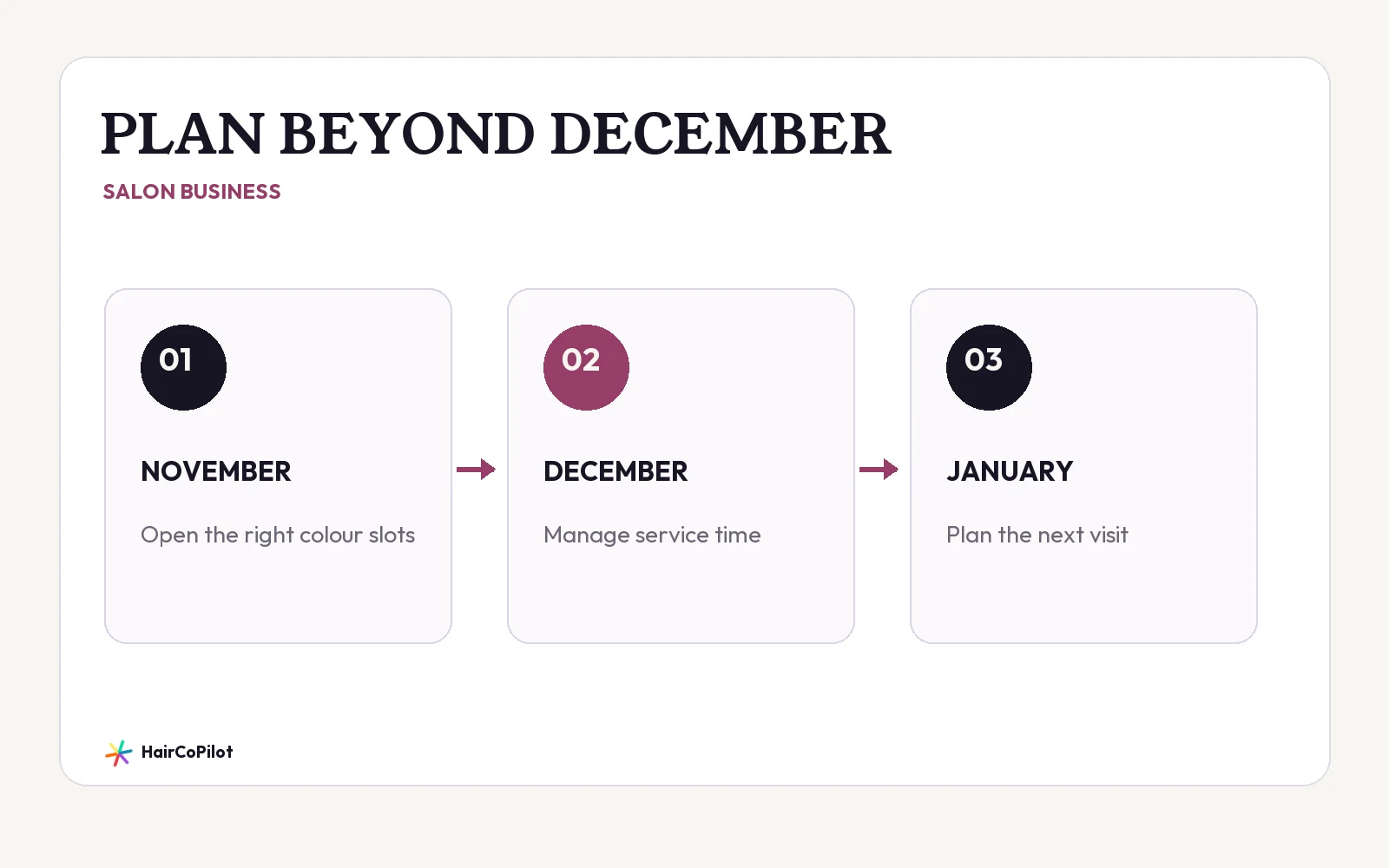
Early to mid-November. Measure actual service durations. Confirm which regular clients need a December appointment and contact them first, before the diary fills with occasional bookings. This is the highest-yield outreach of the entire season and it is not marketing, it is a list.
Mid to late November. Open the December diary properly and make availability visible. Clients who cannot see what is available assume there is nothing, and book elsewhere. Decide which slots are protected for long services and hold them rather than letting them be filled by short ones.
Early December. Stop taking new long services beyond a cut-off you set now, and communicate it. Start every appointment’s closing conversation with the January question, because from this point every client in the chair is a January booking opportunity.
Mid to late December. Protect the team. Overruns compound, breaks disappear and errors increase; a fifteen-minute buffer built into the afternoon costs less than one rushed correction. Keep the retail conversation relevant rather than seasonal for its own sake.
Late December to early January. Review what happened while it is fresh: which services overran, which slots went unfilled, how many January appointments were booked in advance, and where the diary broke. Next year’s plan is written now, not next November.
Communicate availability rather than urgency
Most holiday salon communication tries to create urgency. The clients who respond to urgency are already booking. The clients you actually want to reach are the ones who assume you are full.
So the message worth sending is factual: these are the weeks that still have colour availability, these are the services that fit into them, and this is the last date for longer work. That is more useful than a countdown, and it converts better, because it answers the question the client is actually asking.
Two practical points. Say the last dates explicitly, including the last date for a long colour service, which is usually two to three weeks before the ones clients assume. And be specific about what you cannot do, because a client who books a two-hour transformation expecting a four-hour result creates a problem for everyone.
If you are sending reminders and confirmations manually, this is the season where that stops scaling. Our guide to salon automation workflows covers the sequences worth setting up before the volume arrives rather than during it.
Retail, without inventing offers
Holiday retail works when it is an extension of the service conversation and fails when it is a display. The rule that holds all year holds harder now: recommend from the diagnosis.
What changes in December is the reason for the purchase. Some clients are buying for themselves ahead of an event, some are buying as gifts, and those are different conversations. The gift conversation in particular needs care, because the buyer is not the user and the recommendation has to be robust to that — which is a topic in its own right and one worth treating separately rather than improvising at the till.
What to avoid: bundling products into sets that do not go together, discounting to move stock that was over-ordered, and any offer that trains regular clients to wait for December. A promotion you cannot repeat sustainably is a cost you have deferred, not revenue you have gained.
Make January a measurement, not a hope
January is built in December, in the last two minutes of each appointment. That is the entire mechanism, and it works only if it is systematic.
The metric is simple: what proportion of clients seen in December leave with a January appointment booked. Measure it weekly, by stylist, from the first week of December, because a rate you only discover in January is a rate you cannot influence.
What moves it is not persuasion. It is connecting the next appointment to the colour goal the client has already agreed to: when the tone will need refreshing, when the regrowth will show, when the service you have both planned needs to happen. A client who understands why the date is that date books it. A client who is asked whether she would like to book something feels sold to.
The retention systems in our guide to client retention apply here directly, and the seasonal version is simply that the conversation has to happen in December rather than being deferred to a message in January when the client has already moved on.
The numbers to review afterwards
Four, and they should be looked at together rather than separately. Our guide to salon KPIs covers each in full; the seasonal reading is:
- Utilisation through the period: how much of the available capacity was actually sold, by week and by stylist.
- Rebooking rate in December, which is the leading indicator for January.
- Average service duration against booked duration, which tells you whether the diary is realistic or optimistic.
- January’s opening position: how many appointments were on the books on 1 January compared with the same point last year.
The last one is the measure that matters most and the one least often recorded, because by the time anyone looks at January it is already happening.
A salon example
A three-chair salon reviews its previous December and finds two things. Colour services ran on average twenty minutes over their booked time, which produced a cumulative delay of over an hour by mid-afternoon on the busiest days. And the first two weeks of January had a 40% lower booked position than the first two weeks of December, because rebooking conversations stopped once the salon got busy.
The plan that follows is not promotional. Booked durations for the three most common colour services are increased by twenty minutes from mid-November. Two long-service slots per week are held and not released to short bookings. A cut-off date for long colour work is set and communicated in the first week of December. And the rebooking conversation is made a fixed part of the closing routine, with the rate reviewed every Monday.
None of that requires a discount, a campaign or new software. It requires the diary to describe reality and the last two minutes of each appointment to be used.
Frequently asked questions
When should the December diary open?
Practically, once actual service durations have been measured and regular clients have been contacted — typically mid to late November. Opening it before durations are corrected means building the busiest month of the year on optimistic timings.
Should we run a holiday promotion?
Only if it solves a problem you actually have. December is usually capacity-constrained rather than demand-constrained, so a discount on an already-full period reduces revenue without increasing bookings. If a promotion is worth running, aim it at the empty weeks in January.
Is it acceptable to turn away a correction in December?
Yes, and it is better for the client than a rushed result. Offer the consultation now and the appointment in January, which protects the outcome and fills the month you are short of.
What is the single most useful number to track?
The proportion of December clients who leave with a January appointment booked, reviewed weekly rather than at the end of the month.
Use HairCoPilot in your salon
A December diary works when the next appointment is connected to the colour plan rather than guessed at. HairCoPilot keeps the formula and the client record together, so the stylist closing the appointment can see what was done and what comes next. Start your free trial.