


Hair salon marketing becomes expensive when every quiet week triggers a new promotion. A post is boosted, a discount is created and the team waits to see whether the diary moves. That activity can produce attention, but it rarely creates a dependable system.
A stronger plan starts with the right client, a clear reason to choose the salon and a simple path from discovery to consultation, booking, result and return visit. The best low-cost strategies work because they reuse trust the salon is already creating every day.
Define the right client before choosing a channel
The ‘right client’ is not everyone who could book a haircut or color service. It is the person whose goals, maintenance expectations, budget and timing match the salon’s strongest work.
- Which services do you want to grow, and which clients receive the best result from them?
- What problem or desired outcome causes those clients to search now?
- What concerns stop them from booking: trust, price uncertainty, maintenance, previous damage or availability?
- What proof would reduce that uncertainty: consultation explanation, before-and-after work, reviews or transparent maintenance guidance?
Write one short client-and-service statement for each campaign. For example: ‘Professionals with previously colored hair who want a dimensional, lower-maintenance result and need a consultation before committing.’ This is far more useful than targeting ‘women aged 25-55 interested in beauty.’
Build the local foundation first
Google explains that local results are mainly based on relevance, distance and prominence. A salon cannot change where a potential client is standing, but it can improve how clearly Google and the client understand the business.
- Keep the Google Business Profile name, category, address, phone, hours and booking link complete and accurate.
- Use the most specific primary category that correctly describes the business and add relevant services.
- Publish real, consistent photos of the salon, team and work with documented client consent.
- Ask for honest reviews at an appropriate moment and respond to them professionally.
- Make sure the website clearly explains services, location, consultation and how to book.
Google states that businesses cannot request or pay for a better local ranking. Complete information, helpful reviews, links and the business’s wider prominence contribute to visibility. Treat the profile as an operating asset, not a one-time setup.
Marketing principle: Do not measure a salon campaign by reach alone. Measure whether the right clients booked the right services, attended, returned and referred someone else.
12 low-cost hair salon marketing strategies
1. Turn the Google Business Profile into a booking page
Review the profile monthly. Update special hours, services, booking links and photos. Read the questions clients ask in reviews and messages; those questions should also be answered on the website and in consultation content.
2. Ask for reviews with context
A generic ‘leave us a review’ request is easy to ignore. Ask after the client has seen the finished result and understands the maintenance plan. Make the link easy to use, never offer incentives that violate platform rules, and never tell clients what rating or wording to use.
3. Create proof, not just pretty pictures
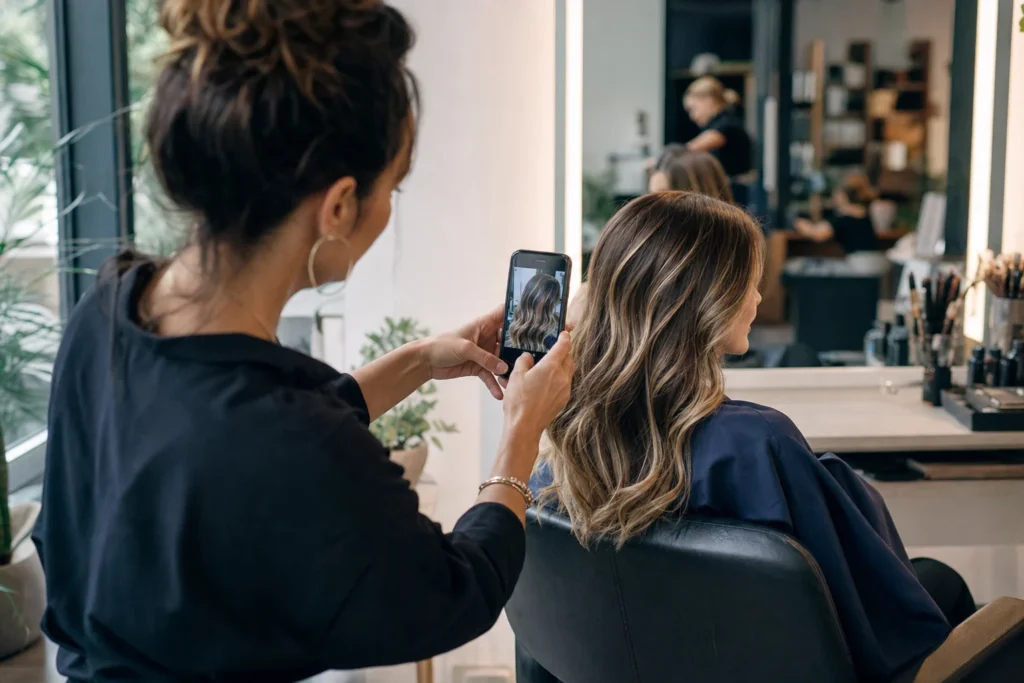
A strong before-and-after post explains the starting point, goal, limits, consultation decision and maintenance. That context demonstrates expertise and helps future clients recognize whether the service is right for them.
Use consistent lighting and framing. Obtain permission that covers the channels where the images will appear, and follow local privacy rules. Store the consent with the client record rather than relying on memory.
4. Answer one consultation question every week
Build a recurring content series from real questions: Can this be done in one visit? How often will it need maintenance? What should a client disclose about previous color? What changes the price? One useful answer can become a blog section, a short video, an email and a consultation script.
5. Market the next visit before the client leaves
Rebooking is marketing because it converts a successful service into a planned relationship. Explain the recommended timing and why it protects the result. Give the client an option to book, set a reminder or receive a follow-up instead of using pressure.
Zenoti’s 2026 salon report says new guest visits declined across salon segments and describes retention as a primary growth engine for top performers. Acquisition still matters, but it becomes far more valuable when the return journey is designed.
6. Build a referral moment into the experience
Referrals happen when the client can easily describe who the salon is right for. Give the team a natural line such as: ‘If you know someone trying to solve the same maintenance problem, we are happy to start with a consultation.’ If you use a reward, protect margin and follow local promotion rules.
7. Segment the client list by need, not only age
Useful segments reflect service behavior: consultation completed but not booked, maintenance due, new client not yet returned, inactive loyal client, retail recommendation due for replacement, or a specific service interest. Send fewer, more relevant messages and respect consent and unsubscribe requirements.
8. Create small seasonal service stories
A seasonal campaign should solve a timely problem, not simply announce a discount. Examples include lower-maintenance color before holidays, repair and reset after summer exposure, event-ready consultation windows or a back-to-work refresh. Define capacity before promotion so the offer does not overload the team.
9. Partner with one local business that shares the client
Choose a complementary business with a similar standard and audience: bridal, photography, fashion, wellness or hospitality. Start with useful content, a client event or a referral protocol. Avoid partnerships based only on exchanging social posts.
10. Give each stylist one repeatable content role
A salon does not need every team member to become a creator. One person can capture before photos, another can explain home care, another can answer consultation questions and another can collect recurring client language. A shared process reduces the burden and keeps the brand coherent.
11. Reuse one expert idea across four formats
Start with a substantial answer. Turn it into a blog or Content Hub resource, a short social post, a consultation checklist and an email. Reuse the idea, not the exact block of text. Each format should help the client take the next step on that channel.
12. Follow up on unbooked consultations
A client may need time, a strand test, budget clarity or a different plan. Record the reason and agree on the next action. A short, personalized follow-up is more useful than placing every lead into the same automated sequence.
A practical 30-day hair salon marketing plan

Week 1 – Foundation
- Define one priority service and the right-client statement.
- Audit the Google Business Profile, website service page, booking path and contact details.
- Create a simple source field in the booking or consultation process: How did you hear about us?
Week 2 – Proof
- Publish one detailed before-and-after case with consent and maintenance context.
- Ask five suitable recent clients for an honest review using the direct review link.
- Answer one high-intent consultation question on the website and social channels.
Week 3 – Relationship
- Identify clients due for maintenance and send a relevant, permission-based reminder.
- Create one referral message for the priority service.
- Contact one local partner with a specific useful collaboration idea.
Week 4 – Review
- Count inquiries, consultations, bookings, attended appointments and rebookings by source.
- Compare the service capacity promoted with the capacity actually sold.
- Keep the two activities that created qualified bookings; improve or stop the rest.
Measure the booking journey, not vanity metrics
Likes and reach can help diagnose content, but they are not the business result. Use a small marketing scorecard:
- Qualified inquiries by source.
- Consultation booking rate and consultation-to-service conversion.
- Show rate and cancellation rate.
- New-client return rate within the expected maintenance window.
- Average ticket and contribution from the promoted service.
- Referral bookings and review growth.
- Marketing spend divided by new clients who attended, not merely leads collected.
Google’s guidance on helpful, people-first content recommends original, substantial information that demonstrates experience and helps the reader complete a goal. For a salon, real consultation knowledge and clearly explained decisions are a stronger long-term asset than mass-producing generic trend posts.
Content quality check: Before publishing, ask: Is this advice specific enough for a salon professional to use? Does it demonstrate real consultation or service knowledge? Does the title accurately describe the page? Can the reader take the next step without searching again?
Frequently asked questions
What is the most effective marketing for a hair salon?
The most effective mix usually combines local search visibility, proof of results, reviews, referrals and a designed return journey. The right mix depends on the salon’s service focus and available capacity.
How can a salon market itself with a small budget?
Start with assets already produced by the business: consultations, results, client questions, reviews and local relationships. Improve the booking path and measurement before buying more reach.
How often should a salon post on social media?
Choose a schedule the team can sustain without reducing service quality. One useful, specific piece each week is more valuable than frequent generic posts. Measure inquiries and bookings, not consistency for its own sake.
Should a salon use discounts to attract new clients?
Discounts can create demand, but they can also attract clients who do not fit the intended service or remove the margin needed to deliver it well. If you use an offer, define the service scope, capacity, target client and expected return behavior first.
Make marketing part of the salon system
Low-cost salon marketing is not free; it uses attention, team time and client trust. Treat those resources with the same discipline as product and chair time. Define the client, publish useful proof, make booking easy and connect every successful first visit to a thoughtful return journey.
HairCoPilot helps color-led salons keep consultation, formula history, care and return visits connected. Explore HairCoPilot for salons at HairCoPilot for salons.