


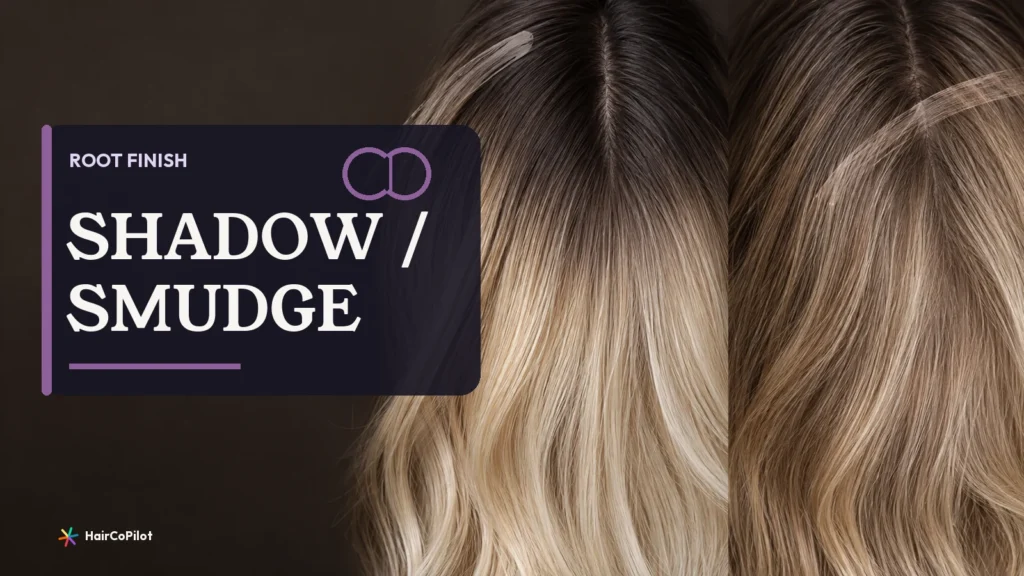
Start by admitting the problem: these two terms are not standardised. Educators, brands and stylists use root shadow, root smudge, root melt and shadow root in overlapping and sometimes contradictory ways, and no definition in this article will override what a colleague was taught on a different course. What is standardised is the outcome: a root area that is deeper than the lengths and transitions without a visible line. This guide sets out a workable distinction, then focuses on the decisions that actually change the result, which are depth, placement and transition rather than vocabulary.
What the terms usually mean
The most useful published definition comes from Wella, which describes a shadow root as “a darker and gently diffused root area, creating a contrast against the mid-lengths and ends of your client’s hair”. The same guidance acknowledges that shadow and smudge are often used interchangeably and offers a distinction based on subtlety: smudge applies where the crown shade closely matches the mid-lengths, while shadow is the broader term covering both subtle and stronger contrasts. It also notes the lengths sitting at least two levels lighter than the root for a shadow.
That gives a practical split worth adopting, provided you state it rather than assume it.
Root smudge is a blending action. It has little or no contrast of its own, and its job is to dissolve a line that already exists — typically where fresh foils meet natural hair at the scalp. The product used is usually close to the natural base or to the toned lengths, applied at the scalp and feathered down a short distance, often during or immediately after the toning step.
Root shadow is a design element. It has deliberate contrast, and its job is to create depth that was not there before, usually to give the lengths something to be bright against. It sits deeper than the lengths on purpose, extends further down, and is a decision about how the hair looks rather than a repair to a boundary.
In shorthand: a smudge hides a transition, a shadow creates one.
The four decisions that determine the result
Whatever you call it, four variables decide what the client sees.
Depth
How much deeper than the lengths is the root going to sit? A half-level difference reads as softness. A two-level difference reads as a deliberate root. Three or more begins to read as a separate colour, which can be exactly right on a high-contrast look and completely wrong on a client who asked for “natural”.
The trap is choosing depth against the target tone in your head rather than against the lengths as they will be after toning. If the lengths lift brighter than planned, a root you chose in advance becomes heavier than intended. Decide the root depth after the lightening result is visible, not before.
Placement: how far down
A smudge that travels a centimetre reads differently from one that travels five. Further down means a longer, softer gradient and a root that stays acceptable for longer as it grows, but it also means more of the expensive lightened hair is being covered.
That trade-off is worth stating to the client, because it is the one that affects how the service looks in week eight, and it is the one clients never anticipate.
The transition itself
This is where the technique lives. A sharp application line, however soft the colour, produces a visible band. The transition is made by how the product is applied and moved — feathered, diffused, worked down with the side of the brush or with fingers — and by giving it somewhere to go rather than stopping abruptly.
One practical point: transitions made against wet, freshly toned hair behave differently from those made against dry hair, because the product spreads further than you intend. Know which you are working on.
Opacity
A translucent deposit lets the lightened hair underneath show through, so the root reads as a shadow in the literal sense. An opaque deposit blocks it, and the root becomes a colour. Demi-permanent products at low developer strength are the usual tool for the first; permanent colour at the scalp is the usual tool when grey coverage is also required, and that combination changes the whole job.
If grey coverage is in the brief as well as a shadow, you are doing two things at once with conflicting requirements: coverage wants opacity, shadow wants translucency. Solve it by accepting that the root will read as a colour rather than a shadow, and design the contrast accordingly, instead of pretending both are achievable in one application.
How to choose, in consultation
Three questions settle it.
Is there a line, or is there a flatness? A visible boundary where foils stop is a smudge problem. Lengths that look uniformly bright and one-dimensional from root to tip are a shadow problem. They have different causes and the same client may describe both as “my roots look wrong”.
What does the client want the grow-out to do? This is the strongest argument for a root shadow and worth making explicitly. A root that is already deeper than the lengths has far less contrast against new natural growth, so the grow-out is softer and slower to become obvious. Clients who stretch their appointments benefit disproportionately.
How much brightness can she afford to lose? A deep, long shadow on a client whose whole reason for being blonde is the brightness at the front is a service she will not enjoy, even if it is technically excellent. Ask where she wants the light to be.
If the underlying pigment logic behind the root deposit is something you want to revisit — particularly when going deeper on pre-lightened hair, where the result can turn dull or ashy — our guide to professional colour theory covers what you are depositing onto.
A salon example
A client comes in six weeks after a full head of foils. She likes the brightness, but says her roots look “stripy” and asks whether she needs the whole head done again.
What is actually visible is a hard boundary about a centimetre from the scalp where the previous foils stopped, with natural level 6 above it and level 9 below. There is no lack of dimension in the lengths; there is a line.
That is a smudge, not a full head. The service is a deposit close to her natural base applied at the scalp and feathered down through the boundary, blending the two into a gradient rather than a step. The time and cost are a fraction of a full head, and the result addresses exactly what she complained about.
The second part of the conversation is the one that matters for next time. If she had a deeper root shadow built in at the last appointment rather than foils taken to the scalp, this line would not have formed in the same way. She books that for the next visit, having seen the problem it solves rather than being sold a technique by name.
Maintenance, and what to tell her
A deposited root fades. On pre-lightened hair a demi-permanent deposit softens over a defined number of washes, so a root shadow typically becomes lighter and less defined before the new growth becomes visible. That is usually a pleasant fade rather than an ugly one, and it is worth describing so she is not alarmed by it.
The point to be clear about is that a shadow or a smudge does not stop regrowth. It changes how obvious regrowth is. A client who hears “this will make your roots grow out better” and understands “this will delay my appointment indefinitely” will be disappointed on her own timetable.
Record the depth, not just the shade
The detail that makes a root service repeatable is not the shade number. It is the depth relative to the lengths, how far down it travelled, what the lengths were at the time, and how long it was left on. A shade code alone tells the next stylist almost nothing, because the same code produces a different result against different lengths.
Our guide to colour formula management covers what to capture, and the same principle applies here with one addition worth making a habit: note the application distance. It is the single most repeatable variable in the service and the one most consistently lost between appointments. Keeping it with the rest of the colour record is what turns a good result into one you can reproduce.
Frequently asked questions
Is a root smudge the same as a root shadow?
The terms overlap and are used interchangeably across the industry. Wella’s guidance distinguishes them by subtlety: smudge where the crown shade closely matches the mid-lengths, shadow as the broader term covering subtle and stronger contrasts. A workable rule is that a smudge blends an existing line and a shadow creates deliberate depth.
How much deeper than the lengths should a shadow root be?
It depends on the contrast the client wants. Wella’s shadow root guidance describes lengths sitting at least two levels lighter than the root. Half a level reads as softness, two levels reads as a deliberate root, three or more reads as a separate colour.
Does a shadow root make the colour last longer?
It does not slow regrowth. It reduces the contrast between coloured hair and new growth, so the regrowth is less obvious for longer. Say it that way to the client.
Can it be done at the same time as grey coverage?
Coverage needs opacity and a shadow needs translucency, so the two pull in opposite directions. It can be done, but the root will read as a colour rather than a shadow, and the contrast should be designed with that in mind.
Use HairCoPilot in your salon
Root depth is only repeatable if the detail survives to the next appointment. HairCoPilot lets you save the formula — line, shade, quantities, developer and processing time — in the client record and reopen the service next time, so the version that worked is the one you start from. Start your free trial.