



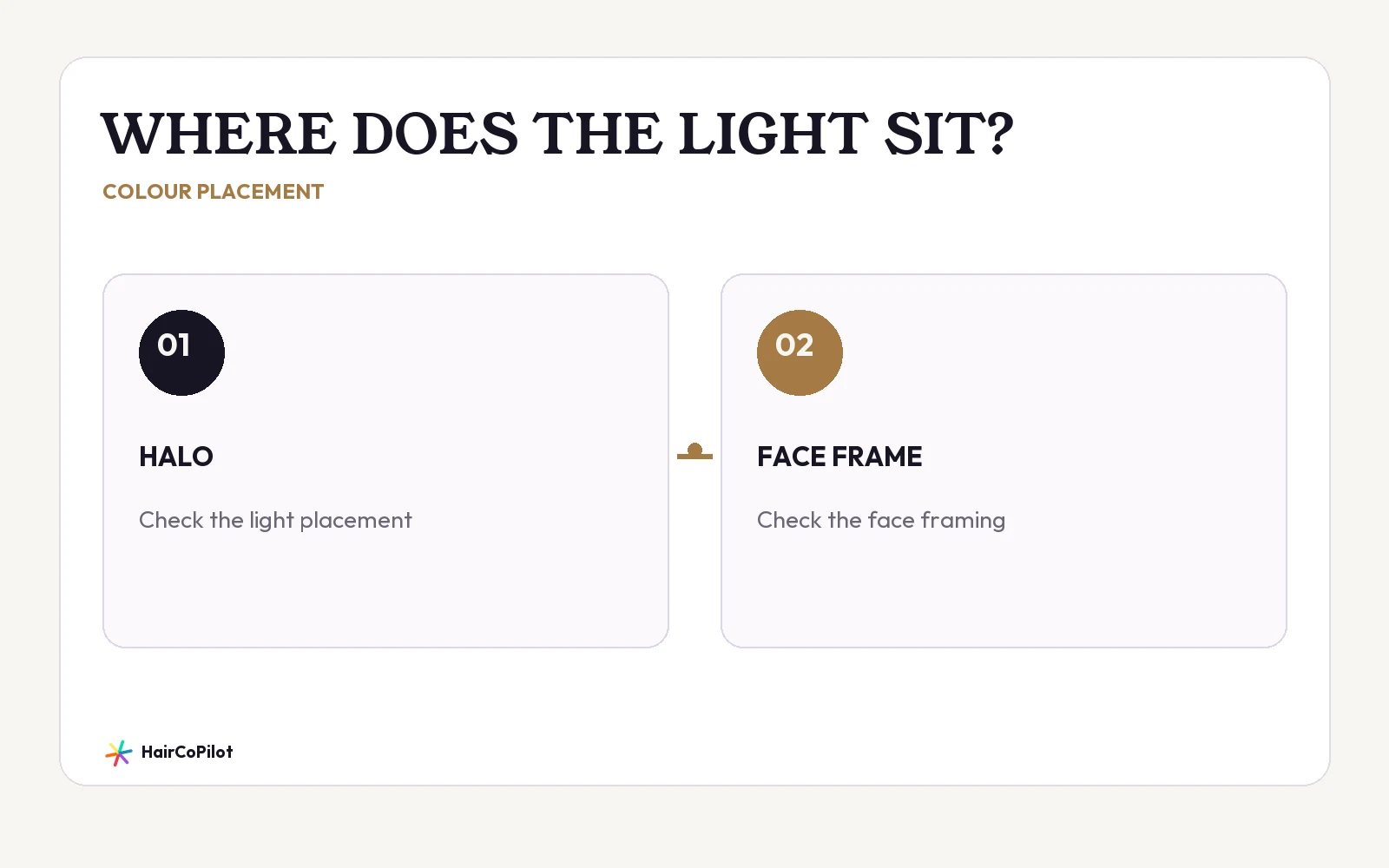
Both techniques put light near the face. That is where the similarity ends. A halo places brightness as a band that sits above and around the crown, catching light the way a ring would; face framing places it at the perimeter, against the skin. They require different amounts of lift, they suit different hair densities and lengths, and they grow out in completely different ways. This guide covers what each one is doing visually, what base each needs, and which client brief each actually answers.
Where the term comes from, and what it is not
Halo Contouring is a signature technique name used in Redken education. It describes a professional colouring approach built around multidimensional brunette results, placement and formulation.
It is a training concept, not a product launch or evidence of client demand. The technique name belongs to a brand education programme; the underlying placement principle is what this article explains.
What each placement is doing
The halo
Brightness concentrated in a band through the upper section of the head — around the crown and the parting area, above the ear line — with depth retained below it and often at the very perimeter.
The visual logic is lighting. Hair is brightest where light naturally falls, which is the top of the head, and a halo exaggerates that rather than contradicting it. The effect reads as luminous rather than as highlighted, because the brightness has a shape.
What it needs: enough density in the upper section to carry the effect, and hair worn in a way that shows the crown. On very fine hair, a halo can expose the scalp through the brightest area rather than reading as light.
Face framing
Brightness placed at the perimeter around the face, from the parting down past the temples, usually brightest at the front and softening backwards.
The visual logic is contrast against skin. It draws attention to the face, it reads immediately in photographs, and it delivers a visible change with relatively little of the head processed.
What it needs: a section that can carry the lift without becoming fragile, since front hair is the most exposed and the most frequently heat-styled on the whole head.
The difference in one sentence
A halo changes how the hair looks. Face framing changes how the face looks. Clients asking for “brightness around my face” almost always mean the second, and clients who say their hair “looks flat” usually mean the first.
The base each one needs
The halo is the more demanding of the two, because it sits in a large, continuous area and any unevenness within it is visible. It works best when the section it occupies has a consistent history — no old band running through it, no significant difference between the mid-lengths and the ends in that zone.
Face framing is more forgiving in that respect, because the area is smaller and the eye reads it against skin rather than against surrounding hair. But it is less forgiving about condition, since front hair takes the most heat.
Both are deposit-and-lift decisions rather than purely tonal ones, and the underlying pigment that appears when you lift is what decides whether the result reads clean or brassy. Our guide to professional colour theory covers that sequence, and it is worth revisiting before committing to a placement on a base you have not lifted before.
One constraint applies to both. Neither technique overcomes a lifting limit. If the hair in the placement area has been coloured before, permanent colour will not lift it, and the brightness has to come from a lightener or the plan has to change.
Grow-out: the argument that usually decides it
A halo grows out gently. The brightness is not at the scalp across the whole head, and because it sits in a band with depth above and around it, new growth blends into the existing depth rather than creating a line. Clients who stretch their appointments do disproportionately well with it.
Face framing grows out visibly. It is at the scalp, at the front, where the client looks every morning, in the section that is most exposed. That is precisely why it reads so well on day one, and precisely why it needs attention sooner.
So the two techniques have opposite maintenance profiles, and the client’s appointment rhythm is a better predictor of which one suits her than her hair type is.
How to choose, in consultation
Four questions.
Where does she want people to look? At her face, or at her hair. It sounds like a soft question and it is the most discriminating one available.
How does she wear it? A client who wears her hair up most days will barely see a face-framing result and will get everything from a halo. A client who wears it down and parted deeply will see the reverse.
How often does she come back? Short cycles support face framing. Long cycles support a halo.
What is the condition of the front section? If the front is already fragile from heat, adding lift there is a decision with consequences, and the honest version may be a halo instead — or a placement that starts slightly further back.
Record the answers, not just the conclusion. The reason a placement was chosen is what makes it reproducible when someone else is covering the appointment, and our guide to what a consultation form should capture covers the fields worth having.
A salon example
A client arrives with a saved image of a brunette with strong warm light around the crown. She has fine, shoulder-length, naturally level 5 hair, wears it in a low ponytail for work most days, and comes in every ten to twelve weeks.
The image is a halo result. The consultation produces three observations.
Her density in the crown is on the low side, so a full halo at the brightness in the image risks reading as scalp rather than as light. The placement can be done, at lower contrast and with finer sections, but it will not match the photograph and she should be told that before it starts.
Her ten-to-twelve-week cycle suits a halo well and would make face framing a poor choice, because the front would need attention at week six.
And she wears her hair up. Which means most of what she actually sees, and most of what other people see, is the crown area — the halo zone.
What she books is a lower-contrast halo, finer than the reference, with the depth below it kept intact to support the effect. The result she gets is less dramatic than the picture and better suited to her hair, and she was told which of those two things was happening and why.
Maintenance, described honestly
For a halo: the brightness will soften tonally before the regrowth becomes an issue, so the likely first intervention is a toning service rather than a new placement. That is a shorter, cheaper appointment and worth saying so.
For face framing: the regrowth becomes visible before the tone fades, and the intervention is a repeat of the placement at the front. Some clients are happy to do only the front between full appointments, and offering that as an explicit service rather than a favour is worth doing.
For both: the placement is reproducible only if it was recorded. Section pattern, how close to the scalp, how far back the placement travelled, what was deliberately left out. That last one matters most and is written down least.
Frequently asked questions
What is halo contouring?
It is a signature technique name used in Redken education for a placement that concentrates brightness in a band through the upper section of the head, around the crown and parting. The underlying idea — placing light where light naturally falls — is not brand-specific.
Is it the same as face framing?
No. A halo sits above and around the crown and changes how the hair reads. Face framing sits at the perimeter against the skin and changes how the face reads. They need different bases and grow out very differently.
Which one lasts longer?
A halo, generally, because the brightness is not concentrated at the scalp across the front. Its first intervention is usually tonal rather than a new placement.
Does the masterclass mean the technique is being launched?
No. A training session on an education platform is a professional education signal. It is not a product launch and it is not evidence of client demand in any particular market.
Use HairCoPilot in your salon
A placement is only repeatable if the detail survives to the next appointment. HairCoPilot keeps the formula — line, shade, quantities, developer and processing time — in the client record, so the version that worked is the one you start from next time. Start your free trial.