



Professional hair colour theory gives colourists a shared language for describing depth, tone, undertone and change. It does not replace product knowledge or practical testing. It helps the professional interpret the starting point, explain a realistic direction and document why a formula was chosen.
In consultation, theory is most useful when it connects what the client sees with what the colourist needs to plan. “I want it less orange” must become a precise conversation about the current level, exposed warmth, target, condition and maintenance.
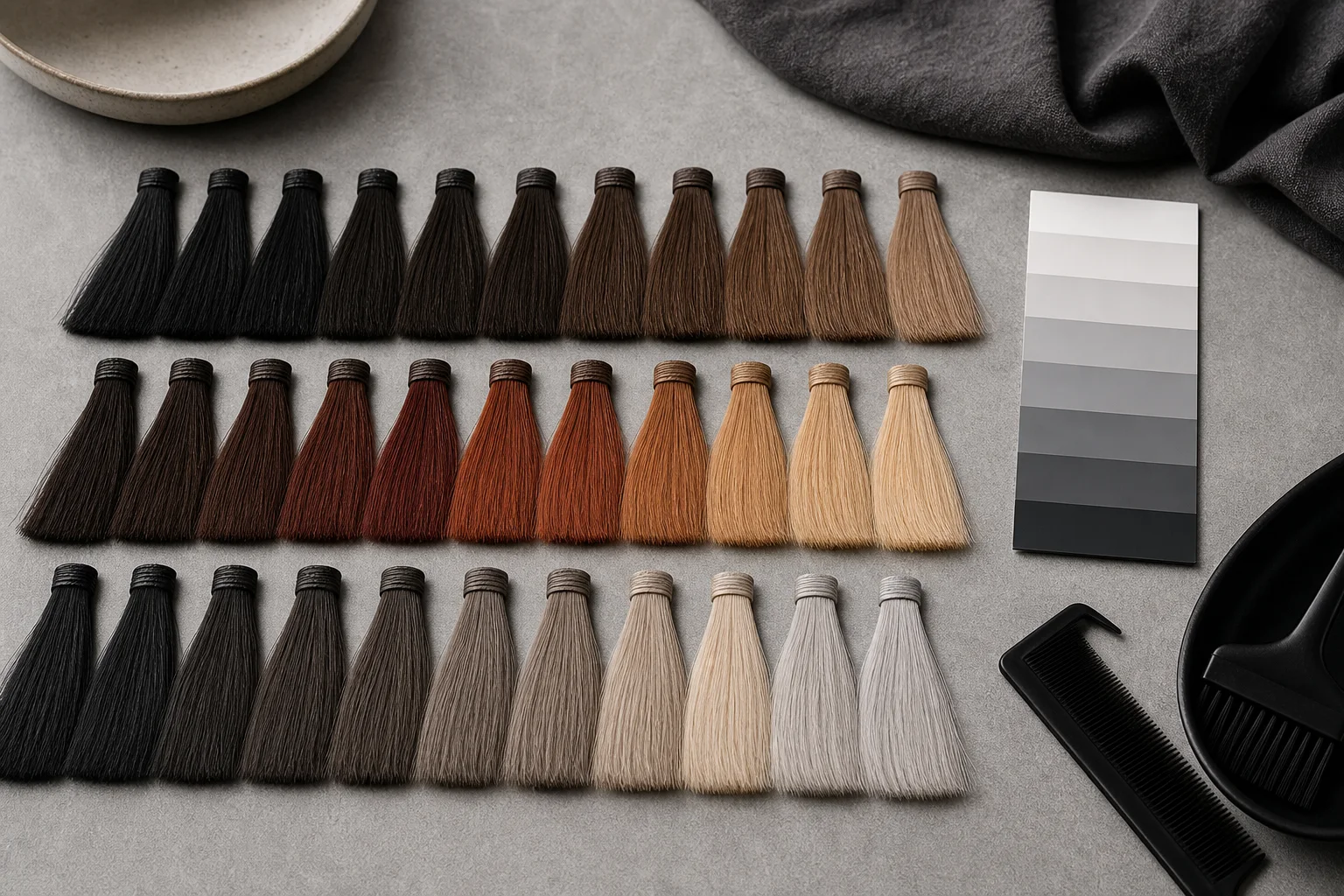
Level describes depth, not every aspect of colour
A level system places hair from darker to lighter. The exact numbering and naming can vary by manufacturer or education system, so the salon should follow the product line’s technical guidance and use one clear internal convention.
When assessing level:
- Separate natural regrowth from previously coloured lengths.
- Check different areas; the hairline, crown and ends may not match.
- Use neutral, consistent lighting where possible.
- Consider density and background colour, which affect visual perception.
- Record uncertainty or banding rather than reducing the whole head to one number.
A target level is also not a guarantee that every section will reach the same depth in one service. Previous colour, condition and realistic lift must shape the plan.
Tone describes the colour direction
Tone is the visible character within a depth: warm, cool, neutral or a more specific tonal family. Clients and professionals may use the same word differently. “Ash”, “beige”, “golden” and “natural” need visual confirmation with references or swatches.
Ask the client what they mean and what they want to avoid. A useful consultation question is: “Which part of this image matters most—the lightness, the warmth, the contrast or the placement?” That separates the desired feature from the overall edited photograph.
Undertone appears as hair is lightened
Lightening reveals underlying warm pigment. The visible undertone changes with the depth reached and affects how the colourist neutralises, enhances or balances the result. Professional planning therefore begins with both the starting point and the realistic level of lift.
Neutralisation is not simply choosing the opposite colour on a wheel. The colourist must consider:
- The actual depth and intensity of the unwanted tone.
- Whether the goal is neutral, cool, warm or dimensional.
- Porosity and the likelihood of uneven deposit.
- The chosen product system and manufacturer instructions.
- How the colour will fade and what maintenance the client accepts.
The colour wheel is a planning tool
Opposing colour relationships can help explain neutralisation, while neighbouring colours help explain harmony and tonal movement. In salon work, the wheel should be used with depth, concentration and product behaviour—not as a stand-alone formula generator.
For example, a small amount of corrective tone at a suitable level behaves differently from a dense deposit on porous hair. The professional decides how much control is needed and whether pre-treatment, filling or staged work is more appropriate.
Natural, cosmetic and visual colour can differ
A client may have natural regrowth, cosmetic colour through the mid-lengths and faded or environmentally altered ends. Each zone can require a different strategy. Write the assessment by zone rather than assuming one formula should cover everything.
Also distinguish the measured technical result from visual perception. Gloss, texture, lighting, background colours and phone processing can make hair appear lighter, darker, warmer or cooler. Show important consultation references under more than one relevant light source when practical.
Porosity changes how tone is received
Porous hair can take and release colour unevenly. Condition, elasticity and previous chemistry affect both the technical route and predictability. A beautiful target that ignores hair integrity is not a professional plan.
- Assess porosity across different zones.
- Use appropriate strand testing for uncertain or corrective work.
- Adjust the route according to the chosen product system.
- Explain when a staged result protects condition or improves control.
- Record how the hair responded for the next visit.
Use theory to improve client communication
Clients do not need a colour-science lecture. Translate theory into decisions:
- “To make this feel cooler, we first need to understand how much warmth will be exposed.”
- “The reference is lighter and more dimensional than your current colour, so we need a staged route.”
- “Your ends are more porous, so the same formula may not behave evenly from root to end.”
- “This result will need a gloss and home-care plan to keep the tonal direction.”
Clear explanation builds trust because the client can see how the plan follows from the starting point.
A consultation sequence based on colour theory
- Identify the client’s goal and the feature they value most.
- Assess natural and cosmetic level by zone.
- Describe the current tone and likely underlying warmth.
- Assess condition, porosity and previous chemistry.
- Define the realistic target level and tonal direction.
- Discuss neutralisation, enhancement or dimension in client-friendly language.
- Agree testing, stages, maintenance and limits.
- Document the plan and the observed result.
For a broader foundation, read Standard Colorimetry Techniques. For the client conversation itself, use our hair colour consultation checklist.
Common theory mistakes in consultation
Choosing tone before confirming level
A tonal family cannot be planned accurately without understanding the depth and exposed undertone.
Treating every zone as identical
Regrowth, lengths and ends often have different histories and porosity. Separate assessment supports controlled formulation.
Using the client’s vocabulary without visual confirmation
Words such as warm, brassy, dark and natural are subjective. Confirm with swatches, examples and a description of what the client dislikes.
Ignoring maintenance
A target may be technically achievable but unsuitable for the client’s preferred appointment frequency or home-care commitment.
Frequently asked questions
What is the difference between tone and undertone?
Tone describes the visible colour direction of the hair. Undertone commonly refers to the underlying warmth exposed as hair is lightened. Product systems may use specific terminology, so follow their education and instructions.
Why does hair colour look different in salon and daylight?
Light source, intensity, surrounding colours, texture and phone processing can change colour perception. Evaluate under consistent neutral light and, when relevant, compare with natural daylight.
Can an app replace hair colour theory?
No. A tool can organise information or support visual communication, but the colourist needs theory, product knowledge and practical assessment to judge whether an output is suitable.
Make theory visible in the plan
Professional hair colour theory is valuable when it improves decisions, explanations and records. Assess level and tone by zone, anticipate undertone, protect condition and connect the target to realistic maintenance. Then document the outcome so the next consultation starts with evidence.
Explore HairCoPilot for salons and continue with our guide to hair colour formula management.