



Blending and covering are two different promises, and most disappointment about grey comes from a consultation where only one word was used and two things were meant. Full coverage sets out to make the white hair invisible. Blending sets out to make it read as light rather than as grey. Both are legitimate results. They require different products, different expectations and a different sentence at the mirror. This guide covers how to tell them apart visually, how to choose between them with the client, and what to say about the limits before anything is mixed.
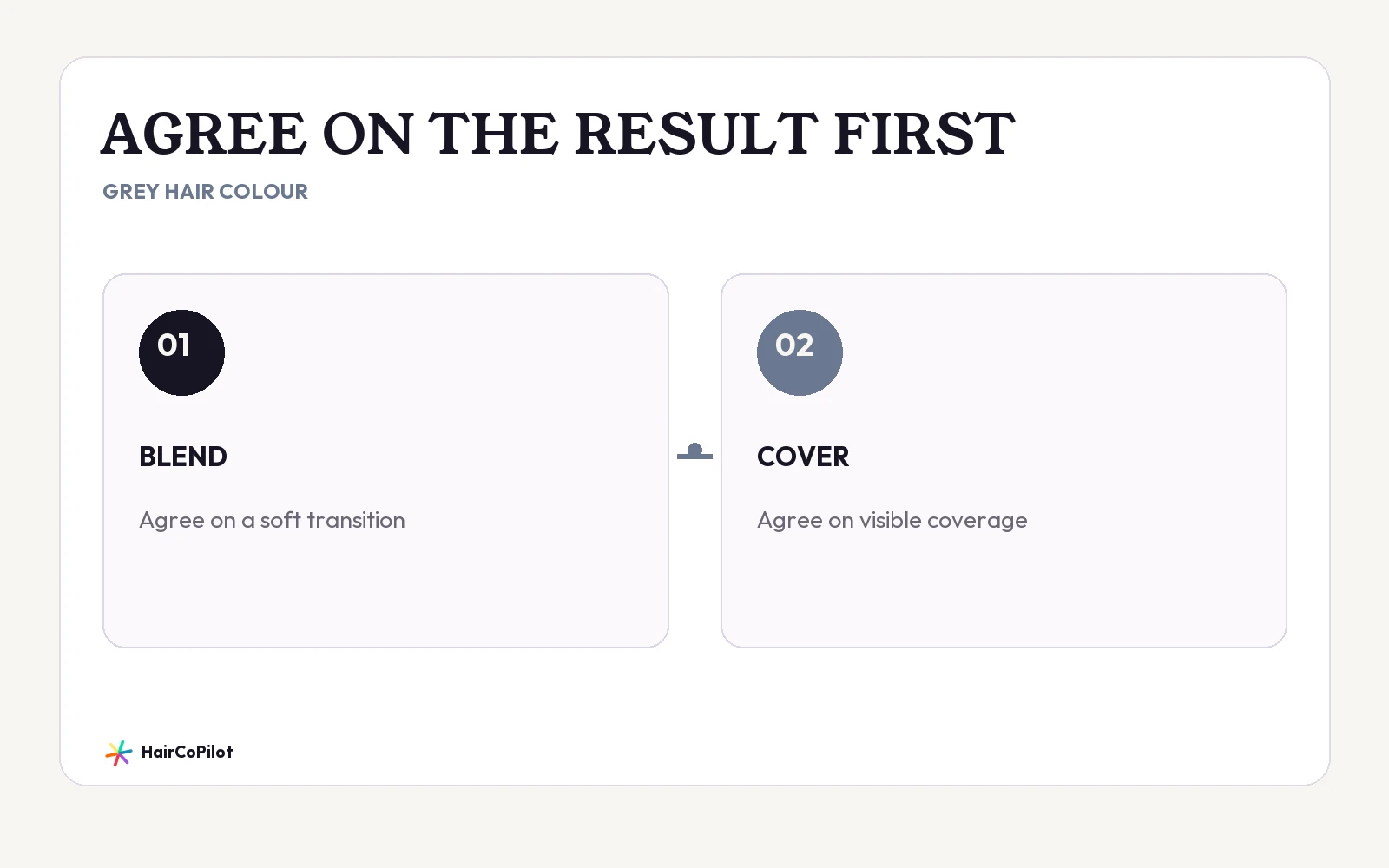
What each result actually looks like
Full coverage
Full coverage aims for an even, opaque depth across the whole head, in which the white hair is no longer readable as white. It is a permanent-colour outcome, because it needs enough dye deposit to make resistant white hair take on the same tone as the pigmented hair around it. Wella states that Koleston Perfect delivers up to 100% grey coverage, and its usage guidance for coverage of grey or white at the same depth or darker specifies a 1:1 mix with 6% developer.
The result is uniform. That uniformity is exactly what many clients want, and it is also its limitation: an evenly deposited base at a single depth reads flatter than hair with tonal variation in it, and on a client with a high percentage of white it can look heavier than she expected.
Blending
Blending leaves the white hair present but changes how it reads. Deposit is lighter and more translucent, so the white picks up tone without becoming fully opaque, and the eye reads the result as dimension rather than as regrowth.
This is a demi-permanent outcome. Wella’s Color Touch guidance sets out soft grey blending with 1.9% developer, and intense grey blending with Color Touch Plus at 4%, with grey coverage stated at up to 70%. Those numbers are the honest frame for the conversation: a demi is not a weaker attempt at full coverage, it is a different design with a different ceiling.
The option that gets forgotten
There is a third result which is neither: using the white hair as a light source with foils or fine weaves, so the grey becomes part of a dimensional design rather than something to be cancelled. It suits clients who like the brightness the white gives them but dislike the pattern it grows in. It belongs in the same conversation, because for some clients it is the answer to a question they asked badly.
The criteria that decide it
Work through these with the client in front of the mirror, not from the record card.
How much white there is, and where
A scattered ten per cent through the whole head behaves very differently from a solid concentrated band at the parting and temples. Scattered white blends beautifully, because there is pigmented hair everywhere around it doing the visual work. Concentrated white at the front is the hardest thing to blend convincingly, because there is nothing to blend into: it reads as a light patch, not as dimension.
The practical rule is that density in one area pushes towards coverage, and dispersal across the head allows blending.
How resistant the white hair is
Coarse, wiry, glassy white hair takes deposit slowly and can refuse a demi altogether. Fine, soft white takes colour fast and can go darker than intended. This is a texture assessment you can make with your fingers in thirty seconds, and it is the single most common reason a blending service under-delivers.
How much contrast the target depth creates
A level 6 target on 40% white is a much more demanding job than a level 8 target on the same head, because the difference between the deposited colour and the untouched white is larger. Deep targets on a lot of white push towards full coverage, because anything less will show the contrast as stripes rather than as softness.
This is also where the underlying pigment conversation comes in, particularly when a client wants to move lighter and cover at the same time. If that logic is not something you explain confidently, our guide to professional colour theory covers the sequence you are working with.
What the client actually feels about grey
Ask it directly, and separate two things clients routinely merge: disliking grey, and disliking the way grey grows in. Some clients are perfectly happy with silver at the front and hate the mixed, pepper-and-salt stage through the mid-lengths. Some want none of it visible, ever. Others are trying to stop colouring and want a route out.
The answer changes the service completely, and it is not predictable from age, profession or anything else. Our checklist of colour consultation questions covers how to ask about preference without leading the answer.
What has already been done to the hair
Years of permanent colour at a single depth leave a dense band of artificial pigment through the lengths. A client in that position who now wants blending is not choosing between two services; she is asking for a transition that will take more than one appointment. That needs to be said in the consultation, not discovered halfway through.
What to explain about the limits, before you start
Three sentences save most of the complaints.
Coverage percentages are manufacturer claims. “Up to 100%” and “up to 70%” are brand figures under brand conditions on brand test hair. They are useful for choosing a product family. They are not a guarantee for one client’s resistant white temples, and quoting them to a client as a promise is how you end up defending a number instead of a result.
Blending is a design, not a partial failure. If a client leaves with grey still visible and she was not told in advance that grey would still be visible, she will read it as the colour not working, however good it looks. Say the words: “you will still see some of your natural white, and that is what makes this look like hair rather than like a block of colour.”
Coverage is easier to enter than to leave. Committing to full coverage means the contrast between coloured hair and new white growth will be at its maximum, and that reversing the decision later is a transition service rather than a switch. A client who is unsure is better served by blending first, because blending can become coverage far more easily than coverage can become blending.
Three typical cases
Scattered white, wants it gone at the front only. A client with roughly 20% white, dispersed, concentrated slightly at the temples. She does not object to grey in principle but dislikes how it catches the light at the front. A blending service through the length with a more opaque approach at the hairline gives her what she actually asked for, and the conversation to have is about what “gone” means: reduced and softened, not erased.
High percentage, resistant texture, wants it invisible. A client with around 70% coarse white and a level 5 target. This is a full coverage brief and there is no version of a demi that satisfies it. The consultation work here is not about choosing the service, it is about the depth: a level 5 on 70% white will read as very solid, and showing her a lighter option at the mirror before committing is often the difference between a result she tolerates and one she likes.
Wants to stop colouring. A client with a long history of permanent colour who has decided she wants her natural silver. Neither blending nor coverage is the answer on day one. This is a staged transition, and the honest opening is a realistic account of how many appointments it involves and what the hair will look like in between. Some clients will decide, hearing that, to continue colouring for now. That is a good outcome, because she decided it with the facts.
Demonstrate, do not describe
Grey conversations go wrong in language and get rescued at the mirror. Two habits help.
Section the hair where the white actually is and show her, rather than talking about percentages she cannot see. Clients routinely over-estimate how much white they have, because they only ever look at the parting.
And use the swatch or a previous client photograph to show the difference between a blended result and a covered one at a similar depth. The gap between the two is obvious in a picture and almost impossible to convey in a sentence.
Write down what was agreed, in her words
The agreement is the deliverable. Record which outcome was chosen, in language that would mean something to a different stylist reading it: not “grey coverage”, but “blending, client happy to see some natural white through the lengths, more opaque at the hairline”. Record what you told her about the limits, and record what she said about how she feels about grey, because that is the part that changes over years and the part nobody writes down.
Our guide to what a colour consultation form should record covers the structure. The specific addition for a grey client is the preference itself, kept alongside the formula, so that the next conversation starts where this one ended.
Frequently asked questions
Can a demi-permanent colour cover grey completely?
Not as a rule. Wella’s own guidance positions Color Touch for soft grey blending at 1.9% developer and intense grey blending with Color Touch Plus at 4%, with grey coverage stated at up to 70%. Permanent colour is the product family for full coverage.
What percentage of grey is the cut-off for blending?
There is no fixed threshold, and any number quoted as one is a simplification. Distribution and texture matter more than percentage: scattered white blends well at a high percentage, while a concentrated band at the parting is hard to blend even at a low one.
Why does the white hair at the temples not take?
Coarse, resistant white takes deposit more slowly than the hair around it. That is a formulation and timing question in the salon, and it is a reason to be cautious about promising full coverage at the hairline on the basis of how the rest of the head behaves.
Can a client move from full coverage back to blending?
Yes, but as a transition over several appointments rather than in one service, because the lengths carry a dense band of artificial pigment. Say so before the first coverage appointment, not at the one where she asks.
Use HairCoPilot in your salon
A grey decision is worth nothing at the next appointment if nobody wrote it down. HairCoPilot keeps the formula — line, shade, quantities, developer and processing time — saved in the client record, so what you agreed and what you mixed are in the same place when she sits back down. Start your free trial.