


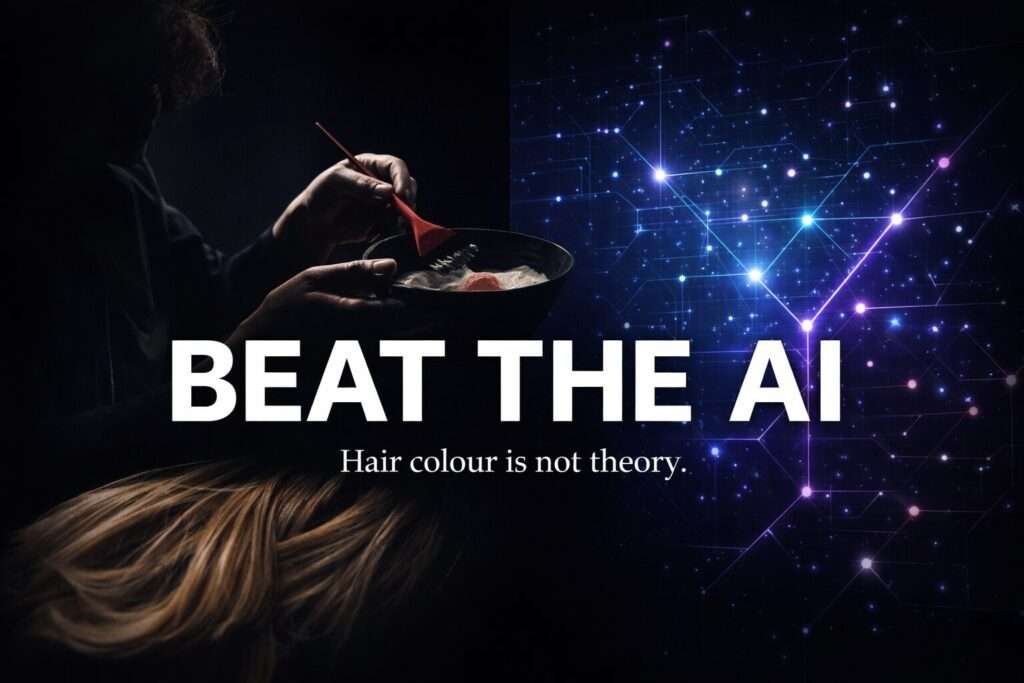
BEAT the AI
You say AI can’t replace hairdressers.
Prove it.
Everyone has an opinion about AI in salons.
“It can’t understand real hair.”
“It doesn’t know porosity.”
“It’s fine for theory, but not for real colour work.”
Fair enough.
So here’s the challenge: BEAT the AI.
This is not a demo.
Not a tutorial.
Not a marketing gimmick.
It’s a direct challenge to professional hairdressers and colourists:
answer real colour questions faster and more accurately than an AI built for your industry.
This is not a game for beginners
BEAT the AI doesn’t test trivia.
It tests how you think.
- base levels and underlying pigment
- porosity and colour history
- timing decisions
- tonal correction logic
- real-world salon scenarios
The same decisions you make every day — just without the client in the chair.
No filters.
No excuses.
Why this challenge exists
HairCoPilot was created for one reason:
to reduce guesswork in professional colour work.
It analyses photos, evaluates technical variables, and produces colour proposals that are:
- consistent
- repeatable
- brand-compatible
But here’s the truth:
AI is only powerful when compared to real expertise.
That’s why BEAT the AI exists — not to replace you, but to challenge you.
The uncomfortable question
If an AI can match your answers…
or beat them…
What does that say?
And if you beat the AI — decisively —
that’s proof of something far more valuable than confidence: professional mastery.
This is where skill meets reality
HairCoPilot doesn’t pretend to “know better”.
It documents logic, supports decisions, and helps professionals stay consistent.
But experience still matters.
Judgement still matters.
You still matter.
So let’s test it.
Ready to BEAT the AI?
👉 Take the challenge now
https://haircopilot.com/beat-the-ai/
What the challenge is really measuring
A fast answer is not automatically a good answer. Professional colour decisions require the ability to identify the variables that matter, reject unsafe shortcuts and explain a sequence that another colorist could follow. BEAT the AI is most valuable when it is treated as a skills diagnostic rather than a scoreboard.
Each scenario can reveal a different part of professional reasoning:
- Observation: noticing missing information before proposing a formula.
- Technical logic: connecting level, tone, underlying pigment and colour history.
- Risk awareness: recognising when the requested outcome needs testing, more time or a different route.
- Communication: turning a technical decision into language a client or junior team member can understand.
- Consistency: reaching a defensible decision without relying on memory alone.
How to use a wrong answer
The learning begins after the result. When your answer differs from the suggested route, write down the assumption that produced the difference. Did you interpret the starting level differently? Did you miss a previous colour service? Did the scenario leave out information that you would normally collect in the salon? This creates a concrete training note instead of a vague feeling of being right or wrong.
For team development, repeat the same scenario individually before discussing it together. Compare not only the final answers but the questions each person wanted to ask. Senior staff often identify risks quickly; less experienced staff may introduce a useful alternative or reveal where the salon’s shared method is unclear.
Human versus AI is the wrong final question
The professional objective is not to defeat every tool. It is to make better, safer and more explainable decisions. AI can process a structured prompt quickly, but it does not stand behind the chair, inspect the hair under changing light or carry responsibility for the service. The hairdresser supplies context, physical assessment, empathy and accountability.
A strong result therefore has two parts: the quality of the technical answer and the quality of the reasoning behind it. If the challenge exposes a gap, use it to choose the next training topic. If it confirms your judgement, use that confidence to explain decisions more clearly to clients and colleagues.
Turn the result into a development plan
- Record the topic of every uncertain answer.
- Group gaps into consultation, colour theory, correction, safety or communication.
- Select one area to practise during the following month.
- Repeat comparable scenarios and look for more consistent reasoning.
That learning loop is the real way to beat the AI: not through a single score, but by making professional expertise visible, testable and stronger over time.