


A good colour consultation is a decision-making process, not a questionnaire that ends when every box is ticked. The form should help the colourist collect useful facts, identify gaps, structure the conversation and record the professional plan. It should not encourage the salon to promise a result before the hair has been assessed.
That distinction matters. A client can describe their goal and disclose their history before the appointment, but only the professional can compare that information with the visible starting point, condition, scalp, previous exposure and realistic maintenance.
A well-designed hair colour consultation form therefore has two jobs: prepare the conversation and preserve the decisions that come out of it.
Why a generic client intake form is not enough
Name, telephone number and appointment date identify the booking. They do not explain the colour case.
A colourist needs to understand what is on the hair now, what has happened to it previously, what the client wants, what they are prepared to maintain and what must be checked before a product is selected. When that information is scattered across messages, memory and camera rolls, the consultation starts from fragments.
The form should bring those fragments into one place without pretending that client answers are a technical diagnosis. Think of it as the beginning of the digital hair colour record, not a replacement for professional observation.
The five layers of a useful consultation form
The most practical structure moves from the client’s words towards the colourist’s final record.
1. The request
Capture what the client is asking for in their own language. Include inspiration photographs, but ask what they like about each image: depth, tone, brightness, placement, contrast or overall mood.
“I want this blonde” is not precise enough. One client may be looking at the cool tone while another is responding to brightness around the face. The same reference can represent very different goals.
2. The known history
Ask about previous professional colour, home colour, lightening, toners, direct dyes, henna, smoothing services, perms and other chemical treatments. Record approximate dates and where each product was applied.
Do not treat “nothing for a year” as a blank history. Long hair can still contain several years of previous work through the mid-lengths and ends.
3. The professional assessment
This is completed or confirmed by the colourist. Record the observed starting level, visible tone, natural regrowth, white percentage where relevant, density, texture, porosity, elasticity, condition and any significant differences between zones.
The professional hair colour theory guide explains why levels, tones and undertones need to be assessed in consistent lighting rather than inferred from a client photograph.
4. The agreed route
Write down what the first service is intended to achieve, what it may not achieve and whether the route is expected to take more than one appointment. Include placement, broad product route, timing range, price range and the agreed maintenance commitment.
5. The evidence and next action
Record required tests, photographs, the final formula, processing observations, result, aftercare and recommended return timing. This turns the form into a connected service record instead of a document that disappears after check-in.

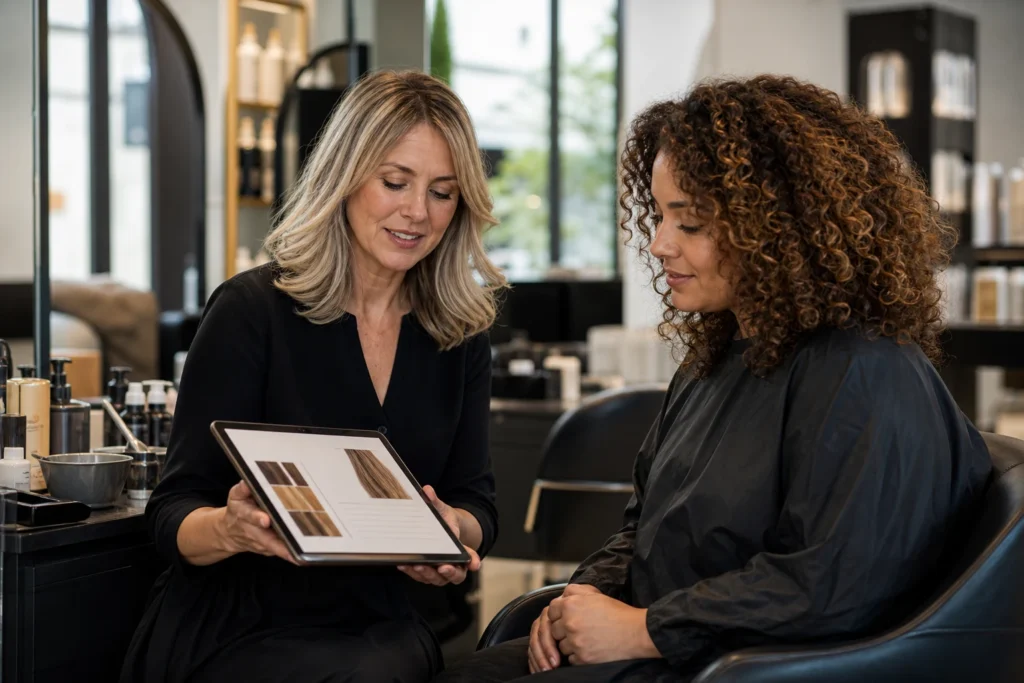
Suggested caption: A useful consultation record turns client information into a clear professional plan.
What the client can complete before the appointment
A pre-consultation form is useful when it collects information the client genuinely knows.
Ask for:
- contact details and preferred communication method;
- the service or change they are considering;
- clear current-hair photographs in neutral light;
- inspiration images and what they like about them;
- their remembered colour and chemical history;
- previous reactions, sensitivities or relevant changes;
- normal styling and washing habits;
- preferred salon-visit frequency;
- home-care commitment;
- budget and timing constraints;
- an upcoming event or deadline that affects the plan.
Keep the language understandable. Clients should not be asked to diagnose their own porosity, undertone or structural condition. Those belong to the professional assessment.
What the colourist must confirm in person
The in-chair consultation should verify rather than merely repeat the form.
Compare the written history with the visible hair. Look for bands, uneven porosity, mineral or product build-up, fragile areas, artificial pigment and differences between roots, mid-lengths and ends. Clarify any uncertain dates or home-colour descriptions.
Then turn the request into specific decisions:
- What is the realistic target for this appointment?
- Which areas require different treatment?
- What needs testing before the service?
- Which risks or limitations must be explained?
- What will the client need to maintain at home?
- When should the result be reviewed or refreshed?
The professional consultation questions checklist can help the team ask consistently without making the conversation sound scripted.
Keep testing records separate and explicit
Do not hide safety checks inside a general consent paragraph.
An allergy alert test and a strand or test cutting have different purposes. Record which protocol applies, the manufacturer and product information, relevant dates, the result and the action taken. Follow the current manufacturer instructions and the salon’s documented procedure.
The NHBF’s allergy alert testing guidance stresses that timings and protocols can vary by manufacturer. A generic form should therefore point the professional towards the correct instructions rather than invent one universal interval.
Consent is not a substitute for following product instructions or professional safety procedures. A signature does not make an unsuitable service suitable.
Record the agreed outcome, not just the desired outcome
The most useful field on the form may be the final agreement.
After the consultation, summarise:
- the client’s priority;
- the professional assessment;
- the service agreed for today;
- limitations and likely evolution;
- tests completed or still required;
- estimated time and price range;
- home-care expectations;
- likely return interval;
- what would trigger a change of plan.
This gives both parties a clearer reference. It also makes the final formula and result easier to understand at the next appointment.
Separate technical records from marketing permission
Consultation photographs can support diagnosis and continuity. Public before-and-after photographs serve a different purpose.
Do not bundle technical image use, marketing publication and general terms into one vague checkbox. Explain what is being collected, why it is needed and how it will be used. If the salon wants to publish identifiable photographs, handle that permission separately and make the choice clear.
UK data-protection principles include purpose limitation, data minimisation, accuracy, storage limitation and security. In practical salon terms, collect information you can justify, restrict access, keep it accurate and define how long different records are retained.
Make the form usable on a busy day
The best form is not the longest. It is the one the team can complete properly.
Use conditional questions so correction clients see more detailed history fields while a straightforward returning client sees only what needs updating. Combine quick selections with short free-text fields. Avoid asking the same question in booking, consultation and consent unless the repetition has a clear verification purpose.
Build a visible sequence:
Client brief
-> professional assessment
-> testing status
-> agreed service plan
-> formula and process
-> result and aftercare
-> next visit
This sequence is also how HairCoPilot approaches the colour case: the brief, formula, result, care and return strategy stay connected instead of becoming isolated notes. Salons can explore that wider workflow on the HairCoPilot for Salons page.
A practical consultation-form checklist
Before adopting a form, check that it:
- distinguishes client-provided history from professional assessment;
- captures photographs without treating them as colour-accurate evidence;
- records zone differences, not only one overall starting level;
- separates testing records from general consent;
- includes maintenance, budget and timing expectations;
- produces a clear agreed plan;
- links to the formula, result and return visit;
- avoids collecting information with no defined purpose;
- can be updated without overwriting the previous service history;
- works for the team on mobile, tablet or desktop.
Frequently asked questions
Should a client complete the whole colour consultation form online?
No. Clients can provide goals, photographs, remembered history and practical preferences. The colourist should complete or verify the technical assessment and agreed service route in person.
Is a consultation form the same as a consent form?
No. A consultation record supports information gathering and professional planning. Consent, allergy protocols, manufacturer instructions and photography permissions need their own clear treatment.
Should returning clients complete a new form every time?
They should not need to repeat an unchanged life history at every visit. Confirm relevant changes, add a new service record and preserve previous formulas, results and adjustments.
Turn the form into the start of the colour record
A hair colour consultation form is valuable when it improves the decision and makes the next appointment safer to understand. It should lead naturally into the formula, processing notes, result, aftercare and return strategy.
That is the difference between collecting information and building professional memory. The form should not finish the consultation. It should give the colourist a better place to begin.