



This article calculates one thing: the variable product cost of a single bowl of color. Not the price of the service, not the margin, not the hourly rate of the chair. Just what the tube, the developer, and any additive that went into that bowl cost you. It is a narrow number, and it is the one most salons cannot produce on request, which is why every conversation about color profitability tends to start with a guess.
The method below takes about fifteen minutes to set up and roughly thirty seconds per service once it is running.
The four inputs you need
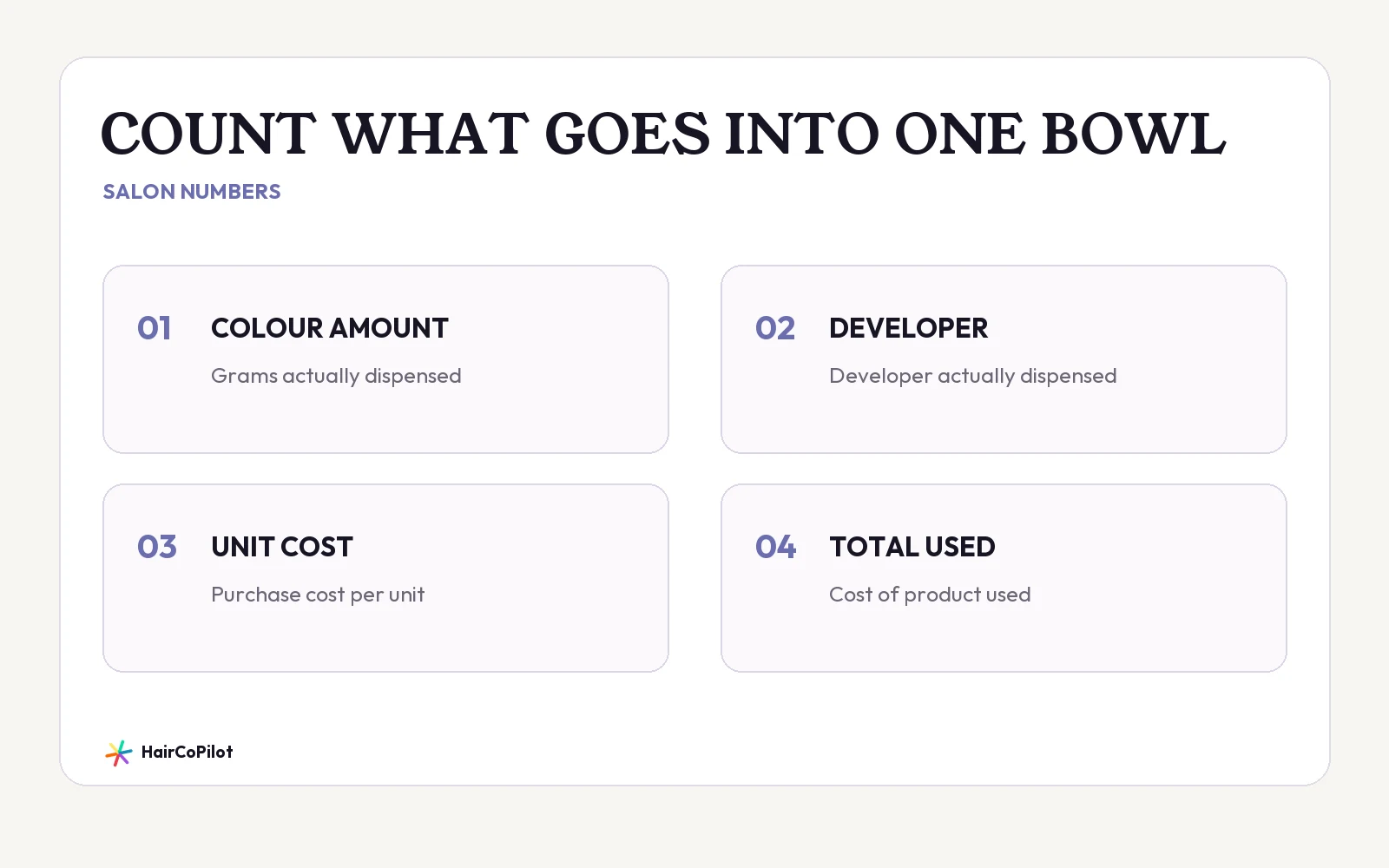
Everything rests on four pieces of data, and three of them you already have. The pack cost and pack size of each color line. What you pay per tube, excluding VAT if you are registered for it, and how many grams or milliliters are in it. This gives cost per gram, which is the number you will actually use. Most salons hold several lines at different price points; each needs its own figure. The pack cost and pack size of each developer. Same calculation. Developer is usually bought in larger volumes and is far cheaper per milliliter than color, which is why mixing ratios matter to the cost more than people expect. The pack cost and dose of any additive. Bond additives, intensifiers, correctors. These are frequently the most expensive component per milliliter in the whole bowl and the one most often left out of the calculation entirely. The actual quantity used. This is the input you probably do not have, and it is the one that determines whether the exercise is worth anything. Not the recipe quantity, the quantity that went into the bowl.
Measure the quantity, do not estimate it
Estimating defeats the purpose. A stylist who believes she uses 60 g on a regrowth application and actually uses 85 g is producing a cost figure that is 40% wrong, and the error is systematic rather than random, because the same estimate is applied to every service. The practical method is a two-week measurement period on a kitchen scale, recording the weight of color and the volume of developer actually mixed for each service, alongside the service type and hair length. Two weeks is enough to establish realistic averages for your most common services and to expose the variation between stylists, which is usually larger than anyone expects. Record what was left in the bowl at the end as well. Product mixed and not used is a real cost, and it is invisible unless someone writes it down. If a stylist routinely mixes 30 g more than she needs, that is a cost line with a name.
The calculation
For one bowl: Color cost = (pack cost ÷ pack size in grams) × grams of color used Developer cost = (pack cost ÷ pack size in milliliters) × milliliters of developer used Additive cost = (pack cost ÷ pack size) × amount used Variable product cost of the bowl = color + developer + additive Where two or more tubes go into the same bowl, calculate each separately and add them, because they frequently come from lines with different costs per gram. Where a service uses more than one bowl — a root application plus a toner, say — calculate each bowl and add them. Keeping them separate rather than merging them is what lets you see which part of a service is actually expensive.
A worked example, explicitly illustrative
The numbers below are invented for the purpose of demonstrating the method. They are not benchmarks, they are not typical, and they should not be used as a reference for your own costs. Substitute your own invoice prices. Assume a color tube costing €9.00 for 60 g, a developer costing €7.00 for 1,000 ml, and a bond additive costing €40.00 for 500 ml. A regrowth application uses 50 g of color, 75 ml of developer at a 1:1.5 ratio, and 5 ml of additive.
- Color: €9.00 ÷ 60 g = €0.150 per g × 50 g = €7.50
- Developer: €7.00 ÷ 1,000 ml = €0.007 per ml × 75 ml = €0.53
- Additive: €40.00 ÷ 500 ml = €0.080 per ml × 5 ml = €0.40
- Variable product cost of the bowl: €8.43
Two observations from the arithmetic, and they hold regardless of the specific numbers. The developer is close to irrelevant to the cost, at roughly 6% of the total in this example. Salons that worry about developer waste are usually worrying about the cheapest thing in the bowl. And the additive, at 5 ml, costs almost as much as the developer at 75 ml. Per milliliter it is more than ten times the price. That is the line worth measuring precisely.
Reconcile it against what you actually bought
The per-bowl figure is a model. The reconciliation is what tells you whether the model matches reality, and it is the step that gets skipped. Take a period — a month is convenient — and compare two numbers: the total color product cost your per-bowl calculations predict for all the services performed, and the actual value of color product consumed over that period, taken from opening stock plus purchases minus closing stock. If the actual consumption is meaningfully higher than the model predicts, the gap is real and it has a cause: quantities larger than recorded, product mixed and discarded, breakage, retail or personal use not recorded, or stock leaving without a service attached. The reconciliation does not tell you which. It tells you that there is something to look for, and how big it is. That gap is usually the single most actionable number a salon can produce about its color costs, and it only exists if both halves are measured.
What this number is for, and what it is not
What it is for. Comparing the material cost of different services against each other. Seeing what an additive actually adds. Understanding why long hair is not the same service as short hair. Spotting when a supplier price change has quietly moved your costs. Giving a factual basis to a discussion about a price list rather than an impression. What it is not. It is not the cost of delivering the service, because it excludes the stylist’s time, the chair, the towels, the water, the card fees, and everything else. It is not a margin, and dividing the service price by it produces a ratio that means nothing on its own. Building a price from a cost is a separate exercise with its own method, and our guide to salon pricing covers it properly. This article deliberately stops at the product cost, because that is the input the pricing conversation usually lacks. Equally, the per-bowl figure only becomes a management tool when it is read alongside the salon’s other numbers. Our guide to salon KPIs covers where profit margin sits relative to utilization and rebooking, and the product cost is one input among several rather than the headline.
A salon example
A salon runs the measurement for two weeks and finds two things it did not expect. The first is variation between stylists on the same service. On a standard regrowth application, recorded quantities range from 45 g to 80 g. Some of that is genuine — hair density and regrowth length differ — but not all of it, and the stylists at the top of the range are consistently at the top regardless of client. The second is the bond additive. It was being added to every color service as standard, at a dose nobody had checked against the manufacturer’s instruction, and it was the second largest line in the bowl after the color itself. What changes is not a rule about quantities, which would be resented and ignored. It is that the measured averages become the mixing guideline for each service type, reviewed rather than imposed, and that the additive dose is checked against the manufacturer’s instruction and applied where it is indicated rather than universally. Neither change reduces the quality of a service. Both were invisible before anyone weighed anything.
Record the quantity with the formula
The measurement only stays true if the quantity is captured as part of the record rather than as a separate exercise. A formula that records the shade and the developer but not how much of each was used cannot be costed afterward, and reconstructing it from memory is worse than not doing it. Capturing quantity alongside line, shade, developer, and processing time as a matter of routine is what makes the whole calculation repeatable rather than a one-off audit — the practice our guide to color formula management describes, used for a commercial purpose as well as a technical one.
Frequently asked questions
What does cost per bowl actually include?
Only the variable product cost: the color, the developer, and any additive that went into that bowl. It excludes labor, overheads, retail, and everything else involved in delivering the service.
How do I get cost per gram?
Divide the pack cost by the pack size in grams. Use the price you actually pay, net of VAT if you are registered, and recalculate it when a supplier price changes.
Do I need to weigh every service forever?
No. Weigh for a couple of weeks to establish realistic averages per service type, then use those averages, and re-measure when a line changes, a stylist joins, or the reconciliation gap widens.
Why reconcile against stock at all?
Because the per-bowl figure is a model of what should have been used. The stock movement tells you what actually was. The difference between them is the number worth investigating.
Use HairCoPilot in your salon
Costing a service is only possible if the quantity was recorded at the time. HairCoPilot lets you save the formula with the line, shade, quantities, developer, and processing time in the client record, which makes the quantity available afterward rather than lost. Four days free, no card required.