


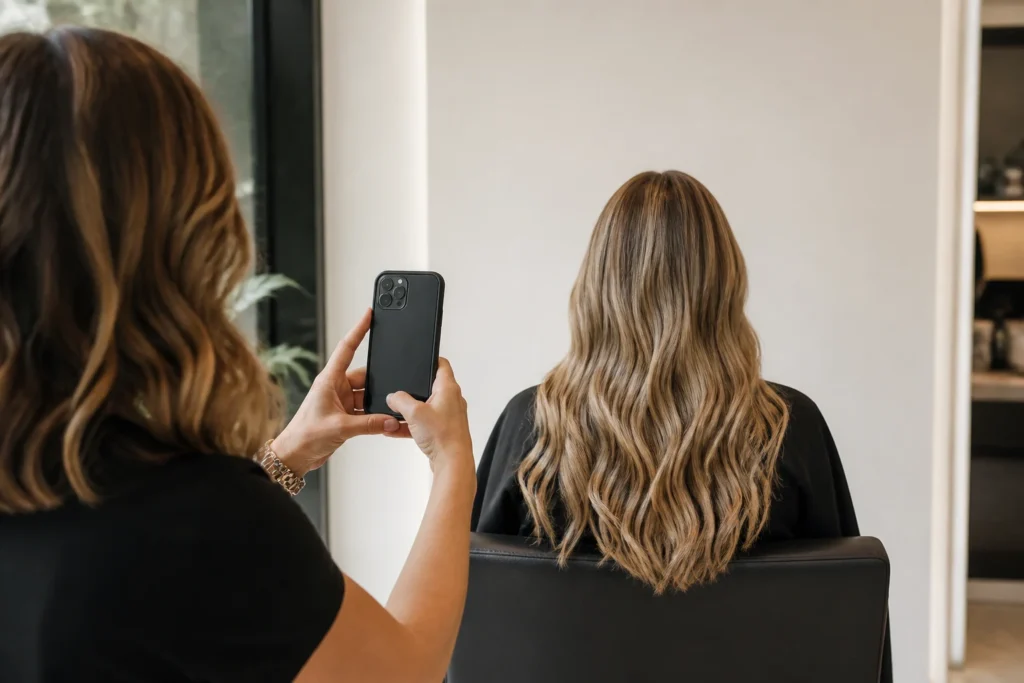
A beautiful result can look ordinary in a rushed photograph. More importantly, an impressive photograph can become technically useless when the light, angle and camera processing hide what the colourist actually needs to remember.
A reliable before-and-after hair photography salon workflow serves two different purposes. It creates honest technical photographs for the next appointment and—with the client’s clear agreement—credible before and after hair photos for the salon portfolio or marketing channels.
The goal is not to turn every colourist into a studio photographer. It is to remove avoidable variation so that photographs from different days and team members can still be compared.
Decide the purpose before taking the photograph
Ask what the image needs to show.
A technical record might document:
- the starting level and distribution of previous colour;
- a band, fragile area or uneven section;
- placement before processing;
- the finished tone in consistent light;
- how the colour has faded at the next visit.
A portfolio image may prioritise shape, movement and finish. A consultation reference may need several angles and a close view of one area. One image rarely performs every job equally well.
Purpose also affects permission. A photograph stored in the salon’s service record is not automatically approved for a website, social platform or Google Business Profile. Explain each intended use clearly and record the client’s choice.
Standardise one photography point
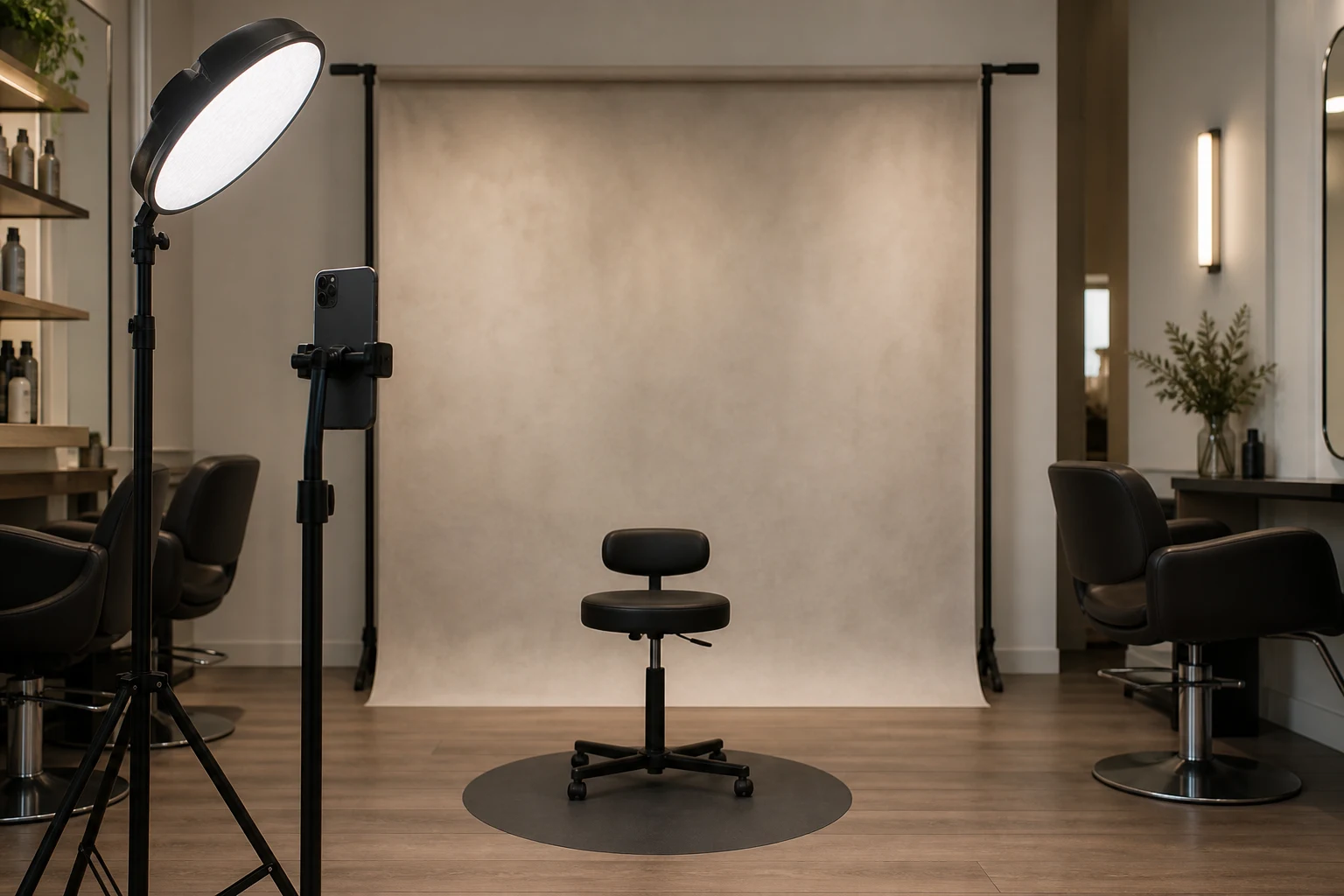
Choose a repeatable place in the salon rather than finding a new attractive corner each time. The ideal point has:
- stable, neutral-looking light;
- a simple background that does not compete with the hair;
- enough distance to avoid an ultra-wide camera view;
- a marked position for the client and photographer;
- no confidential information, mirrors or other clients in frame;
- space to photograph the hair without blocking the salon workflow.
Daylight can be flattering, but it changes with weather and time. If it is your main source, note that comparison photographs will still vary. A consistent salon light with a suitable colour rendering quality may produce a more repeatable record.
Avoid mixing strong sources with visibly different colour temperatures. Warm ceiling light plus cool window light can create different casts across the same head of hair.
Lock the variables you can control
Use the same phone or camera, main lens, approximate distance and height whenever possible. Clean the lens before the session; product haze can soften detail and lower contrast.
For a phone workflow:
- Use the standard rear camera rather than the front camera.
- Avoid digital zoom; move to the marked position instead.
- Tap the hair to set focus and check that highlights are not blown out.
- Keep portrait filters, beauty effects and artificial background blur off.
- Use the same orientation and framing for before and after.
- Review one image at full size before the client leaves.
Automatic processing varies between devices. Consistency matters more than finding a dramatic setting for each result.
Prepare the hair consistently
The finish affects how colour reads. Smooth, straight styling may reveal blends and bands; movement may show dimension; curls may show placement differently again.
Record the result in a presentation that makes sense for the service, but do not disguise an area that matters technically. If a glossy styled image is used for the portfolio, take an additional neutral technical view before adding heavy shine spray or arranging the hair to hide an uneven section.
Remove capes and coloured towels that cast reflected colour onto the hair. Keep clothing and background reasonably neutral where practical.
Create a five-view colour record
A simple sequence makes the record easier to repeat:
- Back: camera level with the main body of the hair.
- Left side: show the face frame only with permission and appropriate framing.
- Right side: match the height and distance of the left view.
- Top or parting: document roots, white coverage or placement where relevant.
- Detail: capture the specific band, tone or condition point that informed the service.
Use the same sequence for the starting point and result. If only one result image is taken, the next colourist may not know whether an unseen area behaved differently.
Keep before and after genuinely comparable
The strongest comparison uses:
- the same location and main light;
- the same camera and lens;
- the same orientation, distance and height;
- a similar head position;
- no colour-changing filter;
- a clear label for the service date and view.
Do not photograph the “before” under flat overhead light and move the “after” to direct golden sunlight. The difference may be visually dramatic but it is not a fair representation of colour change.
HairCoPilot’s guide to the visual communication of colour explores why lighting and camera choices can change perceived tone. Use those principles as the technical foundation, then make the capture sequence easy enough for the whole team to follow.
Name photographs so they can be found
An image is not a record if it remains in a personal camera roll.
Attach photographs to the client’s salon-owned record and connect them to:
- the appointment date;
- before, process or result status;
- the view or section shown;
- the service and formula record;
- a short note explaining why a detail matters;
- the permissions that apply to the image.
The digital hair colour records guide shows how photographs, consultation details, formulas and outcomes can form one case history. This is far more useful than separate folders with names such as “blonde final 2”.
Build consent into the workflow
Identifiable client photographs are personal data. Treat permission as a clear choice, not a rushed question while the camera is already pointing at the client.
A practical process should explain:
- why the image is being taken;
- where it will be stored;
- whether the face will be visible;
- whether it is for the service record, training, marketing or more than one purpose;
- which channels may be used;
- how the client can change a marketing choice later;
- who can access the record.
Separate service-record photography from promotional use so the client can accept one and decline the other. Record the choice and date. If a client withdraws a marketing permission, follow the salon’s documented process rather than relying on somebody to remember which posts contained the image.
UK data-protection guidance also emphasises purpose limitation, data minimisation, accuracy, storage limitation and security. Define retention and access rules with appropriate professional advice for your business rather than keeping every image indefinitely.
Select portfolio images honestly
Google’s Business Profile guidance asks for images that are in focus, well lit and representative of reality. Its photo policies also restrict misleading, irrelevant or low-quality media.
Apply the same standard to every public portfolio:
- use the salon’s own work;
- avoid filters that alter the hair colour;
- do not remove technical imperfections in a way that misrepresents the result;
- crop distractions without changing the service outcome;
- publish only under the permissions recorded;
- add useful context instead of exaggerated claims.
An honest photograph helps a prospective client understand the salon’s style. A heavily edited image may win attention but create the wrong expectation for the consultation.
Make team quality review quick
Before saving a set, check:
- Is the main result sharp?
- Is the light reasonably consistent across views?
- Can the tone be judged without a strong colour cast?
- Are before and after framed comparably?
- Does the technical detail show what the note says it shows?
- Are other clients, screens and private information excluded?
- Is the permission recorded for the intended use?
- Have the files been transferred to the correct salon record?
If one answer is no, retake the image while the client and setup are still available.
Use photographs in the next consultation
At the return visit, compare the previous result with the current starting point in similar light. The difference can help the colourist discuss fade, regrowth, condition, home care and whether the previous plan behaved as expected.
The photograph does not replace the physical assessment. It supplies another piece of evidence. Connect it to the formula and written outcome rather than asking the next colourist to infer everything from pixels.
The hair colour consultation questions guide provides the wider conversation structure. Previous photographs can make those questions more specific: “This is the tone we recorded six weeks ago. How did it feel after the first few washes?”
A 90-second salon photography routine
Once permission is confirmed:
- Move to the fixed photography point.
- Clean the lens and select the standard rear camera.
- Position the client on the floor mark.
- Capture the five agreed views.
- Review focus, exposure and confidential background details.
- Save the files to the correct client and appointment.
- Label before, detail or result and add one useful note.
- Apply the recorded usage permission before any public selection.
The routine should be short because consistency has to survive a busy Saturday, not only a planned content day.
Frequently asked questions
Should salon photographs always show the client’s face?
No. The framing should match the purpose and the permission given. Many technical records can focus on the hair, but a person may still be identifiable from other details, so privacy and secure handling still matter.
Is a ring light enough for accurate hair colour?
It can improve consistency, but no single light guarantees accurate colour. Its colour quality, distance, reflections, ambient light and camera processing all affect the result. Test the complete setup and keep it consistent.
Can the salon use a photograph if the client said yes verbally?
The salon needs a reliable, appropriate way to demonstrate the permissions that apply. A recorded choice is clearer for the team and easier to manage later. Seek professional guidance for the exact consent and privacy process your business requires.
Should every photograph go on social media?
No. Technical records, training images and marketing assets have different purposes. Publish only suitable work under the relevant permission.
The operational principle
Great salon photography is not mainly about a better camera. It is about a repeatable point, honest light, consistent views, useful labels and respected permissions.
When every image is connected to the colour case, photographs stop being a scattered gallery and become evidence the salon can use at the next decision.