


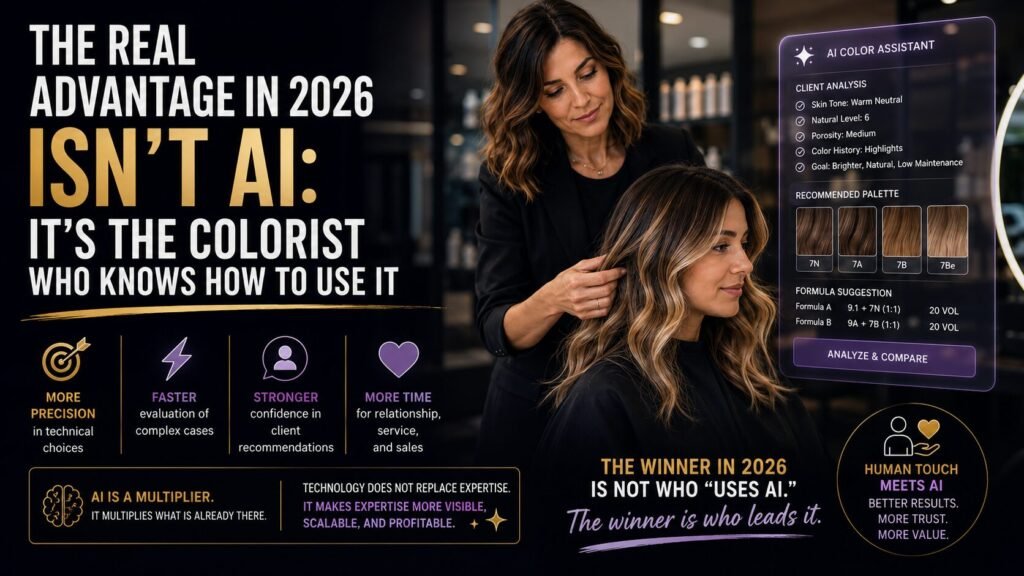
In 2026, the winner is not who “uses AI.” The winner is who leads it.
AI is everywhere now. But in professional color work, the real difference is not the tool — it’s the expert behind the chair.
Software can suggest, compare, and speed up decisions. But it cannot truly read a client the way you can: skin tone, color history, real goal, maintenance routine, lifestyle, and emotion.
That’s where competitive advantage is born.
AI alone is not enough
If two salons use the same technology, technology is not the differentiator. The differentiator is method: consultation, diagnosis, formulation, and communication.
AI is a multiplier. It multiplies what is already there.
If your process is strong, it amplifies precision and productivity 🚀
If your process is weak, it amplifies confusion.
The new positioning of the modern colorist
The strongest professionals are not those who fear AI, but those who use it to elevate what already makes them unique:
– more precision in technical choices
– faster evaluation of complex cases
– stronger confidence in client recommendations
– more time for relationship, service, and sales
Technology does not replace expertise. It makes expertise more visible, scalable, and profitable ✨
A useful question
If your competitor uses the same AI you use, why should a client choose you?
The answer is not in the software.
It is in your method, your professional judgment, and your human touch.
When that human touch meets AI in the right way, clients feel more value, more trust, and better results.
Want to measure your real advantage?
Take our quick test to see how ready you are for the new professional landscape.
Take the quiz now: https://haircopilot.com/beat-the-ai/ 🎯
A human-led workflow for AI-assisted colour work
The most useful way to introduce AI is to give it a defined role inside an existing professional process. It should organise information, surface options and expose questions that need checking. It should not turn a complex service into an automatic answer.
- Diagnose first. Record natural level, cosmetic history, porosity, condition, percentage of grey and any previous lightening or corrective work.
- Clarify the client’s real goal. Separate the inspiration image from the acceptable maintenance, budget and appointment time.
- Ask for options, not permission. Use AI to compare possible routes and identify missing information. The colorist remains responsible for selecting the route.
- Verify against professional sources. Check manufacturer instructions, development limits, compatibility and salon safety procedures before application.
- Document the final decision. Save what was chosen, why it was chosen and what should be reviewed at the next visit.
Where professional judgement creates the advantage
A camera can provide context, but it does not reproduce every shift in lighting, porosity or previous artificial pigment. A client may also describe a desired result in emotional language rather than technical terms. The colorist translates that language into achievable priorities, recognises when information is incomplete and decides when a strand test or a different plan is necessary.
This is also where communication matters. A strong professional can explain why a reference photograph may need several appointments, why a safer route may look different from the original request and how home care will affect longevity. AI can help structure that explanation; trust is created by the person delivering it.
Measure whether the tool is actually helping
Do not judge an AI workflow by novelty. Review practical indicators over several weeks:
- consultation time without reducing the quality of the questions;
- number of corrections or reformulations;
- consistency of notes between team members;
- client understanding of maintenance and realistic outcomes;
- time saved when preparing repeat services.
If the process becomes faster but the records become weaker, the workflow needs adjustment. If decisions are clearer, easier to explain and easier to repeat, the technology is supporting the craft rather than distracting from it.