


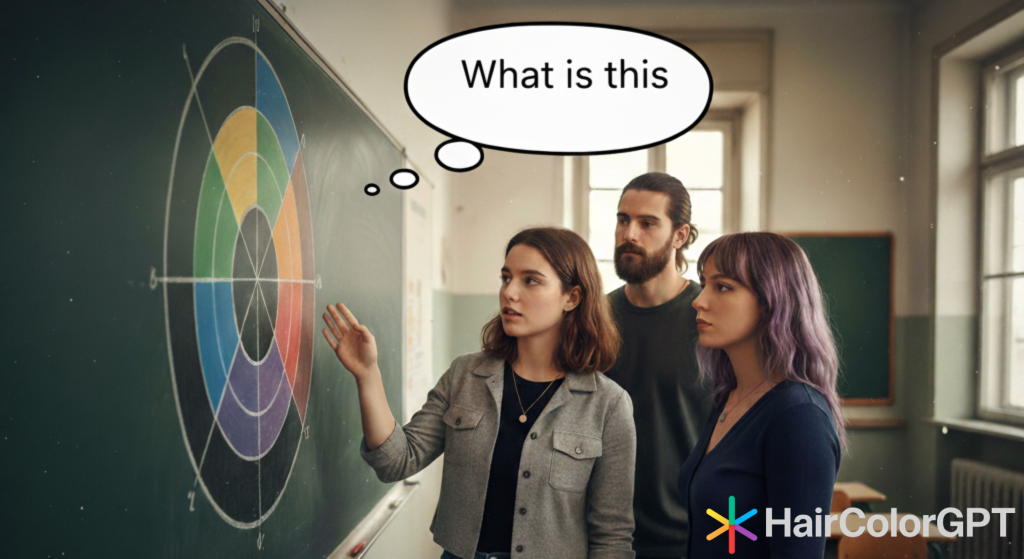
Standard Colorimetry Techniques: The Foundation of HairCoPilot
In the world of professional colorimetry, there are rules, techniques, and methodologies recognized and shared internationally. They are not opinions or personal interpretations — they are the scientific and technical foundations on which every colorist’s work is built.
When developing HairCoPilot, we asked ourselves a simple but crucial question:
“How can we create a tool that speaks the same language as every hairstylist, anywhere in the world?”
The answer was clear: base everything exclusively on standard techniques.
Why Start from Standard Techniques
Every coloring technique — whether it’s a global application, shatush, balayage, or grey coverage — follows precise rules that define it. Those rules are what make it possible to say: “This is truly that technique.”
These rules were not invented by us, nor are they shaped by personal taste. They are what every professional learns during training, and they represent the starting point of any well-executed color service.
HairCoPilot takes these “pure” techniques and makes them available — ready to use or combine as needed.
Creativity Remains at the Core
A hairstylist is not a robot executing formulas — they’re an artist who starts from shared principles and then interprets and personalizes.
HairCoPilot doesn’t aim to replace that creative process. On the contrary, it provides a solid, reliable foundation that allows every professional to use it as a springboard for their own artistic expression.
Want to apply a technique exactly as described in the manuals? HairCoPilot guides you step by step.
Want to mix multiple approaches to create something unique? You’ll always have a solid reference to rely on.
Continuous Training and Support
Not every hairstylist has the same level of experience. Some master every technique, while others may have gaps — or simply don’t remember every detail.
In this sense, HairCoPilot also acts as a training tool: it recalls the core principles, explains the logic behind each application, and helps you understand why a technique works the way it does.
This way, even less experienced stylists can work with confidence, while experts gain a fast, reliable support system to save time and focus on creativity.
Conclusion
HairCoPilot is not “one hairstylist’s method,” but the digital embodiment of standard colorimetry techniques — recognized and shared worldwide.
Its strength lies in offering universal and objective foundations that every professional can build upon to express their own unique artistry.
Because true creativity can only flourish when the foundation is solid.
START HERE!
The five observations behind a repeatable colour plan
Professional hair colorimetry starts with a shared vocabulary. Before selecting products or techniques, document five observations: the natural level, the visible tone, the underlying pigment expected during lift, the cosmetic colour history and the current porosity or condition. These observations help different team members discuss the same case without relying on descriptions such as “a little warm” or “quite dark”.
Formal colorimetry, as described by the International Commission on Illumination, provides standards for measuring and describing colour under defined viewing conditions. Salon colour theory is a practical application domain with additional variables: hair fibres are not uniform samples, cosmetic pigments change during processing and the visual result depends on texture, light and previous services. HairCoPilot can help organise those variables, but it does not turn them into a universal formula.
A practical consultation sequence
- Define the starting point. Examine regrowth, mid-lengths and ends separately instead of assigning one level to the entire head.
- Reconstruct the history. Record permanent colour, direct dyes, lighteners, smoothing treatments and home applications.
- Define the target precisely. Separate desired depth, tonal direction, brightness and placement.
- Identify the limiting factor. Condition, time, existing artificial pigment or maintenance may change the recommended route.
- Choose and verify the technique. Use manufacturer technical information, strand testing when appropriate and the salon’s safety process.
- Document the result. Save formula, ratios, timing, application order, observations and photographs captured under consistent light.
Standardisation does not remove creativity
A standard process controls the information that should never be forgotten; it does not prescribe the same aesthetic result for every client. Two colorists may use the same diagnosis and select different creative placements. The benefit is that each decision can be explained, repeated and improved.
Standardisation also supports training. A junior can compare their assessment with a senior colorist’s reasoning, while an experienced professional gains a faster way to review complex cases and maintain useful records. HairCoPilot should be used inside this professional framework: as a structured assistant, never as a substitute for physical assessment, product instructions or responsibility for the service.
A checklist before application
- Is the starting level recorded separately for regrowth, lengths and ends?
- Is previous artificial pigment documented?
- Are condition and porosity compatible with the proposed route?
- Does the plan follow the selected brand’s instructions and limits?
- Are the client’s maintenance expectations realistic?
- Can another team member understand and repeat the documented process?
When these questions have clear answers, creativity rests on a stronger technical foundation and future appointments become easier to plan.