


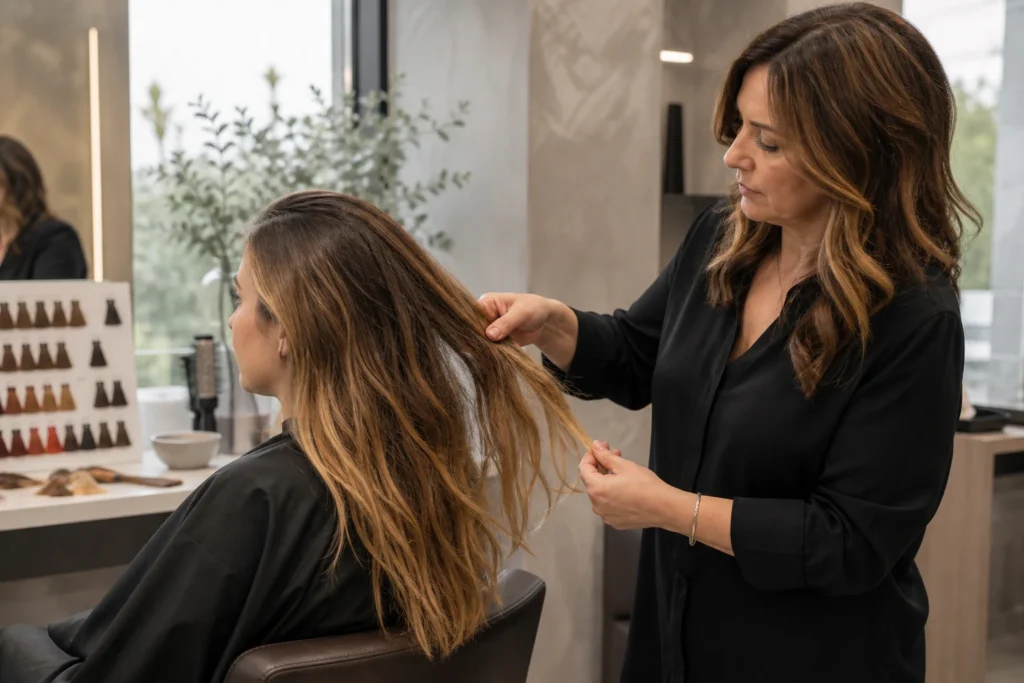
Colour correction is rarely one problem with one formula. It is a collection of starting points, previous decisions, unknowns and compromises distributed across the same head of hair.
That is why the hair colour correction consultation carries more responsibility than an ordinary shade selection. Before discussing a promised result, the colourist needs to establish what is present, what the hair can reasonably tolerate, what the client considers successful and which route can be tested rather than guessed.
The consultation is not the first ten minutes of the correction appointment. In many cases, it should be a separate assessment that determines what can be booked next.
Begin by defining the real problem
“Colour correction” can describe very different situations:
- unwanted warmth after lightening;
- banding from repeated root applications;
- dark artificial pigment that needs to be reduced;
- uneven home colour;
- direct dye or henna history;
- over-toned or muddy lengths;
- compromised hair after repeated chemical services;
- a client who is technically happy with the result but wants a major change;
- a previous salon result that did not match the agreement.
Do not assume the visible colour is the whole problem. Ask the client what they want changed and why. They may be reacting to tone, depth, placement, contrast, maintenance or how the result appears in a particular light.
Schwarzkopf Professional’s technical guidance on colour challenges recommends identifying why the client wants a change and using previous record-card information as the basis for a new consultation. That is a useful principle even when the previous service happened elsewhere: separate the client’s experience from the technical diagnosis.
Reconstruct the history before choosing the route
A correction plan is only as reliable as the history behind it.
Ask for a timeline rather than a list. Record:
- the client’s natural colour and typical grey or white pattern;
- professional colour services and approximate dates;
- home colour, including where it was applied each time;
- lighteners, toners, direct dyes and colour-removing products;
- henna or metallic-salt concerns;
- smoothing, relaxing, perming and other chemical services;
- areas that have broken, stretched or felt different when wet;
- current home-care products and mineral or product build-up concerns;
- what happened immediately before the unwanted result appeared.
Photographs from previous stages can be useful, but do not treat filtered images or uncertain dates as definitive evidence. Mark what is known, what is remembered and what remains unknown.
The more uncertainty there is, the more cautious the next decision should be.
Assess the starting point zone by zone
One overall level cannot describe a correction case.
Divide the hair into meaningful zones and record each separately:
- natural regrowth;
- previously coloured roots;
- mid-length bands;
- lighter or more porous ends;
- face frame;
- resistant or fragile sections;
- areas with different product histories.
For each zone, assess visible depth and tone, porosity, elasticity, density, texture, condition and likely artificial pigment. Use consistent lighting and clean sections. Compare what you see with the client’s history rather than forcing the hair into one simple description.
The professional hair colour theory guide is a useful refresher on separating level, tone and undertone during consultation.
Screen for reasons to pause
Some consultations should end with more information gathering, testing, conditioning or referral rather than a colour booking.
Pause when:
- the hair history is materially incomplete;
- the client reports a previous reaction or the required allergy protocol is unresolved;
- the scalp appears unsuitable for the planned service;
- a strand or test cutting gives an unacceptable response;
- elasticity or breakage suggests the proposed route is not responsible;
- the requested result depends on an unverified assumption;
- the client cannot accept the likely stages, cost or maintenance;
- the salon does not have the competence, time or controls required for the case.
This is professional decision-making, not failure. A correction becomes safer to manage when the colourist is willing to say, “We do not have enough evidence to proceed today.”
Use tests to answer specific questions
Do not perform a generic test simply to say the case was tested.
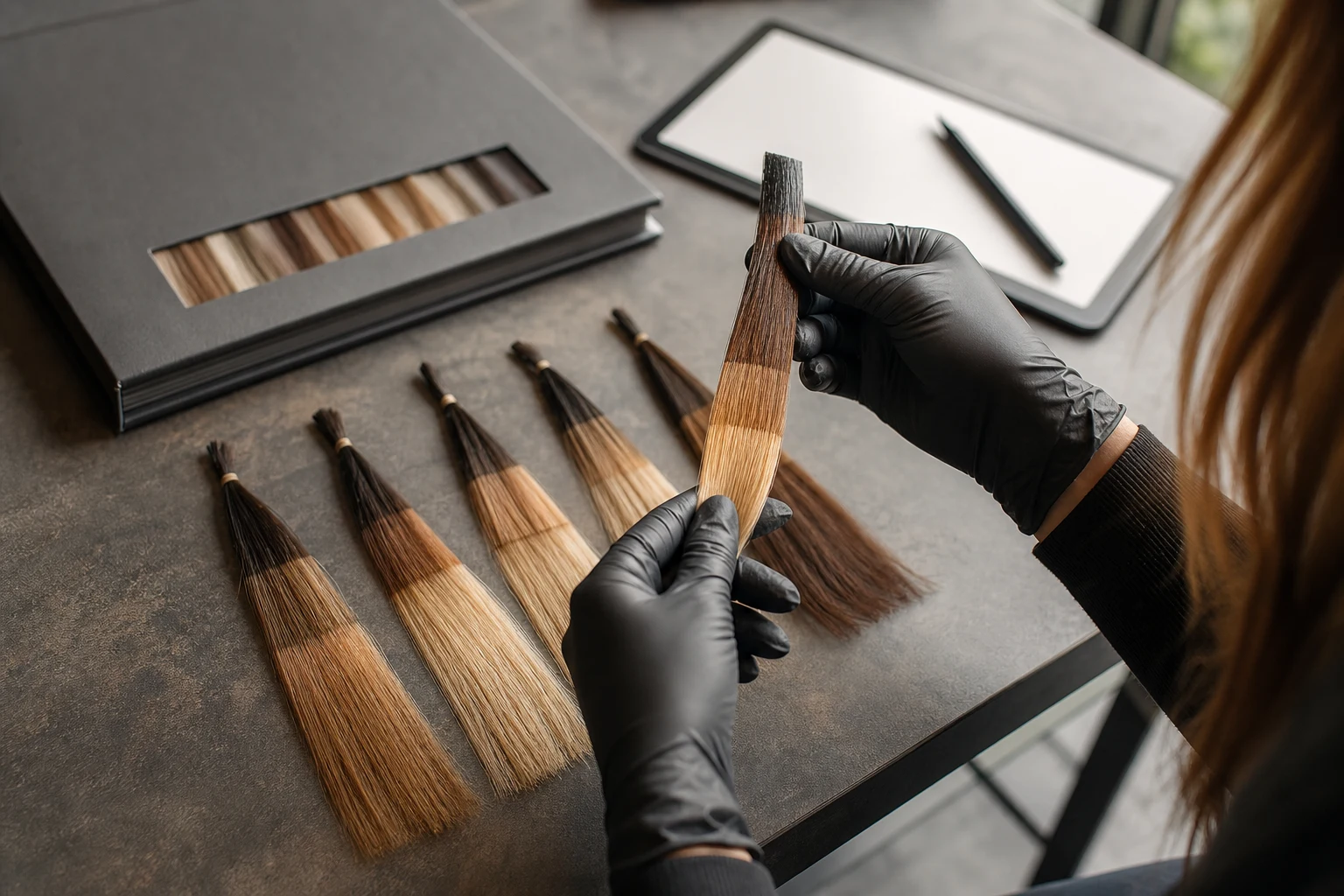
Define what you need to learn. A strand or test cutting may help assess:
- how a selected area responds to a proposed remover, lightener or colour route;
- whether artificial pigment shifts evenly;
- which undertone is exposed;
- how quickly the hair changes;
- how the structure feels during and after the process;
- whether the expected route needs to be changed.
An allergy alert test addresses a different question and must follow the current manufacturer’s protocol. It does not prove that the hair can tolerate lightening or that the desired colour is achievable. The distinction is explained in the companion guide to patch tests and strand tests for hair colour.
Record the product, mixture, section, timing, observations and conclusion for every technical test. “Strand test fine” is not enough for another colourist to understand what was actually assessed.
Build more than one possible route
Correction consultations are clearer when the client can compare realistic options.
Route A: the most direct responsible route
Explain what can reasonably be attempted first, the expected visible improvement and what remains uncertain.
Route B: a staged route
Describe how several appointments could protect condition, improve control or spread cost and maintenance. Avoid promising that every stage will land on a fixed date; later decisions depend on the actual response.
Route C: a lower-intervention alternative
Sometimes the best professional option is to blend, soften, add dimension, adjust tone or improve condition rather than chase the original reference immediately.
For each route, discuss:
- likely change at the first appointment;
- what cannot be guaranteed;
- time and price range;
- maintenance and home care;
- the point at which the plan will be reassessed;
- conditions that would stop or change the service.
Keep the formula separate from the promise
A formula is one part of a correction route. It should not be written before the assessment just to make the consultation feel complete.
When a route is approved, record formulas by zone with product, shade, developer, ratio, amount, timing and application sequence. Add processing observations and any adjustment made during the service.
The salon hair colour formula management guide explains how this level of detail supports repeatable results and safer team handovers.
If the first stage changes the starting point, the next formula must respond to the new evidence. Do not treat a multi-visit plan as one formula divided across future dates.
Discuss condition without using it as a vague refusal
“Your hair is damaged” gives the client little useful information.
Be specific about what you observe and how it affects the route. Explain whether the concern is breakage, reduced elasticity, uneven porosity, roughness, previous over-processing or an uncertain chemical history. Describe what the salon can do now, what needs improvement and how progress will be reassessed.
Avoid diagnosing medical conditions. If a scalp or health concern is outside the colourist’s scope, pause the service and recommend appropriate professional advice.
Include workplace controls in the plan
Correction services can increase handling time, product changes and exposure to powders, liquids and repeated rinsing. Salon risk management therefore belongs alongside the client assessment.
The UK Health and Safety Executive advises hairdressing businesses to identify hazards, use product labels and safety data sheets, assess how people may be exposed and put suitable controls in place. Its hairdressing guidance highlights risks including dermatitis and respiratory sensitisation from some products.
In practical terms, check that the salon has the right ventilation, protective equipment, storage, mixing process, team competence and time for the planned work. A client consent form does not replace the salon’s COSHH responsibilities.
Document the agreement before booking
The correction consultation record should finish with a concise professional summary:
- the client’s priority and unacceptable outcomes;
- confirmed and uncertain history;
- starting point by zone;
- testing status and findings;
- agreed first route and alternatives discussed;
- limitations and stop conditions;
- estimated appointment time and price range;
- likely number of stages without promising an exact total;
- home-care and maintenance expectations;
- photographs and permissions;
- review point after the first service.
Give the client a clear summary in language they understand. Keep the deeper technical notes attached to the salon record.
HairCoPilot is designed around this connected case: consultation, formula, result, care and the next appointment remain part of the same technical history. See the wider workflow on HairCoPilot for Salons.
A professional colour-correction checklist
Before confirming the service, ask:
- Do we understand why the client wants the colour changed?
- Is the history detailed enough for the proposed route?
- Have we assessed roots, bands, lengths and ends separately?
- Are manufacturer-led allergy requirements complete?
- What technical test is needed, and what question will it answer?
- Can the hair condition support the proposed first stage?
- Have we explained realistic alternatives?
- Are time, price and maintenance ranges clear?
- Does the team have the competence and controls required?
- Is the decision documented well enough for another colourist to understand?
Frequently asked questions
Can a salon quote a colour correction from photographs?
Photographs can help with triage, but they cannot show the complete product history, elasticity, porosity, scalp condition or response to testing. A final route and price normally require an in-person professional assessment.
Does every correction need several appointments?
No. The number of stages depends on the starting point, history, condition, target and response. The consultation should explain realistic possibilities without promising a fixed number before the evidence supports it.
What if the client cannot remember which home colour they used?
Record the uncertainty. Ask about dates, areas of application and any packaging or photographs they can find. Choose a cautious assessment and testing route rather than converting an unknown product into a guessed fact.
The consultation is the first technical service
A professional hair colour correction consultation gives the salon permission to slow the case down and make the unknowns visible.
It defines the problem, reconstructs the history, assesses every zone, uses tests deliberately and turns realistic options into a documented agreement. The goal is not to make the most exciting promise. It is to choose the first responsible decision that leaves the colourist with better evidence for the next one.